Modal Jersey Buying Guide: MJ 819-4, 200 GSM, 32 Colours
Everything a buyer needs to check before placing the first order for a 200 GSM LENZING Modal stretch jersey, written from the specification card rather than from a generic datasheet.
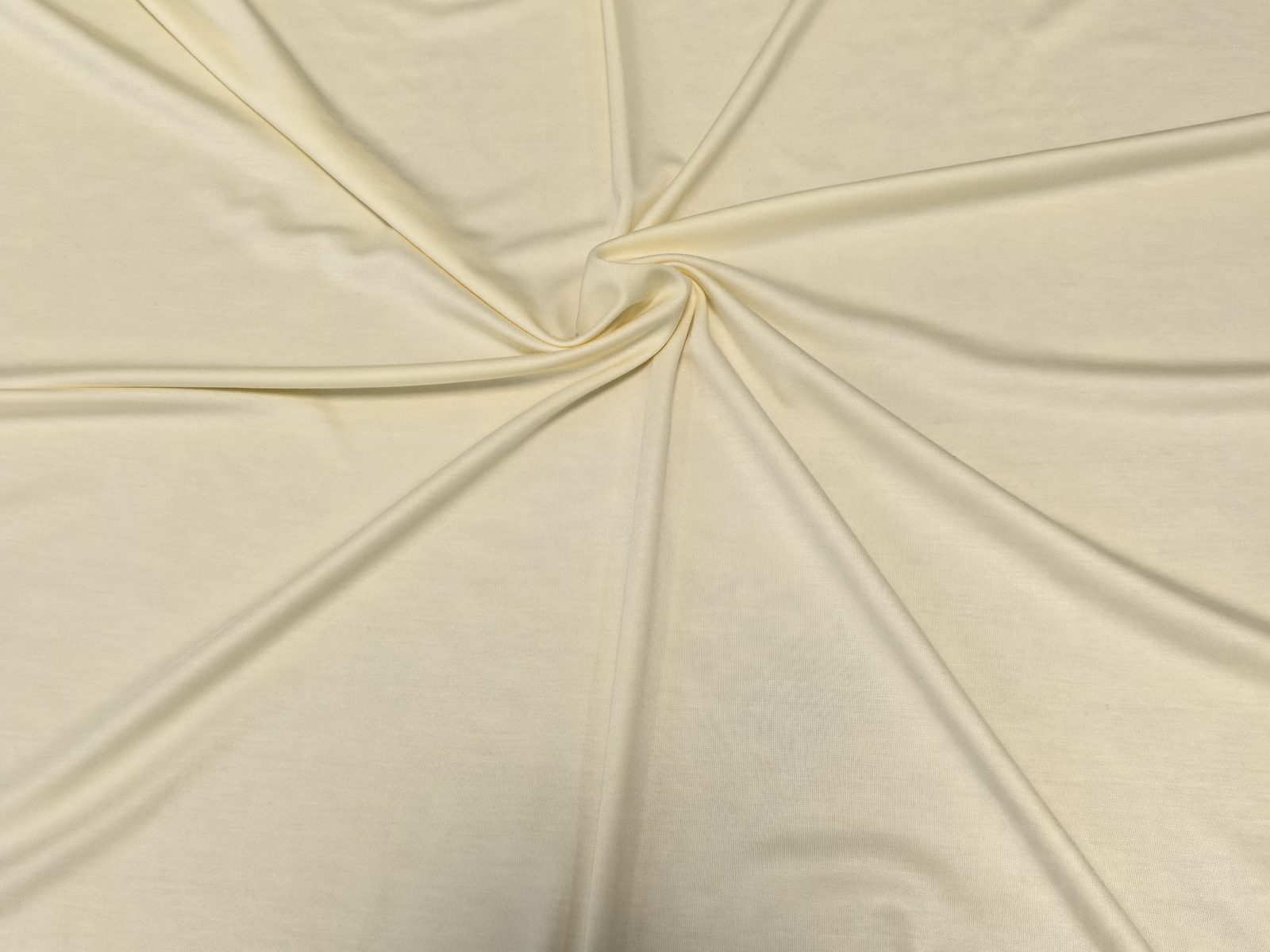
The standing 32-colour card for MJ 819-4, 200 GSM, 165 cm cut width.
MJ 819-4 is a circular-knitted single jersey in 92 percent LENZING Modal and 8 percent elastane, 200 GSM, 165 cm cut width, held in 32 stock colours. It is knitted to our specification at a partner knitting mill; our own looms are woven, so we do not claim a knit line of our own. What we control is the specification, the dyeing and the inspection. This guide takes the numbers in the order a buyer actually uses them: what the cloth will do on the body, what the commercial terms mean, how the roll is checked, and where orders most often go wrong. All figures below come from the MJ 819-4 card and the standing colour card; where a term is our house practice rather than a card value, it is labelled as such.
What buyers actually ask before the first order
The first question we are asked about MJ 819-4 is almost never about the fibre. It is about what happens after the third wash: will the knee bag, will the neckline grow, will a cream dress need a lining. Buyers who have used a cheap modal jersey ask this because they have already paid for the mistake once. The answer sits in three numbers on the card — 200 GSM, 8 percent elastane, 165 cm cut width — and in how the cloth was knitted, dyed and finished. A specification sheet is only useful when each line is tied to a consequence on the garment, so that is how this guide is arranged.
The second question is about the number itself: is 200 GSM heavy for a dress, and what would a lighter cloth change. The short answer is that 200 GSM is where a modal jersey stops needing a lining in pale shades and starts holding a clean hem, while still falling fluidly rather than standing away from the body. Below that, buyers commonly report show-through at the hip and a hem that curls after washing. Above it, the same dress begins to feel like a ponte and loses the drape that modal is bought for. The number is a compromise, and it is the right compromise for the applications on the card: dresses, tees, wide-leg trousers and loungewear.
| Parameter | MJ 819-4 specification |
|---|---|
| Composition | 92% LENZING Modal / 8% Elastane |
| Fabric weight | 200 GSM |
| Width | 165 cm cut width |
| Construction | Circular-knit single jersey, four-way stretch |
| Colour range | 32 colours on a standing card |
| MOQ | 300 m our colour / 2,000 m your colour |
| Lead time | within 7–10 days |
| FOB price | FOB from US $8.10/m (band US $8.10–8.30/m by packing and quantity) |
| Quality check | AQL 2.5 in-line inspection and a 4-point roll check |
| Applications | dress / tee / trousers / lounge |
The specification sheet, read line by line
The table below is the whole MJ 819-4 card in one place. Read the left column as the question a buyer asks and the right column as the answer we can put in writing. Composition, weight, width, construction, colour range, MOQ, lead time, FOB price, quality check and applications are the ten lines we are willing to confirm before a sample is cut. Nothing in this table is a target or an aspiration; each value is the value we will put on the order confirmation. Where a buyer needs a different figure, that is a new development, not a rounding of an existing one.
Two lines deserve a note before you use the table commercially. Construction says circular-knit single jersey made to our specification at a partner knitting mill: we are a woven mill with 30 looms, and we say so plainly rather than implying vertical knitting capacity we do not have. Quality check says AQL 2.5 in-line inspection plus a four-point roll check before packing; that is our house practice under the Mujia Textile Quality Standard, the same discipline applied to our woven fabrics. The FOB line is written as a band, from US $8.10 to US $8.30 per metre, because packing and quantity move it. If a quote arrives as a single number, ask which packing and which quantity it assumes.
| Order basis | What the number means |
|---|---|
| Minimum, our colour | 300 m per colour from our standing card |
| Minimum, your colour | 2,000 m for your own colour matched with a lab dip |
| Price basis | FOB from US $8.10/m, band US $8.10–8.30/m by packing and quantity |
| Production window | within 7–10 days |
| Terms | FOB China port, T/T 30/70, larger orders by agreement |
Why 200 GSM is the decision point
Weight is the first filter because it decides opacity, hem behaviour and how the cloth moves. Modal fibre is finer and more absorbent than cotton, and a light modal jersey can look beautiful on the roll and fail under a cutting-room light. At 200 GSM the loop structure is dense enough that a cream or optic white body does not need a lining for most garments, and the cut edge sits flat instead of rolling. That is the practical reason buyers move up from 140 or 160 GSM rather than a marketing one. It is also why we do not offer this cloth at 160 GSM under the same item number: the two behave differently and should not share a specification.
There is a cost side to the same number. Heavier cloth means more fibre per metre, so a 200 GSM jersey will not compete with a 140 GSM one on price per metre; it competes on fewer linings, fewer rejected panels and fewer returns. When you cost the garment rather than the roll, the comparison changes. We would rather state that plainly than let a buyer discover it after the first production run. The standing card keeps the weight fixed at 200 GSM across all 32 colours, so a repeat order in a different shade does not silently change the hand or the yield. If a buyer asks for a lighter version, we treat it as a separate development with its own sample, its own MOQ and its own price.
What the 8 percent elastane actually does
Elastane is the second number buyers want explained, because 8 percent sounds either high or low depending on what they usually buy. In a single jersey it does two things: it lets a close-fitting dress pass over the hip without a zip, and it pulls a stretched neckline back towards its original shape. It does not turn the cloth into a compression fabric, and it does not make it suitable for swimwear. Chlorine and salt will dull modal over a season, and the recovery profile is not what a swimsuit needs. For shape retention wet and dry we make a different cloth, MJ 30305, a 170 GSM nylon-spandex swim knit; the two sit under one knit category but are not interchangeable.
Recovery is worth testing on the actual garment, not on a flat swatch. We ask buyers to cut one front panel, stretch it gently across the width, hold for ten seconds and let it rest, then measure again after a wash. A jersey with the right elastane content and the correct finishing will come back close to its original width; one that has been over-stretched in finishing will stay grown. That simple check separates a well-made 200 GSM modal jersey from a cheap one more reliably than hand-feel does. It is also why we keep the finishing recipe fixed across repeat orders: a change in heat setting shows up first as neckline growth, months later as a return.
165 cm cut width and marker efficiency
Cut width is the number most often left out of a buying decision, and it is the one that quietly decides cost per garment. MJ 819-4 is 165 cm cut width, which gives the marker planner a usable width after the selvedge is trimmed. On a straight dress or a wide-leg trouser, the difference between 150 cm and 165 cm can be one fewer panel or a more economical lay, and over a few thousand metres that is a real saving. We state cut width rather than loom width because the buyer cuts what is delivered, not what left the machine. When you compare quotes, compare usable width, not the headline number.
Width also interacts with shrinkage and with the direction of the stripe or nap. Single jersey has a natural curl at the cut edge, so we recommend laying the pattern with the grain line clearly marked and allowing a relaxation period after the roll is opened. A buyer who cuts straight from a tightly wound roll can find the panels relaxing into a slightly different size by the time they are sewn. That is a handling issue rather than a defect, and it is worth writing into the tech pack. Our roll check records the usable width at the head, middle and tail of each roll, so a narrow roll is caught before it reaches the cutting table rather than after.
Standing card colours versus a lab dip
Colour is where repeat orders most often drift. MJ 819-4 is held in 32 stock shades on a standing card, from optic white through dusty pink, sage and olive to navy, black and a deep burgundy. A standing card means a repeat order is matched to the same reference rather than to whatever the lab happens to mix that week, which is the practical defence against shade drift between seasons. If the buyer wants a colour that is not on the card, we make a lab dip first, get it approved under an agreed light source, and only then book bulk. The 2,000 metre minimum for a custom shade exists because a dye lot that size is the smallest one we can hold to a single reference.
Approving a lab dip under one light source is not pedantry; metameric matches are a common cause of a bulk roll looking right in the factory and wrong in a retail fitting room. We ask for approval under D65 and a store-light reference, and we keep the approved dip physically on file so the next lot has something to be compared against. For stock shades, the same discipline applies: each production lot is checked against the master card before packing. A buyer who plans a capsule across two cloths should also check that the modal jersey shade and the swim knit print ground are being approved together, because two separate approvals can quietly land half a step apart.
MOQ: 300 metres and 2,000 metres explained
The two minimums on the card answer two different questions. Three hundred metres per colour from the standing card is the smallest run we can dye and finish to a held reference without the lot drifting. Two thousand metres for your own colour is the smallest run that justifies a dedicated lab dip and a dedicated dye lot; below that, the approval cost and the risk of a one-off reference outweigh the value of the custom shade. Both are per colour, not per order, so a three-colour trial on the standing card is three times three hundred metres. Stating it that way avoids the common misunderstanding that a mixed-colour order can be placed at a single three hundred metre minimum.
A trial order is a sensible way to start, and we would rather a buyer run one than commit to a full seasonal volume on a first approval. What we ask is that the trial uses the standing card, because that is the only way the result can be repeated exactly. A custom-shade trial is possible but it consumes the lab dip that a full order would use, so most buyers keep the first run to stock shades and move to a custom colour once the fit and the hand are signed off. If a buyer needs several shades for a sample set, we can supply short cuts from the standing card for approval purposes; those are samples, not a production MOQ, and we label them as such on the packing list.
The FOB band and what moves it
FOB is quoted as a band from US $8.10 to US $8.30 per metre, and the two things that move it are packing and quantity. A larger quantity earns the lower end; a special packing request, extra roll length, individual polybags or a particular label format pushes it towards the upper end. We write the band rather than a single figure so a buyer can see which assumptions are inside the quote. What the price does not include is freight, insurance, duty and destination charges, all of which sit outside FOB China port. If a landed cost is needed, ask for it as a separate line with the port named; mixing FOB and landed figures in one comparison is how budgets go wrong.
Payment terms on the card are T/T 30/70, with larger orders open to agreement. We put the terms in writing at the same time as the price because a cheap price with an unusual payment structure is not the same offer. The same applies to the lead time: a 7-10 day window only holds for stock shades, and it starts after the specification and the colour reference are confirmed, not from the first enquiry. Buyers who need a fixed delivery date for a launch should tell us before approval rather than after; the difference between a stock shade and a custom shade is roughly three to four weeks, and that is the single biggest scheduling variable on this item.
Lead time: 7-10 days and 30-35 days
Lead time is quoted two ways on purpose. Stock shades from the standing card run within 7 to 10 days, because the greige, the dye recipe and the master reference already exist and only the finishing and packing have to be scheduled. A custom shade runs 30 to 35 days after lab-dip approval, because the approval itself, the dedicated dye lot and the extra shade checking all have to happen before finishing. The clock starts at approval, not at enquiry. We state both windows in the order confirmation so nobody has to infer which one applies. If a buyer is working backwards from a retail drop date, that approval date is the milestone to plan around.
Two practical notes on scheduling. First, the 7-10 day window assumes the order is packed in our standard roll length and standard labelling; a special pack is quoted separately and may add a few days. Second, the two knit cloths under this category do not share a schedule: MJ 30305 swim knit has its own print and its own approval path, so a capsule that needs both should be placed as two lines with two approvals rather than one combined date. We would rather split the shipment and be accurate than promise a single date that one of the two lines cannot meet. If an order is time-critical, say so at enquiry and we will confirm the window in writing before any deposit.
AQL 2.5 and the four-point roll check
Inspection is where a specification becomes a promise. Our house standard is AQL 2.5 in-line inspection during finishing, followed by a four-point roll check before packing: each roll is examined across its length, defects are scored by size, and any roll over the agreed penalty limit is set aside rather than shipped. The same discipline is applied to our woven fabrics under the Mujia Textile Quality Standard, so a buyer moving from corduroy to this jersey is not entering a different quality regime. We record the usable width at three points on the roll, the shade against the master card, and the roll length, and the record travels with the packing list.
A buyer does not have to take our word for it. We welcome a third-party pre-shipment inspection, and we would rather it happen at our packing stage than at destination, where a rejected roll is expensive for everyone. If an inspection standard other than AQL 2.5 is required, agree it before production and we will write it into the order confirmation; changing the acceptance rule after the cloth is finished is not workable. The four-point record also makes claims easier: if a shade or width dispute arises, there is a measured record from the head, middle and tail of the specific roll rather than a general assurance. That is the practical reason we keep it.
Three failure modes we are asked to prevent
Three problems come up often enough that we address them before an order is booked. The first is bagging at the knee on a fitted dress, which is usually a recovery problem rather than a weight problem: the elastane content or the finishing tension was wrong. The second is neckline growth after washing, which shows up when the heat setting changed between lots or when the garment was cut before the roll relaxed. The third is shade drift on a repeat order, which happens when a second lot is matched to a mixed standard instead of the held master card. Each has a check earlier in this guide, and each is cheaper to prevent than to fix after shipment.
The fourth thing worth naming is the one buyers rarely ask about: using the wrong cloth for the job. We are sometimes asked whether MJ 819-4 can serve as a swimsuit or a compression legging because it stretches and feels soft. It cannot, and saying so early saves a season. Chlorine and salt dull modal, and the recovery profile is built for drape and skin comfort, not for holding a wet silhouette. That is why the knit category carries two cloths with a comparison table rather than one cloth presented as universal. A buyer who wants one cloth to do both jobs will end up with a dress that sags and a swimsuit that shines; the split is the whole point of the category.
How to place the first order
A first order goes faster when the enquiry already contains the four things we need: the garment and its target weight, the shade or the standing-card reference, the quantity per colour, and the destination port. With those four, we can confirm the GSM, the cut width, the MOQ band, the lead-time window and the FOB band in one reply. Without them, the first two exchanges are spent asking for them. We also ask buyers to say at enquiry whether a third-party inspection is planned and whether a special packing is needed, because both change the quote. Nothing is booked until the specification and the colour reference are confirmed in writing.
Once the order is confirmed, the buyer receives the specification line by line, the packing list with the roll records, and the shade reference used for approval. That set of documents is what makes a repeat order a repeat rather than a new development. The full specification and the 32-colour card are on the MJ 819-4 product page, and the two knit cloths are set side by side on the knit fabric page. If any figure in this guide disagrees with those two pages, the product page is the authority and we will correct the guide. A buying guide is only useful while it stays tied to the live specification.
Frequently asked questions
Is 200 GSM too heavy for a summer dress?
No. At 200 GSM the jersey is opaque enough in cream or white to skip a lining while still falling fluidly. Below 160 GSM buyers report show-through at the hip and a hem that curls after washing; above it the cloth starts to feel like a ponte and loses the drape modal is bought for.
Can you match our own colour?
Yes, via a lab dip approved under an agreed light source before bulk is booked. A custom shade carries a 2,000 metre minimum per colour and a 30 to 35 day lead time after approval. Stock shades are 32, with a 300 metre minimum per colour and 7 to 10 days.
What is the minimum for a trial order?
300 metres per colour from the standing card. The minimum is per colour, not per order, so a three-colour trial is three times 300 metres. Short cuts from the card can be supplied as approval samples; those are samples, not a production MOQ.
Will the white or cream shade be see-through?
At 200 GSM, no lining is needed for most garments in cream or optic white. We still recommend a hold-to-light check on the actual cutting-room light, because opacity depends on the garment cut and the lighting, not only on the GSM number.
Do you knit this fabric yourselves?
No. It is circular-knitted to our specification at a partner knitting mill. Our own 30 looms are woven. We control the specification, the dyeing, the finishing and the inspection under the Mujia Textile Quality Standard, but we do not claim vertical knitting capacity.
How is the fabric packed and checked before shipping?
Standard roll length and labelling, with AQL 2.5 in-line inspection and a four-point roll check before packing. Usable width is recorded at the head, middle and tail of each roll, shade is checked against the master card, and the record travels with the packing list.
Need a swatch or a lab dip?
Tell us the garment, the target shade and the quantity. We will confirm the GSM, the cut width, the MOQ band and the lead time against the MJ 819-4 card before anything is booked.
Request a quote