A buyer who has only sourced cotton or viscose usually opens a swim enquiry with the same three questions as a shirting enquiry: weight, width, price. Those three answers do not tell you whether the cloth will survive a season in a chlorinated pool, whether a one-piece will hold its leg line by the third wear, or whether the print will still be on the cloth after a hundred washes. Swim has its own failure modes, and they are not the failure modes a fashion jersey is judged on.
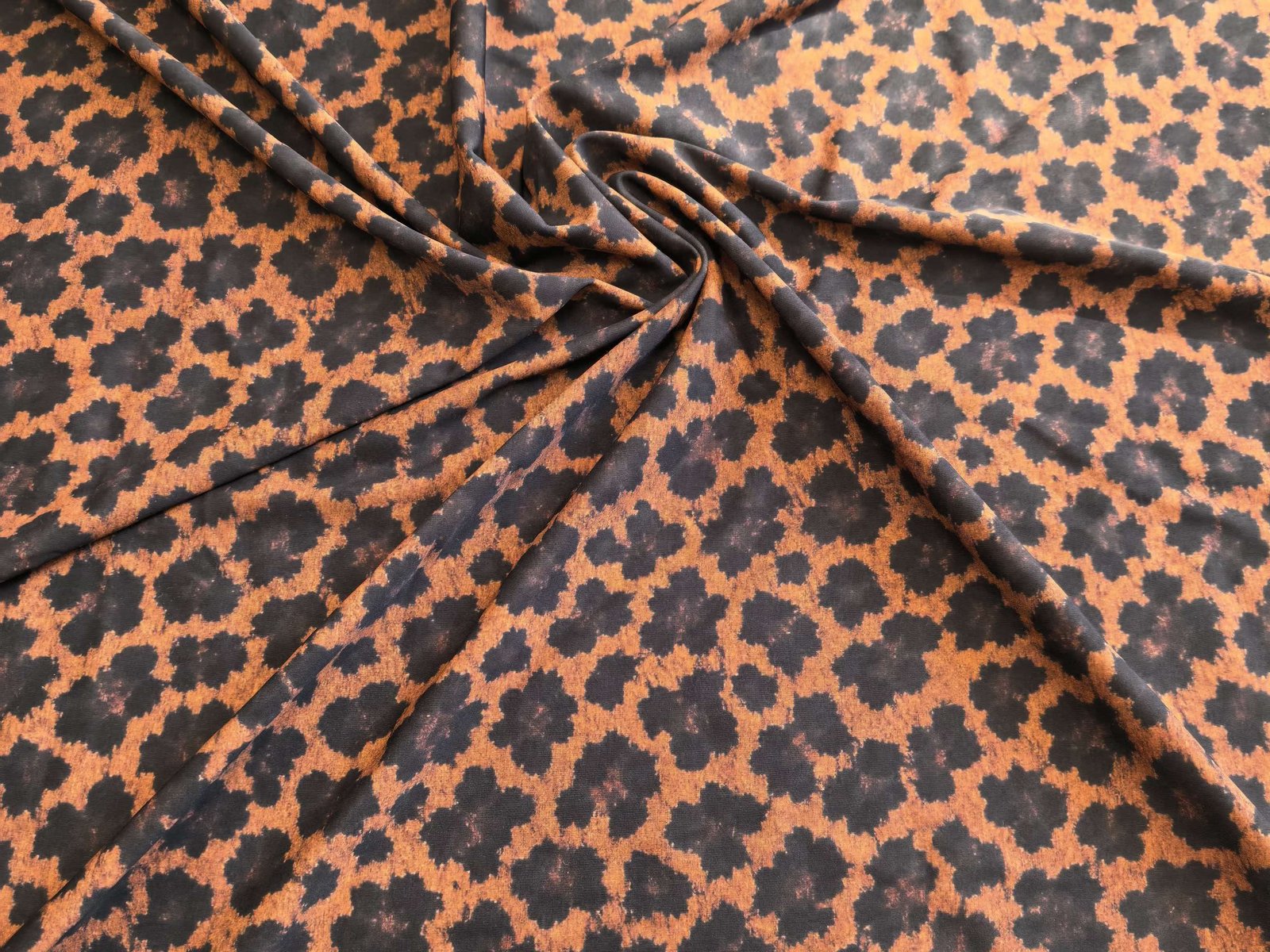
The cloth this guide is written around is our own line, MJ 30305 swim knit: a 170 GSM weft-knitted jersey in 75% nylon and 25% spandex, 160 cm cut width, printed digitally in three house patterns — Amber Leopard, Cream Ripple and Cobalt Daisy — at FOB US $3.05 to 3.20 per metre and 300 metres per pattern. Everything below applies to that cloth. Where a number is specific to it, it is given as specific. Where the point is general to swim, it is written as general, because the four tests do not change when the supplier does.
Why swim knit is not a stretch jersey with a print on it
A cotton jersey and a swim knit can both be described as “a knit”, and that is where the resemblance stops. Three things separate them, and all three come from the same place: the loop structure plus the elastane fraction.
First, the cloth is judged wet. A t-shirt is judged dry, on a hanger, under shop light. A swimsuit is judged wet, on a body, in daylight, with the cloth stretched over a hip and a shoulder. Wet nylon changes how it handles light, so a cloth that looks opaque on the roll can read through when it is soaked and pulled. This is the single most common reason a swim style comes back, and it is almost never tested at the sampling stage.
Second, the cloth has to return. Every wear pulls the garment over a body and every wash relaxes it. What matters is not how far it stretches but how completely it comes back. A knit that stretches 120% and returns to 103% of its original dimension has grown 3%, and 3% growth on a one-piece leg opening is the difference between a garment that fits in March and one that gapes in June. Growth is a measured number, not a hand feel.
Third, the cloth is chemically attacked, not just washed. Chlorinated pool water is an oxidising environment. It attacks dye, and it also attacks the polyurethane chain in the elastane itself. Sunscreen, salt, hot tubs and machine drying all add to the same load. A swim fabric can pass a domestic wash test with a perfect grade and still fail in service, because the domestic wash test does not contain chlorine.
Add a digital print and a fourth variable appears: the ink layer sits on a face that moves underneath it. A print on a rigid poplin is fixed to a dimensionally stable surface. A print on a 25% spandex knit is fixed to a surface that is being stretched and released continuously, and the ink layer locally restricts that stretch. That does not make printing impossible — it makes the repeat and the strike-off the two decisions that matter.
The four tests, and which one kills the order
Four tests cover most of the risk. They are listed in the order that a claim usually arrives, not in the order of importance, because the order of importance depends on your end use.
| Test | What it measures | Method a buyer usually cites | What fails in service |
|---|---|---|---|
| Chlorine fastness | Shade change after chlorinated pool water | AATCC 162 / ISO 105-E03 | Fading, and elastane degradation that reads as “baggy” |
| Recovery and growth | How completely the knit returns after extension | ASTM D2594 | Leg line gapes, back sags, cup loses shape |
| Wet opacity | Whether the cloth reads through when soaked and stretched | Buyer-defined; no single standard | Returns and chargebacks on a garment that was never “faulty” |
| Wet crocking | Colour transfer from a wet printed face | AATCC 8 / ISO 105-X12 (rubbing), read wet | Print marks on lining, on skin, on a towel |
Which one kills the order depends on where you sell. A private-label resort programme that sells mostly to hotels and poolside retail gets hit by chlorine and opacity, because the garment lives in chlorinated water and is worn in public. A brand selling mostly online to a domestic market gets hit by wet crocking, because the return is triggered by a customer opening a parcel and finding print on the lining, not by a lab result. A brand doing a tight one-piece silhouette gets hit by recovery, because growth shows up as a fit complaint in the first four weeks.
The practical consequence is that you cannot order one test and assume the rest. Ask for all four on the bulk lot, and say which one your programme is most exposed to, so the supplier knows what to protect in finishing. A mill can bias finishing toward fastness or toward hand; it cannot maximise both at once, and it will not know which you want unless you say.
Test 1 — Chlorine fastness: what 25% spandex actually survives
Chlorine fastness is reported as a grey-scale grade for shade change after exposure to chlorinated water. The two methods a swim buyer normally names are AATCC 162 and ISO 105-E03. Both do the same job: expose the specimen to water containing available chlorine at a defined concentration for a defined time, dry it, and rate the change against a grey scale. The scales run from 1 to 5 in half steps, and higher is better.
One detail worth settling before a method number goes into a purchase contract: AATCC 162 and ISO 105-E03 are not the same test conditions, so the same cloth can grade differently under each. The ISO method specifies available chlorine at 50 or 100 mg/L — 100 mg/L is the level intended for swimwear, while the lower figure is used for beach towels and accessories — at pH 7.5 and 27 °C for one hour. The AATCC method runs a different concentration and temperature window. Neither is wrong; they are answering slightly different questions. So when a grade goes into a contract, name the method and the edition alongside the grade, or a passing result under one standard and a failing result under the other are both defensible. For Chinese domestic programmes, GB/T 8433 is the national method that corresponds to ISO 105-E03.
The part buyers miss is that the test result is a statement about two different things at once. It reports shade change, which is the dye. It does not report what happened to the elastane, which is the fibre. Chlorine attacks the polyurethane chain in spandex, and the visible symptom is not a colour change but a loss of recovery: the garment starts to feel slack, then starts to sag, and by that point the dye may still grade perfectly. If your programme sells into heavy chlorinated use — hotel pools, swim schools, aqua fitness — ask separately about retained stretch after chlorinated exposure, not only about shade.
Our swim knit runs 25% spandex against 75% nylon at 170 GSM. That ratio is chosen for recovery, not for chlorine immunity. No spandex content makes a knit immune to chlorine; the ratio decides how much recovery is left when the fibre has taken the load. A higher spandex fraction buys more initial recovery and more of it surviving, and it also costs more and gives a firmer hand. A lower fraction needs lining or a power-mesh panel to hold the same silhouette.
What to actually ask for, in one sentence: the chlorine fastness grade on the bulk lot with the method named, plus the spandex percentage, plus a statement of how the retained stretch was checked. Three items. A supplier who answers the first and skips the other two has told you about the dye and nothing about the cloth.
Test 2 — Recovery and growth: the number a one-piece lives on
Recovery is measured by extending a knit to a set load or a set extension, holding it, releasing it, and measuring how far it returns. Growth is the residue: the percentage by which the specimen is longer than it started. The method usually cited is ASTM D2594, Stretch Properties of Knitted Fabrics Having Low Power, and its scope names swimwear directly as a semi-support application; it reports both the extension under load and the growth after release. Note that D2594 is a qualification test, not an acceptance test: the standard itself warns that between-laboratory precision is poor, so agree the pass grade in writing with your buyer rather than arguing over two labs' numbers after the order.
One scope limit worth flagging, because it is the kind of thing a lab will raise after you have already agreed a grade: D2594 is written for low-power stretch knits, and a 75/25 nylon-spandex swim knit sits at the high-power end of that spectrum. The method is still the one normally cited for swimwear recovery, and its scope does name swimwear, but if your buyer's lab reads scope strictly, confirm whether ASTM D4964 is the method they want named instead. Either way, write the method number into the contract so both sides are measuring the same thing.
Why growth matters more than extension: extension is a design decision, growth is a defect. A swim knit that extends 130% is doing what the pattern needs. The same knit growing 6% after five cycles is not, because 6% of a 70 cm leg opening is four centimetres of gap, and four centimetres of gap on a high-leg one-piece is a fit complaint that no amount of pattern adjustment can fix.
Growth is also cumulative in the wrong direction. A garment worn and washed repeatedly does not settle back to its first-cycle dimension; it drifts. That is why the honest way to compare two swim knits is not a single-cycle figure but a figure after a defined number of cycles, and why a buyer who is comparing three suppliers should insist that all three report the same cycle count. A five-cycle number and a one-cycle number are not comparable, and suppliers rarely volunteer which one they are quoting.
Where 170 GSM and 25% spandex land in practice: enough to hold a leg line and a back without a zip or a bonded power-mesh panel. That is the design consequence of the specification, and it is what makes the cloth usable for a one-piece without extra engineering. If your pattern is a high-leg cut with a light lining, test growth on your own strike-off rather than accepting a general figure, because the lining changes how the composite behaves.
Test 3 — Wet opacity: the return reason nobody tests for
There is no single industry standard for wet opacity in swimwear, which is exactly why it goes wrong. Every buyer defines it privately, and a supplier who has not been told the definition will optimise for dry appearance, which is the state the cloth is inspected in.
The mechanism is straightforward. Nylon absorbs a small amount of water and the refractive index of the wet fibre approaches that of water, so light scatters less at the fibre surface and passes deeper into the cloth. Add stretch, which thins the cloth locally and opens the loop structure, and the combined effect is a fabric that reads solid on the table and translucent on a body. Light colours and high-contrast prints make it worse, because a dark ground behind a pale print reads through as a shadow.
The practical test is to do it yourself, on your own colourway, before you approve bulk. Cut a piece roughly the size of the largest panel in your pattern, wet it out, wring it the way a garment would be wrung, lay it over a contrasting surface, and stretch it to the extension your pattern uses. Look at it in daylight, not under a lamp. If you can read the contrasting surface through it, the garment needs a lining, a heavier weight, or a darker ground. If the garment is lined, test the lined composite as well as the single layer: the lining is part of what the wearer sees, and a lining that reads solid on the table can still go translucent when the pair is stretched over a body.
Two specifications change the answer and both are on the table before you order. Weight is the first: 170 GSM single layer holds a one-piece, while a bikini bottom that needs a lining of the same cloth is usually cut from 150 to 160 GSM so the doubled cloth does not go bulky. Ground colour is the second: our three house prints sit on an amber ground, a cream ground and a two-tone blue, and the cream-on-cream ripple is the one that shows the least through a wet single layer while also being the quietest print in the range. That is not a coincidence; a tonal print has less contrast to lose.
Test 4 — Wet crocking: does the print stay on a moving face
Crocking is colour transfer by rubbing. It is measured by rubbing a dry specimen with a dry white cloth and a wet specimen with a wet white cloth, then grading the staining on the white cloth against a grey scale. AATCC 8 and ISO 105-X12 are the methods normally named. Wet crocking is the one that matters in swim, and it is the one that is most often quoted dry because the dry figure is better.
Three things make wet crocking worse on a printed swim knit than on a printed shirting. The cloth is used wet, so the wet figure is the operative one. The cloth is stretched, so the ink layer is being flexed continuously rather than lying flat. And the garment is often lined with a pale cloth, so any transfer is visible immediately against a light ground rather than hidden inside a seam allowance.
The consequence for a print programme is a design rule, not a lab rule: dark saturated grounds on a stretch face are the highest-risk combination, and a pale lining under a dark print is the arrangement most likely to produce a visible transfer. If your style pairs a dark print with a cream lining, ask for the wet crocking grade specifically, on that colourway, and consider whether the lining can be a mid-tone instead.
Digital printing helps here for a reason that is easy to state: there is no thick pigment film sitting on the surface, so there is less material to transfer. That is one of the two reasons swim prints move to digital. The other is cost structure, which belongs to the next section.
Why 170 GSM, and what 150 and 200 cannot do
The four weight bands a swim knit is normally quoted in — 150 to 160, 170, 190 to 200, and 220 GSM and up — and which garment each one suits are set out in our swim fabric buying guide. That page does the band-to-garment mapping properly and this one does not repeat it. What is worth doing here is crossing the bands against the four tests, because a weight decision that looks like a garment decision is usually a test decision in disguise.
| Weight band | Single layer, wet | Drying | Seam plan | Fine detail in a print |
|---|---|---|---|---|
| 150–160 GSM | Reads through; needs a lining of the same cloth | Fastest | Same needle and stitch class, but the doubled seam is thicker | Hairline work loses definition first — less cloth under the ink |
| 170 GSM | Holds a one-piece as a single layer | Middle | Baseline for this article | Medium detail survives; hairline detail reads as tone |
| 190–200 GSM | Visibly more solid | Longer | Stitch density has to be re-set — thicker cloth, different feed | Large motifs are stable; hairline detail still reads as tone |
| 220 GSM and up | Effectively opaque | Longest | Moves toward a ready-to-wear seam plan | Built for large repeats; fine detail is not the point |
Two things follow from reading the table down rather than across.
The opacity column is the one that decides whether you buy one cloth or two. At 150 to 160 GSM the answer to wet opacity is a lining, which means a second cloth, a second minimum and a second colour to match. At 170 the same garment works as a single layer. The saving on the lighter cloth is therefore not a saving once the lining is costed, which is the argument for starting at 170 rather than at the cheapest band on the list.
The print column is the one that decides what artwork you can bring. Fine detail needs cloth under the ink to hold it, and a lighter band gives it less. An artwork that depends on hairline line work for its character will lose that character on a 150 GSM face and will not gain it back at 200. If the artwork is the reason for the programme, the weight follows the artwork, not the other way round.
Our own line sits at 170 GSM for the reason in the first row: it is the lightest weight at which a one-piece holds its silhouette without a lining or a bonded power-mesh panel. Because the minimum on our swim knit is 300 metres per pattern rather than per order, a three-print capsule starts at 900 metres, and a buyer who also needs a lining weight is looking at two cloths and two minimums. That arithmetic is worth doing before the colourway is approved rather than after.
Sunscreen, chlorine and the yellowing nobody warns you about
There is a failure mode that does not appear on any spec sheet and does appear in the field: discolouration of pale swimwear where sunscreen has been applied. It is a known problem in the industry rather than a defect of any one mill, and it is worth knowing about because it changes how you specify a pale colourway and how you write care instructions.
Two mechanisms are usually cited. Some sunscreen actives, and the solvents that carry them, interact with the elastane and with certain dye classes, producing a yellow or brown cast that is not removed by washing because it is not a surface stain. Separately, chlorine and heat accelerate the same degradation, so a pale garment used in a chlorinated pool with sunscreen applied is under the highest combined load of any swim product.
The practical response is not to avoid pale colourways. It is to (a) ask for the fastness package on pale shades specifically, since pale grounds show a cast that a dark ground hides, (b) keep the elastane ratio high enough that recovery survives, and (c) write care instructions that say what actually helps: rinse in cold water immediately after wear, do not leave the garment rolled wet in a bag, do not tumble dry. Our own care line for MJ 30305 is exactly that, and it is on the product page for the same reason.
If your programme sells pale swimwear into a market where sunscreen use is heavy and pool use is heavy, this is a conversation worth having with your supplier before the colourway is approved, not after the first claim. It is one of the few places where a two-line change in the care label measurably reduces returns.
Seam plan: needle, stitch and SPI on a 25% spandex cloth
Swim knit fails at the seam before it fails anywhere else, and the seam is the garment maker’s decision, not the mill’s. Four things matter.
The needle. A 25% spandex knit needs a ballpoint or stretch needle. A sharp needle cuts the elastane filaments instead of pushing between them, and a cut filament does not recover — it becomes a small hole that grows. This is the single most common cause of a swim seam that grin-opens after a few wears, and it is invisible on the inspection table.
The stitch class. A standard overlock is acceptable on a low-stretch seam but will not follow a high-stretch one. A coverstitch or flatlock is the normal choice for leg openings, armholes and necklines, because it carries stretch in the seam itself rather than relying on the cloth to absorb it.
The stitch density. Too few stitches per inch and the seam has gaps that open under extension. Too many and the seam becomes stiff and the needle perforates the cloth densely enough to create a tear line. The right density is a range, not a number, and it has to be set on offcuts of the actual bulk cloth rather than on a sample from a different lot.
The thread. A seam that stretches less than the cloth will fail at the thread, not at the fabric. Elastic or textured thread in the looper is normal on swim. This is also where a small saving on thread turns into a large return rate.
One operational point that follows from all four: the garment maker should be testing on offcuts from the bulk lot, not on the sample. Swim knit is made to order and nothing is cut until the order and the artwork are confirmed, so the first bulk roll is genuinely the first time anyone has sewn this lot. Setting the seam on a strike-off from a different run tests the wrong cloth.
The repeat on a stretch face: measure it relaxed, not stretched
This is the point where printing on swim differs most from printing on a flat cloth, and it is the one that produces the most expensive rework.
On a rigid poplin, the repeat is a fixed dimension. You measure it, you lay your marker, and the print lands where the marker says. On a 25% spandex knit, the repeat is a dimension of a surface that is being pulled. A repeat measured while the cloth is under tension is a repeat that will not hold when the cloth relaxes, and the visible symptom is a print that walks out of register across a panel even though nothing was printed wrong.
The working rule is: specify and measure the repeat on the cloth at rest, and state the state in the artwork approval. Then check it again on the garment at the extension your pattern uses. If the repeat is correct at rest and wrong at extension, the problem is the artwork scale relative to the stretch, not the printer. If it is wrong at rest, the problem is the print.
The second half of the same point is about the strike-off. A paper proof cannot tell you how a print behaves on a stretch face, because paper does not stretch and does not have a loop structure. The strike-off has to be on the actual base cloth at the actual weight. Our route is digital, which means no screen set and no plate fee, so a buyer-supplied file goes straight to a strike-off on the real cloth rather than through a plate-making step that has to be paid for twice if the artwork changes.
Two more constraints on the artwork itself. The repeat has to survive being broken by a seam: if a large motif lands across a side seam, either the panel is planned to break it deliberately or the motif is scaled so it does not have to match across the join. And fine detail has a floor: at 170 GSM on a knit, very fine line work reads as tone rather than as line, so an artwork that depends on hairline detail for its character will lose that character on this cloth.
160 cm cut width and what it does to your marker
160 cm is a cut width, not a grey width, and the distinction matters at the marker. Cut width is the usable width after the selvedge and any edge curl are accounted for, so it is the number you plan against. A knit that quotes a wider grey width and delivers a narrower cut width costs you metres on every lay.
For swim the practical effect is favourable, because swim panels are small. A one-piece front and back, a bikini bottom, a cup piece and a tie are all short panels, and short panels nest well on a 160 cm lay with far less waste than a long dress panel would produce. That is why the same width that is ordinary for a shirting is generous for a swim marker.
The exception is a cover-up or a resort piece. A long open-front robe in the same print consumes the width the way a dress does, and a print that nests beautifully for bikinis can produce a 20% waste factor on a robe. If your capsule mixes swim and cover-ups — and a resort capsule usually does — plan the marker for the longest panel, not the shortest, and treat the bikini efficiency as a bonus rather than as the planning basis.
One more width note specific to prints: a large repeat and a narrow marker interact. If the repeat is wider than the marker can accommodate without a visible join, you either accept a seam through the motif or you choose a print whose repeat is smaller than your narrowest panel. Our three house prints are built to sit together in one capsule on the same ground cloth, which means they share a repeat logic rather than each being scaled independently.
Sampling: what to ask for before you commit 300 metres
Sampling a swim knit is not the same sequence as sampling a shirting. Four things, in this order.
One — a hand sample of the base cloth in the actual weight. Not a lighter weight standing in for it. A 150 GSM sample tells you nothing about how a 170 GSM garment will hold a leg line, and the two are different cloths with different seam plans.
Two — a strike-off on that base cloth, in your colourway. This is where the print decision is actually made. Look for three things: whether the ground is even across the width, whether fine detail survived, and whether the print reads chalky on a dark ground. A print that reads correctly on paper can go chalky on a dark ground, and the strike-off is the only place you will see it before bulk.
Three — the fastness package, on the bulk lot rather than the sample. Chlorine, wet crocking, and wash, each with the method named. Sample-lot figures are not bulk-lot figures, and a supplier who only has sample figures has not yet made your cloth.
Four — your own wet-opacity check, on your own colourway. Nobody can do this for you, because it depends on your panel size, your lining and your market. It takes twenty minutes and it prevents the most common return in the category.
What you do not need at sampling stage: a full garment. A swim sample garment made from a strike-off tests the seam plan, which is useful, but it does not test the bulk cloth, and it is easy to over-read a good-looking sample garment as evidence about the bulk lot. The strike-off plus the fastness package plus your own opacity check is the real evidence.
Inspection: what to check on a swim roll
Roll inspection for swim adds three checks to the standard four-surface-defect pass, and they are all about state rather than about appearance.
Check the roll for compression marks and edge curl. A knit rolled under tension and stored warm can take a set that shows as a flat or a wave after cutting. Look at the roll ends and at the first two metres of each roll, not only at the middle.
Check the width at three points per roll. Knit width varies, and a roll that measures 160 cm at the head and 157 cm at the foot will cost you on the marker. Record the three figures rather than a single average.
Check the print for register and ground evenness across the full width. Digital printing on a stretch face can drift at the selvedge, and a drift that is invisible at the centre is visible on a cut panel. Look at both selvedges, on the same metre, side by side.
The commercial backstop on our side is a seven-day uncut quality guarantee: seven days from delivery to inspect the fabric, uncut, with a full refund or free replacement if defects are found. Cut the roll and the guarantee ends — that is the only condition, and it exists because a cut roll cannot be re-inspected at the mill. A batch test report travels with every shipment, so a claim traces to the exact roll and dye lot rather than to a general conversation about a lot number.
One process note that saves arguments: inspect before you cut, and write the roll numbers into the inspection record. Almost every swim claim that goes badly is a claim where the roll was cut first and the discussion happened afterwards.
Five mistakes that cost a swim order
One — specifying weight without specifying garment. “170 GSM” is not a specification until you say what it is for. A buyer who asks for 150 GSM because it is cheaper, and then needs a lining, has bought two cloths and two minimums to save on one.
Two — accepting a dry crocking figure on a printed swim. The wet figure is the operative one, and the dry figure is always better. Ask for the state, not just the grade.
Three — measuring the repeat under tension. The single most expensive mistake in printed swim, because it produces a bulk lot that is technically correct and commercially unusable, and the argument about who is responsible takes longer than the reprint.
Four — not testing wet opacity on the actual colourway. Free to do, and it prevents the return that no lab test catches because no lab test was defined.
Five — setting the seam plan on the sample instead of the bulk. A swim knit is made to order; the bulk roll is the first time this cloth has been sewn. Set the needle, stitch class and density on offcuts from the bulk, not on a sample from a different run.
Timeline, realistically
Our published lead times for MJ 30305 are 7 to 10 days for the three house prints and 30 to 35 days for custom artwork after approval. Those are production times, and a buyer planning a launch should build the front end of the sequence around them rather than inside them.
The front end has four steps. Artwork approval, which is the one that usually slips, because it needs your file, your colourway decision and your repeat decision, and each of those can take a week if it is being decided by a committee. Strike-off, which is fast on a digital route because there is no plate to make. Fastness testing, which is on the bulk lot and therefore happens after production rather than before it, so a programme that requires a test report before shipping needs that time inside the schedule. And shipping, which depends on your port and your terms rather than on us.
A realistic sequence for a custom print capsule is therefore: artwork decision, then 30 to 35 days production, then bulk test report, then shipping. A programme using the three house prints removes the artwork step and shortens production to 7 to 10 days, which is why a first order against a house print is a reasonable way to test a market before committing to custom development. Terms are FOB China port, with CFR and CIF on request, and T/T 30/70 is standard with larger orders by agreement.
The one-paragraph version
Buy swim knit on four numbers and not on hand feel. Chlorine fastness, asked for on the bulk lot with the method named and paired with the spandex percentage, because chlorine attacks the elastane as well as the dye. Recovery and growth, compared at the same cycle count across suppliers, because growth is what gapes. Wet opacity, tested by you on your own colourway over a contrasting surface in daylight, because no standard defines it and it is the category’s most common return. Wet crocking, asked for wet rather than dry, and planned around by not pairing a dark print with a pale lining. Then specify the repeat at rest and check it again at extension, set the seam plan on offcuts from the bulk lot rather than on the sample, and inspect the rolls before you cut them. Our own line, MJ 30305 at 170 GSM in 75% nylon and 25% spandex with 160 cm cut width, is built for a one-piece that holds its line without extra engineering, in three house prints at 300 metres per pattern — and the four tests above are the ones we expect a serious buyer to run on it.
Frequently Asked Questions
Is 170 GSM enough for a one-piece, or do I need a heavier band?
For a one-piece, a bikini or a tankini, 170 GSM in a 75% nylon and 25% spandex knit is the weight our swim line runs at, and it holds a leg line and a back without a zip or a bonded power-mesh panel. It is not the weight for everything. A bikini bottom that needs its own lining is usually cut from 150 to 160 GSM so the doubled cloth does not go bulky, and a structured resort piece that is worn mostly out of the water goes to 190 to 200 GSM and above for opacity and body. The weight question is really a garment question, so answer it with your pattern, not with a catalogue number.
Will the print survive chlorine?
Ask for chlorinated-water fastness on the bulk lot, not on the strike-off, and ask for it by method name. The two methods a swim buyer usually cites are AATCC 162 and ISO 105-E03, both of which rate the shade change against a grey scale after exposure to chlorinated pool water. A print can pass a wash test and still fail a chlorine test, because chlorine attacks the elastane as well as the dye. That is why the answer is a grade on the bulk lot plus the elastane content, never the word digital on its own.
Why does the spandex percentage matter so much?
Because spandex is what returns the cloth to shape, and it is also the component that chlorine, heat and some sunscreen actives attack first. Our swim knit runs 25% spandex in a 75% nylon blend, which is enough to pull a one-piece back over a hip and a shoulder through repeated wet-and-dry cycles. Below that, the garment needs lining, a power-mesh panel or a zip to hold the same line. Above it, you buy more recovery than a swim silhouette needs and pay for it in cost and in hand.
What is the minimum order for printed swim knit?
300 metres per pattern on our three house prints, at 170 GSM and 160 cm cut width. Because the minimum is per pattern and not per order, a three-print capsule starts at 900 metres rather than 300. Custom artwork is a separate question: it runs 30 to 35 days after approval rather than the 7 to 10 days the house prints take, and the minimum depends on the artwork and the route, so it is quoted per design.
How much does printed swim knit cost?
Our swim knit quotes at FOB 3.05 to 3.20 US dollars per metre, and the spread reflects design, packing and order quantity, not the number of colours in the artwork. Digital printing carries no plate fee and no colour-count penalty, so a twelve-colour artwork costs the same to set up as a two-colour one. That is the main reason swim prints move to digital: a resort capsule can be recoloured or rescaled on the next run without a new screen set.
Can I use my own artwork for swim prints?
Yes. Digital printing needs no screen set and no plate fee, so a buyer-supplied file can go straight to a strike-off on the actual base cloth. Two things decide whether the file works. First, the repeat has to be measured on the cloth at rest, because a print on a 25% spandex face will read differently stretched than relaxed, and in our experience a repeat matched under tension pulls out of register in the garment — that is an observation from our own print runs rather than a published rule, so confirm it on your own strike-off. Second, the strike-off has to be on the real base cloth, not on paper, because a print that reads correctly on paper can go chalky on a dark ground.
Sampling swim knit for a resort or swim capsule?
MJ 30305 runs at 170 GSM in 75% nylon and 25% spandex, 160 cm cut width, three house digital prints, 300 metres per pattern. Strike-offs on the actual base cloth, and a batch test report with every carton.
Ask for a quote