📌 Quick Answer: Sourcing cotton eyelet (broderie anglaise) fabric from China?
Shaoxing Mujia Textile Co., Ltd., established in 2012 in Keqiao, produces cotton eyelet embroidery fabric in 11 in-stock openwork patterns: 100% cotton ground and thread, 100–130 GSM, 135 cm width, supplied in natural off-white and piece-dyeable to your color. MOQ is 300 meters per design, FOB price is US$2.3–2.7 per meter depending on embroidery density and dyeing, and lead time is within 10 days after order confirmation. OEKO-TEX Standard 100 testing is arranged on request.
Table of Contents
- What Is Cotton Eyelet Fabric? Definition & Key Characteristics
- Broderie Anglaise vs. Lace vs. Embroidered Cotton: What's the Difference?
- How Eyelet Embroidery Is Made: From Greige to Cutwork
- Cotton Eyelet Fabric Specifications: What Buyers Need to Know
- Layout Groups: Full-Density vs. Open/Sparse Eyelet Patterns
- What Can You Make with Eyelet Fabric? Applications by Segment
- Dyeing Cotton Eyelet: Piece-Dyeing & Tonal Embroidery
- Cotton Eyelet Fabric Trends 2025–2026
- Eyelet Fabric Pricing: What Determines Wholesale Cost
- How to Source Cotton Eyelet Fabric from China: Step by Step
- Quality Checklist: Verifying Eyelet Before Bulk Purchase
- Caring for Cotton Eyelet Fabric
- Frequently Asked Questions
What Is Cotton Eyelet Fabric? Definition & Key Characteristics
Cotton eyelet fabric is a lightweight woven cotton cloth decorated with cutwork embroidery: fine cotton thread is stitched into the fabric to outline small motifs, and the center of each motif is then cut open to create a clean hole — the "eye." In European trade language this fabric is called broderie anglaise ("English embroidery"); in US buying rooms it is usually called eyelet or eyelet embroidery; some buyers call it cotton cutwork. All three names describe the same construction: flat embroidery plus cut holes on a solid cotton ground.
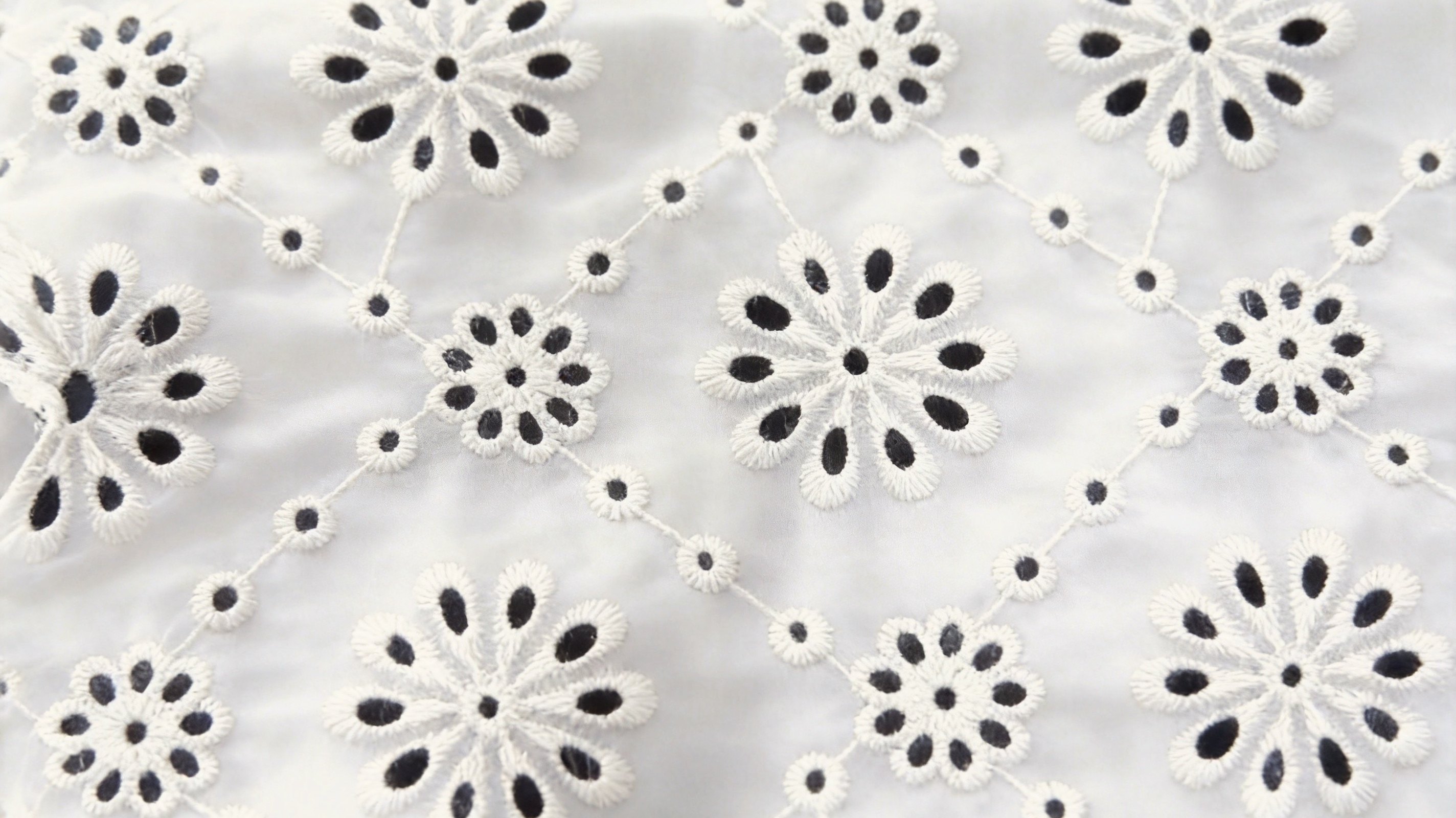
The base is a 100% cotton woven greige in the 100–130 GSM range at 135 cm usable width. Multi-head computerized embroidery machines stitch a dense satin-stitch ring around every future opening before the cutting happens. That stitched ring binds the cut edge, so the holes keep their shape through garment making and repeated wash instead of fraying outward like a simple punched hole would.
The classic presentation is white-on-white — white cotton thread embroidered on natural or bleached white cotton — which is why eyelet has carried a romantic, heirloom association for generations. But the fabric is not limited to white: because both ground and thread are cotton, the finished piece takes dye evenly, and dyed eyelet in sage, lavender, coral, navy and rose is now one of the fastest-moving variants in mid-market womenswear (see the dyeing section).
Key Characteristics at a Glance
| Feature | Description |
|---|---|
| Fabric type | Flat cutwork embroidery on a woven cotton ground (broderie anglaise) |
| Composition | 100% cotton — ground fabric and embroidery thread |
| Weight | 100–130 GSM (light to medium-light) |
| Width | 135 cm usable |
| Surface | Flat and smooth, with bound cut openings; not a raised lace surface |
| Breathability | High — the open holes ventilate directly |
| Hand feel | Light, crisp, airy; softens with washing |
| Stock color | Natural off-white; piece-dyeable to buyer color standard |
| Typical motifs | Small flowers, leaves, wreaths, dots, vines, stars — simple repeatable units |
| Classic look | White-on-white romantic openwork; tonal-dyed versions increasingly common |
Buyer's note: eyelet's commercial strength is that it delivers an ornamental, lacy look on a fabric that still sews, washes and costs like cotton shirting. It is not lace — and the difference matters enough that the next section breaks it down in detail.
Broderie Anglaise vs. Lace vs. Embroidered Cotton: What's the Difference?
This is the single most common point of confusion in buyer inquiries, and confusing the three creates real sampling mistakes. The distinction is structural, not just visual.
Eyelet (broderie anglaise) starts with a complete, solid woven cloth. Embroidery is applied on top of that cloth, and selected areas inside the stitching are cut away. Most of the fabric surface stays intact, so the cloth is flat, stable and easy to cut and sew on standard garment lines. The eye reads a decorated cotton with openings — not a web of threads.
Lace has no solid ground in the eyelet sense. Raschel, crochet-style and leavers-type laces are built from interlooped or twisted yarn systems, often on a hexagonal net ground or with open ground between motifs. The surface carries raised loops and relief, and the material is either much sheerer or, in heavy guipure and bridal laces, substantially thicker and more sculptural. Lace is engineered for bridal gowns, eveningwear, lingerie and trims — contexts where a 3D, formal hand is the point. Eyelet is flat cutwork embroidery, not raised 3D bridal lace.
Plain embroidered cotton is the third category: embroidery stitched onto cotton with no cutting step at all. There are no holes, so the cloth is cheaper to produce (no cutwork labor, no scrap loss), but it also lacks the openwork that defines the eyelet look. Some suppliers show "embroidered cotton" photos in eyelet categories — check whether the product actually has cut openings before comparing prices.
Comparison Table
| Dimension | Cotton Eyelet (Broderie Anglaise) | Lace | Embroidered Cotton (No Cutwork) |
|---|---|---|---|
| Craft | Flat embroidery on woven cotton, then cut openings | Yarn network knitted/twisted on net or open ground | Embroidery on woven cotton, no cutting |
| Surface | Flat, smooth; bound clean holes | Raised loops, net or 3D relief | Flat; closed surface |
| Thickness / hand | Light, crisp cotton, 100–130 GSM | Sheer net lace or heavy sculptural guipure | Light; softest and most shirting-like |
| Sheerness | Opaque ground; open only at the holes | Sheer across the ground as a class | Opaque throughout |
| Typical uses | Dresses, blouses, shirts, skirts, childrenswear, resort | Bridal, evening, lingerie, trim | Blouses, kids' wear, lightweight tops |
| Sewing behavior | Sews like cotton; needs lining decisions at holes | Requires specialist handling and seam coverage | Sews like ordinary cotton |
| Price position | Our program: FOB US$2.3–2.7/m | Typically above eyelet at comparable coverage (construction-dependent) | Typically below eyelet (cutwork step absent) |
If your collection calls for washable, cotton, everyday-wear romance, eyelet is the correct construction. If the brief demands layered 3D texture for a bridal or evening program, specify lace and source from lace specialists rather than expecting eyelet to imitate it.
How Eyelet Embroidery Is Made: From Greige to Cutwork
Understanding the process explains two things buyers repeatedly ask about: why production eyelet motifs look the way they do, and why some artwork "can't be made." The sequence from greige to inspected roll has five stages.
Step 1: Greige Preparation
The 100% cotton ground is woven, inspected for weaving defects, and fed into the embroidery stage in full width. A lightweight stabilizer backing (paper or water-dissolvable type) is run under the cloth to keep the ground from puckering under thousands of needle penetrations.
Step 2: Digitizing the Design (the "Punch")
The artwork is digitized into an embroidery program — the modern equivalent of punching a jacquard card. The program defines every stitch path: run stitches that sketch the motif, satin stitches that form the raised border around each future hole, and any fill areas. Repeat spacing across the 135 cm width is calculated here, including how motifs sit relative to the selvedge and to garment pattern placement.
Step 3: Machine Embroidery
Multi-head computerized embroidery machines run the program across the fabric, with fine cotton thread. Every opening is surrounded by a dense satin-stitch ring in this stage; the cutting comes later. This is also where the two commercial layout families are set: full-density all-over embroidery that covers the width continuously, or open/sparse placement with wide negative space between motifs.
Step 4: Cutwork (Cutting the Eyes)
After stitching, operators cut the fabric inside each stitched ring with small blades or punching tools — the 割孔/雕孔 step. Because the satin-stitch border already locks the edge, the cut opening cannot run or fray. This is a skilled hand-assisted operation: clean cuts and zero nicks into the border stitches are the quality standard.
Step 5: Trimming and Inspection
The backing is removed (or dissolved), loose thread ends are trimmed on both faces, and every roll is inspected over a light table for missed stitches, pulled yarns, cutting errors and repeat alignment before rolling on tubes.
Why Production Eyelet Motifs Are Inherently Simple
This is the key design-to-manufacturing reality: eyelet is a simplification engine. Holes must be small, closed shapes with a continuous stitched border; lines must connect; stitch density must stay within what the needles and ground can survive; and the cutter must be able to reach every opening without nicking the border. Tiny holes plus clear line work scale perfectly — flowers, leaves, wreaths, dots, vines, stars. Photoreal fills, ultra-fine gaps, disconnected islands and fully packed, heavily detailed artwork either cannot be cut without damage or cannot run at commercial speed and yield. When a buyer sends complex artwork, the mill's job is to adapt it into cutwork language before sampling. Expect that conversation, and approve the adapted version early.
Cotton Eyelet Fabric Specifications: What Buyers Need to Know
These are the parameters to put on every RFQ and to check against on every incoming roll. They are the working specifications of Mujia Textile's in-stock eyelet program.
| Parameter | Specification |
|---|---|
| Product | Cotton eyelet embroidery fabric (broderie anglaise / cutwork) |
| Composition | 100% cotton (ground + embroidery thread) |
| Weight | 100–130 GSM |
| Usable width | 135 cm |
| In-stock designs | 11 patterns, E-01 through E-11 (full-density and open/sparse groups) |
| Stock color | Natural off-white (greige state) |
| Dyeing | Piece dyeing available to Pantone or physical standard; tonal result (see dyeing section) |
| MOQ | 300 meters per design |
| FOB price | US$2.3–2.7 per meter (by density, dyeing, volume, packing) |
| Lead time | Within 10 days after order confirmation (stock greige); dyed orders add lab-dip and dyeing time |
| Payment terms | T/T standard; L/C accepted for larger orders |
| Testing | OEKO-TEX Standard 100 testing arranged on request (state product class) |
| Quality control | In-house MTQS inspection, with in-process and final check points |
| Packing | Rolls on paper tubes, poly-bagged, export cartons |
If you are comparing weight systems across suppliers — GSM versus ounces per square yard — or deciding which weight to place where in a collection, our complete guide to cotton fabric types, weights and sourcing maps the full cotton weight ladder and its end uses. For eyelet specifically, the 100–110 GSM end behaves like a decorated blouse cloth, while 120–130 GSM starts to carry skirt and light home-textile structure.
Layout Groups: Full-Density vs. Open/Sparse Eyelet Patterns
All 11 in-stock patterns divide into two layout groups, and the group you choose drives both the aesthetic and the price. The complete lineup with fabric and garment photos is on the 11 in-stock eyelet designs page; here is how to read them.
Full-Density All-Over Group
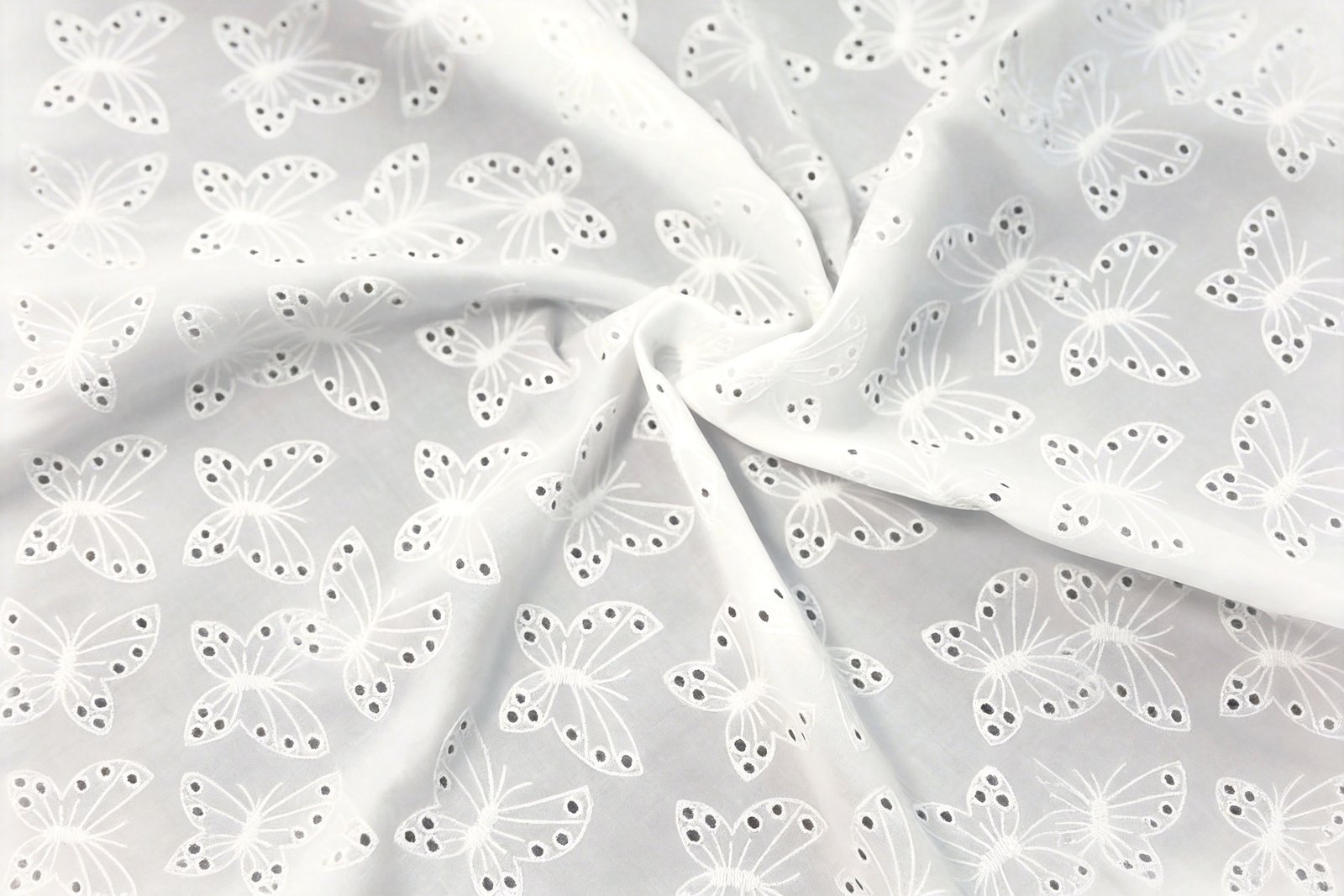
E-01 Butterfly, E-03 Oval Wreath, E-06 Snowflake Star and E-11 Radial Large Flower run embroidery across the width with little blank ground between motifs. The cloth reads rich and almost lace-like from a distance, carries maximum open area, and has the most romantic hand. It is the group to reach for occasion and statement pieces: midi and maxi dresses, full skirts, bridal-adjacent and event-adjacent looks, and cover pieces that need to photograph as "lacy cotton." Stitch counts and thread consumption are highest in this group, which positions these designs toward the upper end of the FOB band.
Open/Sparse Group
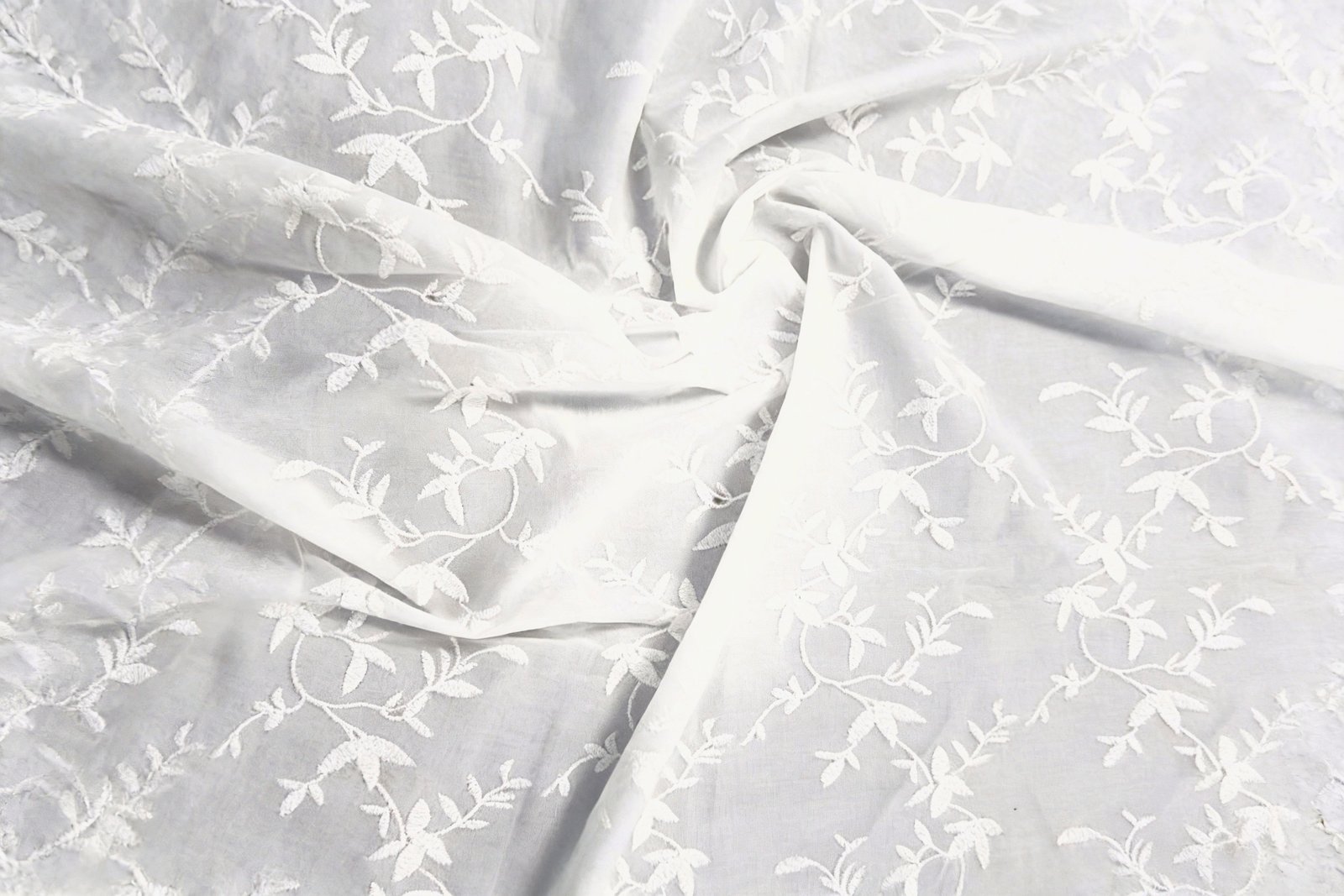
E-02 Trailing Tiny Leaves, E-04 Vertical Stripe Vine, E-05 Scrollwork, E-07 Chrysanthemum Spray, E-08 Ring Medallion, E-09 Trailing Large Bloom and E-10 Dot Posy place motifs at intervals on clean ground. Negative space dominates, the cloth feels lighter and quieter, and the eye registers texture rather than all-over lace. This group is the workhorse for blouses, summer shirting, kids' and baby wear, and any program where eyelet is a detail — a yoke, a sleeve, a front panel — rather than the entire garment. Lower stitch counts per meter also place these designs toward the lower end of the FOB band.
A practical buying pattern we see season after season: brands buy one full-density design as the hero dress fabric and one or two sparse designs to carry tops and childrenswear, then dye all three in the same color story for a coordinated collection. Browse all patterns and their made-up garment shots on the eyelet collection page.
What Can You Make with Eyelet Fabric? Applications by Segment
Eyelet crosses more product categories than most decorative fabrics because it is still fundamentally cotton: breathable, washable and skin-friendly. Segment-by-segment guidance:
Women's Dresses
The largest application. Full-density patterns carry romantic midi dresses, tiered skirts-as-dresses and occasion-adjacent looks; sparse patterns do day dresses and shirt-waist styles. Lining strategy is the main engineering decision — bodice and skirt linings for full openwork, partial linings for sparse layouts.
Blouses and Shirts
Sparse layouts dominate here: eyelet front panels, sleeves, back yokes and collars on otherwise solid cotton shirts, or full eyelet blouses in 100–110 GSM. The flat cotton surface sews on standard shirt lines with no special machinery.
Skirts
The 120–130 GSM end and full-density layouts hold a flared or gathered silhouette without collapsing, while sparse eyelet makes soft summer slip and A-line skirts. Cutwork at hem allowances should be planned in the marker.
Kids' and Baby Wear
A strong perennial: cotton content, direct ventilation through the holes, and a soft heritage visual. Small, rounded sparse motifs are the usual choice for infants and toddlers; for baby programs, specify OEKO-TEX testing to Class I at order stage.
Resort and Vacation
Cover-ups, beach shirts, loose trousers and resort sets — the openwork reads as holiday texture and the cotton handles heat and repeated washing. Piece-dyed coral, mint and lavender are recurring resort choices.
Home and Lifestyle
Curtains, cushion covers, table linens and storage bags at the heavier end of the weight range. Openwork adds texture without the fragility of sheer lace panels.
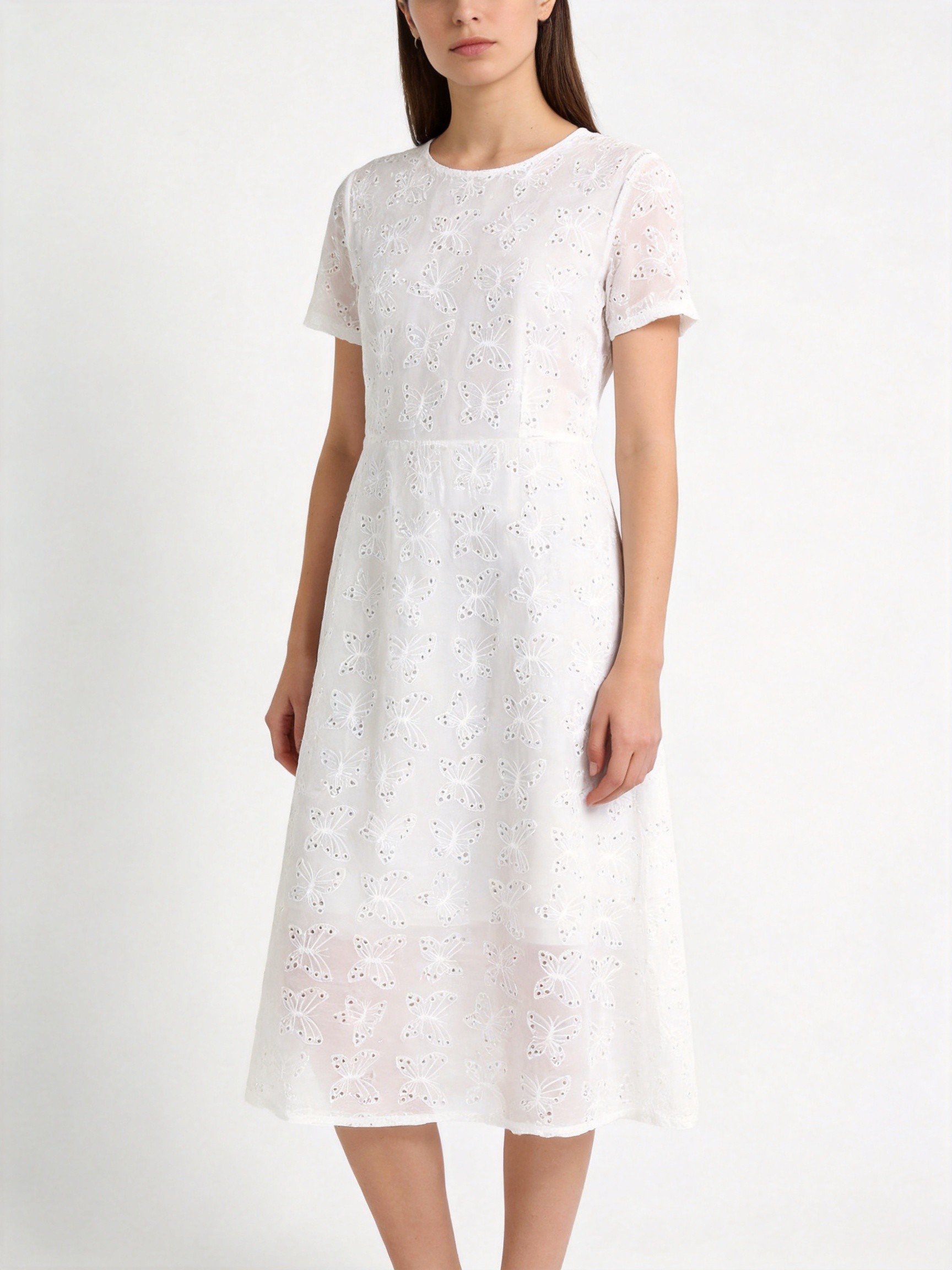
One finishing effect worth knowing when you design with dyed eyelet: dyed eyelet makes the embroidery tonal — same-color thread and ground read as texture and openwork rather than as pattern contrast. It looks expensive in a quiet way, photographs cleanly, and has become the default for brands that want ornament without a print. More on this in the next section.
Dyeing Cotton Eyelet: Piece-Dyeing & Tonal Embroidery
This section covers the question behind roughly half of sample-stage surprises: "I ordered blue eyelet — why isn't the embroidery white?"
How the Dyeing Actually Works
Stock eyelet is produced in natural off-white — the undyed, greige-state cotton. When color is ordered, the finished embroidered and cut fabric is piece-dyed: the whole roll goes through the dye bath after embroidery and cutwork. Since ground cloth and embroidery thread are both 100% cotton, both accept the same reactive dye in the same bath. They come out the same color family. The pattern does not disappear — it is carried by the relief of the satin stitching (which catches light as a raised, slightly denser tone) and by the open holes themselves. That is the tonal look: texture and openwork in one color, rather than white thread sitting on a colored ground.
If a white-on-color contrast is genuinely wanted, that requires a different construction — dyed ground embroidered with colorfast white thread, with its own development and higher MOQ. It is not what standard piece-dyed eyelet delivers, so align your design team before sampling.
Colors That Repeat Season After Season
The recurring commercial palette for piece-dyed eyelet is soft and slightly desaturated: sage and other muted greens, lavender, coral, mint, navy (the strongest deep tone) and rose/dusty pink. Natural off-white itself remains a permanent seller and is the lowest-risk first order for a new account.
What Dyeing Changes Technically
- Shrinkage: the wet dyeing process adds relaxation shrinkage on top of greige-state values; cut openings can relax very slightly. Dyed bulk should be tested for residual shrinkage before garment markers are locked.
- Subtle tonal variation: dense satin-stitch zones absorb dye a touch differently from flat ground because of thread packing; the effect is normally slight and part of the tonal aesthetic, but it should be confirmed on the lab dip, not discovered in bulk.
- Hole edge stability: reactive dyeing does not damage the stitched borders, but aggressive mechanical action should be avoided in the dye cycle to protect openings.
The correct sequence is always lab dip first, bulk after written approval, with bulk cut from matched lots. For the test methods behind shrinkage, color fastness and lot consistency claims — ISO wash tests, staining grades, dimensional change — see our complete guide to fabric testing methods.
Cotton Eyelet Fabric Trends 2025–2026
Eyelet's demand cycle is unusually stable — it has never truly left womenswear — but the way current aesthetics use it has shifted in five visible directions.
Prairie and cottage romance. Tiered dresses, ruffled blouses and milkmaid-adjacent silhouettes keep full-density white and off-white eyelet moving as a core romantic fabrication rather than a summer-only novelty.
Coastal grandmother and relaxed resort. Clean, expensive-looking casuals favor sparse eyelet in natural and white: relaxed shirts, pull-on trousers and cover-ups where the cutwork is a quiet texture on otherwise simple shapes.
Quiet luxury texture play. Low-logo, no-print programs need surface interest that does not shout, and tonal piece-dyed eyelet fits that brief precisely — ornament delivered through relief and openwork in navy, sage and neutral tones. Fast-fashion and mid-tier brands have both been scaling this look because it reads premium at modest fabric cost.
Kids' and baby expansion. Heritage dressing, heirloom-style christening and party pieces, and breathable summer childrenswear continue to pull sparse small-motif eyelet, increasingly with chemical-testing requirements written into the purchase contract.
Resort and destination collections. Coral, mint and lavender dyed eyelet in loose vacation silhouettes remains a dependable warm-season buy for brands shipping into spring/summer programs.
For search and sourcing language, note the regional terminology: EU buyers more often search and RFQ "broderie anglaise fabric," US buyers say "eyelet" or "eyelet embroidery fabric," and "cotton cutwork" appears in both markets. Using all three in supplier communications reduces the chance that matching stock is missed because of a naming gap.
Eyelet Fabric Pricing: What Determines Wholesale Cost
Our published FOB range for the 11 in-stock designs is US$2.3–2.7 per meter. The spread inside that band is not arbitrary — eyelet pricing stacks a second and third process on top of ordinary cotton cloth, and each cost lever is identifiable.
| Cost Driver | Why It Moves the Price |
|---|---|
| Stitch count / pattern density | The largest lever. Embroidery is priced by machine time and stitch volume; full-density all-over designs run far more stitches per meter than sparse layouts. |
| Thread consumption | Dense satin-stitch borders and filled motifs consume more cotton thread; thread is part of the finished meter cost. |
| Ground weight | 100–130 GSM grounds carry different cotton input costs; heavier cloth also moves more slowly through embroidery. |
| Cutwork labor | More holes and tighter detail mean more cutting and trimming time, plus normal scrap from defect control. |
| Piece dyeing | Dyed orders add a dyeing stage plus lab-dip work versus natural off-white greige. |
| Order quantity | Embroidery setup and handling amortize over longer runs; volume tiers step the unit price down. |
| Packing and delivery terms | Tube/roll packing, poly and carton specs, and FOB versus other incoterms change the landed figure even at identical fabric cost. |
In cost-accounting terms, think of a meter of eyelet as: greige cotton + embroidery (priced on stitch volume) + cutwork and trimming + finishing or dyeing + packing. Full-density designs sit toward the top of the $2.3–2.7 band; sparse greige designs toward the bottom; dyed full-density at volume defines the typical ceiling for the stock program. Quotes far below the band generally mean one of three things: omitted cutwork (plain embroidered cotton), lighter ground cloth, or higher defect rates accepted at inspection — worth asking about directly.
MOQ mechanics, deposit structures, L/C thresholds and how payment terms interact with sampling are covered in our fabric MOQ and payment terms guide.
How to Source Cotton Eyelet Fabric from China: Step by Step
The process below is the standard sequence our repeat buyers follow. It is designed to remove surprises before the first 300-meter run.
Step 1: Request Free A4 Swatches
Ask for A4 cuttings of the designs shortlisted — in this program, choose from the 11 stock patterns. Swatches are free for serious inquiries. Compare them side by side: hole size and cleanliness, motif repeat, ground hand and actual weight. Hold sparse and full-density samples against each other before locking the aesthetic.
Step 2: Verify the Technical Points
On receipt, check GSM with a small cut and a precision scale, measure the 135 cm width, rub the cut edges to confirm the stitched borders hold, and wash a cutting once to observe shrinkage and hole stability. Confirm the composition is cotton for both ground and thread.
Step 3: Approve Color via Lab Dip
For anything other than natural off-white, approve a lab dip against your Pantone or physical standard before bulk. Check the dip under your market's relevant light source, and remember the result will be tonal — judge the relief-and-hole effect, not a thread-to-ground contrast that will not exist.
Step 4: Place a Trial Order at MOQ
First programs run at the 300 meters-per-design MOQ, which is enough to prove the fabric through real garment production without overcommitting. Use the trial roll to validate markers (especially holes at seam and hem allowances), lining choices and sewing behavior on your own line.
Step 5: Bulk Production and QC
Lead time is within 10 days after order confirmation for stock greige; dyed orders add lab-dip and dyeing time. Our MTQS inspection covers in-process and final check points — cut quality, missed stitches, ground pulls, repeat alignment, weight and width. Buyers are welcome to add third-party inspection on top.
Step 6: Payment, Packing and Documents
T/T is the standard payment method; L/C is accepted for larger orders. Rolls are packed on paper tubes, poly-bagged and export cartoned, with commercial invoice, packing list and bill of lading, plus test reports where OEKO-TEX or other testing was arranged.
Start the sequence from our inquiry page with your design codes, colors and meterage, or message the factory directly on WhatsApp — both reach the sales desk in Keqiao. The full commercial program is summarized on the cotton eyelet embroidery fabric manufacturer page.
Quality Checklist: Verifying Eyelet Before Bulk Purchase
Eyelet shares the standard cotton checks but adds cutwork-specific failure modes. Use this list at swatch stage and again on bulk arrival.
| Check Item | Method | Acceptable Standard |
|---|---|---|
| Hole edges | Visual + magnifier, face and reverse | Clean cuts; full satin-stitch ring, no fuzzy or unbound edges |
| Cutting damage | Scan whole surface over light table | No nicks, slits or holes outside the design openings |
| Missed / loose stitches | Track several motif repeats | No missing rings, no loose loops that would open after wash |
| Ground condition | Inspect between motifs | No pulled yarns, drawn threads, needle damage or puckering |
| Repeat alignment | Follow repeats across width and length | Motifs register consistently; no drift or staggered joins |
| Backing residue | Check reverse face by hand | Stabilizer fully removed/dissolved; no stiff patches |
| Thread trimming | Both faces | No floating ends that tangle in making or washing |
| Weight | 10cm × 10cm cut on precision scale | Within agreed 100–130 GSM range and tolerance |
| Width | Measure at 3+ points per roll | 135 cm usable within tolerance |
| Shrinkage | One wash on a test cutting | Dimensional change within agreed limit; holes stay stable |
| Shade consistency | Compare roll ends and multiple rolls | No visible lot-to-lot or end-to-end shade gap |
Caring for Cotton Eyelet Fabric
Cotton eyelet is robust for a decorative fabric, but the cut openings need slightly more consideration than plain cotton. The care routine below doubles as the basis for garment wash-care labels.
- Wash gently: machine wash cold on a gentle cycle, or hand wash; use a mild detergent and avoid bleach, which can weaken cotton and yellow off-white stock.
- Expect cotton shrinkage: 100% cotton relaxes at the first wash, and dyed eyelet has already seen a wet process. Brands should pre-shrink or account for residual shrinkage in the pattern rather than surprising the end customer.
- Protect the openwork: wash inside a pillowcase or laundry bag on delicate programs; open holes can catch on zippers, hooks and rough drum surfaces.
- Dry in shade: line dry flat or hanging, away from strong direct sun to protect whites and dyed tones alike.
- Iron from the reverse: medium cotton heat, iron on the wrong side, ideally over a press cloth, so the satin-stitch relief and cut edges are not flattened or scorched.
- Warn on snagging: eyelet garments catch on jewelry and rough hardware — a short line on the care label reduces returns on lacy full-density styles.
- Storage: store clean and dry; roll or fold without sharp creases across dense embroidery for long warehouse dwell times.
Frequently Asked Questions
Is eyelet fabric see-through?
The ground cloth is a compact 100% cotton woven at 100-130 GSM and is not transparent by itself, but the cut eyelet holes are genuinely open, so skin or underlayers show through wherever the openwork sits. Dresses and blouses are normally lined (bodice lining, half slip or cotton voile underlayer), or motifs are placed strategically. Sparse layouts reveal less open area than full-density all-over patterns.
Can cotton eyelet fabric be dyed any color?
Stock eyelet designs run in natural off-white and can be piece-dyed to your color standard (Pantone code or physical sample). Because the ground and the embroidery thread are both cotton, they dye together for a tonal result: the pattern reads through texture, relief and openwork rather than as white thread on a colored ground. Sage, lavender, coral, mint, navy and rose are common requests, and a lab dip is always approved before bulk dyeing.
Eyelet vs lace for a dress: which should I choose?
Eyelet is flat cutwork embroidery on a solid woven cotton ground with a smooth surface and clean cut holes, giving a crisp, washable cotton hand suited to everyday dresses, blouses, shirts and childrenswear. Lace is a network of threads, often on a net ground or with no ground at all, built from raised loops; it is typically more formal, heavier or sheerer, and is used for bridal, eveningwear and lingerie. Eyelet is flat cutwork embroidery, not raised 3D bridal lace.
What is the MOQ for cotton eyelet fabric?
MOQ is 300 meters per design for the in-stock eyelet patterns. Natural off-white greige is stocked in all 11 designs; piece-dyed orders run at 300 meters per design per color. Custom embroidery patterns developed from buyer artwork require a higher development MOQ and a sampling stage before bulk.
Is your cotton eyelet fabric OEKO-TEX certified?
OEKO-TEX Standard 100 testing can be arranged on request, tested to the product class you specify (Class I for baby and infant items, Class II for fabrics in direct contact with skin). Testing is scheduled per order or program, so tell us your requirement before production and the test report can be provided before shipment.
Can you make custom eyelet embroidery patterns?
Yes. New embroidery patterns can be developed from your artwork, with a physical sample produced before bulk. Artwork must be adapted to cutwork constraints: clean closed hole outlines, connected stitch paths and practical stitch density, so very complex or fully packed artwork usually has to be simplified to run reliably on embroidery and cutting equipment. Send your design for feasibility assessment and development MOQ.
What is the wholesale price and lead time for eyelet fabric?
FOB pricing for the 11 in-stock cotton eyelet designs runs US$2.3-2.7 per meter, depending on embroidery density, whether the fabric is piece-dyed, order quantity and packing. MOQ is 300 meters per design and lead time is within 10 days after order confirmation for stock greige; dyed orders add lab-dip and dyeing time. Payment is by T/T, with L/C accepted for larger orders.
Ready to Source Cotton Eyelet Fabric?
Mujia Textile runs 11 in-stock cotton eyelet embroidery designs on 100% cotton, 100–130 GSM, 135 cm — natural off-white off the shelf or piece-dyed to your palette. FOB US$2.3–2.7 per meter, MOQ 300 meters per design, lead time within 10 days, with OEKO-TEX Standard 100 testing arranged on request and MTQS inspection on every run.
Look through all 11 in-stock eyelet designs with fabric and garment photos, check the wholesale program page for commercial terms, then send your design codes, colors and meterage through the inquiry page. Free A4 swatches go out for serious inquiries, and lab dips follow within days for colored programs.