Linen Curtain Fabric: Weight, Drape and Light
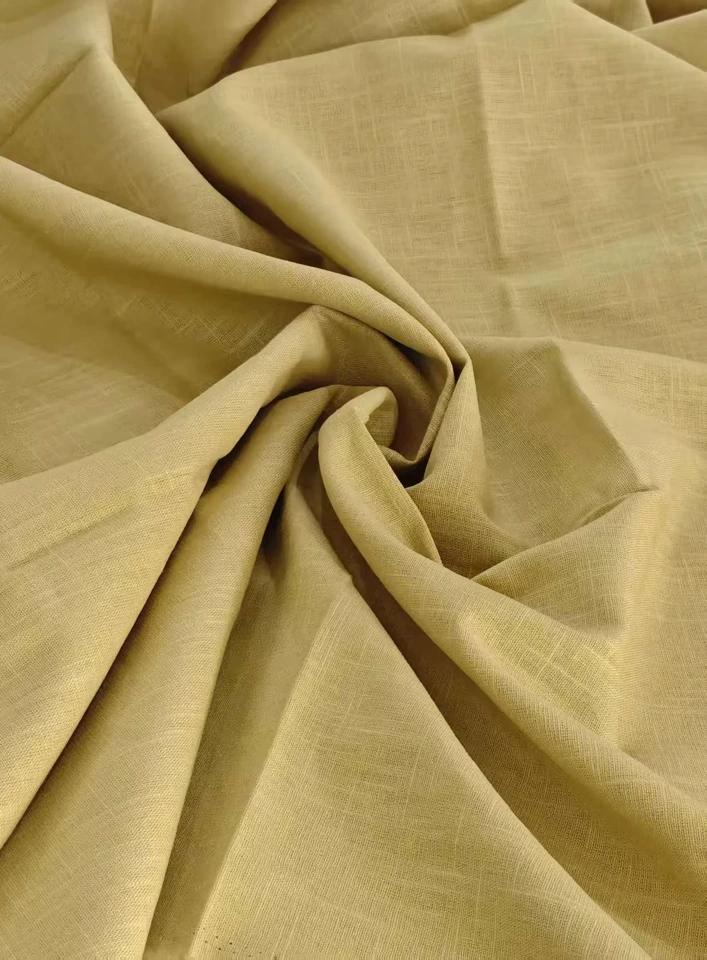
Table of Contents
- Introduction
- Three Numbers, Not a Colour Card
- Weight and Drape
- Width: What 140 cm Actually Means
- How Much Light Linen Blocks
- Light Fastness: The Test Curtains Need
- Shrinkage and the Panel That Ends Too Short
- Flame Retardancy for Contract Work
- Header Types and What They Ask of the Fabric
- The Curtain Fabric Purchase Order
- Our Linen and Linen-Blend Specifications
- Frequently Asked Questions
- Standards and Test Methods Cited
Introduction
The most common mistake in buying curtain fabric is choosing it the way you would choose upholstery: by colour card, then by price. Curtain fabric is judged at a distance, in motion, against light. Two cloths that look identical on a sample card behave completely differently once they are four metres long, gathered onto a rod and backlit by a window. One falls into clean folds and holds them. The other reads as a flat sheet of paper with wrinkles in it.
That difference is decided by three numbers, none of which appears on a colour card: weight per square metre, usable width, and movement after washing. Get all three right and the panel hangs. Get any one wrong and no amount of pressing at the workroom will save it.
There is also an honest commercial point that mills are usually vague about, so it is better to state it at the front. Curtain fabric in the trade is overwhelmingly around 140 cm wide, because that is what the looms run. Wide-width drapery exists, but it is a different and much narrower market. If you are planning a panel that needs 300 cm of width with no join, you are not buying standard drapery linen, and you should know that before you send an enquiry rather than after the sample arrives.
Three Numbers, Not a Colour Card
A quick map of the three, because the rest of this article expands on each.
| Number | Typical drapery range | What goes wrong if it is wrong |
|---|---|---|
| Weight, g/m² | 180–260 for residential; 100–150 for sheers | Too light: thin at the window, folds collapse, lining shows. Too heavy: stiff leading edge, rod strain, expensive gathers. |
| Usable width, cm | 137–142 typical; 280–300 for wide-width | Under-estimated join count, mismatched pattern at the seam, cutting list that comes up short. |
| Shrinkage, % | Varies by fibre and by whether the cloth is pre-washed | Floor-length panel becomes a short panel after the first laundry cycle. Not recoverable. |
Weight and Drape
Drape is not softness. A stiff fabric can drape well if it is heavy enough to hang in folds, and a soft fabric can hang badly if it is too light to hold a fold. What matters is the relationship between the fabric's weight and its bending stiffness.
In practice, for linen and linen blends:
- 100–150 g/m²: sheer territory. Beautiful in a warm climate, but it shows every seam and every lining edge, and it will not gather without a very full ratio.
- 180–200 g/m²: light residential drapery. Soft, airy, good for a casual rod-pocket look. Folds will relax over a season.
- 210–240 g/m²: the working range for residential drapery. Enough body to break into folds at the header and hold them, light enough to gather on a domestic rod and to launder.
- 250–300 g/m²: heavier drapery, good for a floor-length pinch pleat and for a formal room. Needs a properly fixed rod and a heavier header.
- Above 300 g/m²: you are in upholstery weight. It can be used, but it behaves like a hanging wall, not a curtain.
The second variable inside weight is finish. A washed or sand-washed linen blend has a softer hand at the same weight, and the softening is not cosmetic: the wash relaxes the yarn and reduces the residual stiffness that makes a new panel hang like cardboard for the first month. This is the argument for washed blends in drapery, and it is also why the same fabric, unwashed, can feel disappointing when it arrives.
A technical note worth knowing: weight measured as g/m² tells you the mass, not the thickness. Two cloths at 220 g/m² can differ noticeably in how they fold if one is a tighter plain weave and the other is looser. That is why the sample is still necessary even when the specification matches — but the specification tells you which sample is worth requesting. For the measurement method itself, see our guide to fabric weight.
Width: What 140 cm Actually Means
Here is the calculation that catches buyers who are new to drapery. A curtain is not the width of the window. It is the window width multiplied by a fullness ratio, which for a gathered header is typically 1.5 to 2.5 times.
| Window width | Fullness 1.5× | Fullness 2× | Fullness 2.5× | Panels at 137 cm usable |
|---|---|---|---|---|
| 120 cm | 180 cm | 240 cm | 300 cm | 2 to 3 widths |
| 150 cm | 225 cm | 300 cm | 375 cm | 2 to 3 widths |
| 200 cm | 300 cm | 400 cm | 500 cm | 3 to 4 widths |
Every row requires a join. That is normal, and it is not a defect. What matters is how the join is handled:
- Pattern repeat. On a plain linen the join disappears. On a stripe, a check or a slub with a visible repeat, it has to be matched, and matching costs fabric. Add the repeat length per join to your consumption.
- Seam position. Put the join behind a fold, never at the leading edge where the light hits it side-on. On a 2.5× gather the folds move, which helps; on a flat roman blind it does not.
- Direction of the slub. On a slubby linen the weft slubs read differently depending on which way the piece is turned. Cut all widths the same way up, or the panel will show a horizontal band at the join.
- Seam type. A French seam or a flat-fell seam on drapery gives a clean reverse face if the panel is unlined. On a lined panel the seam allowance is hidden and a simple seam is enough.
If you need a seamless panel, say so at enquiry. Wide-width drapery linen is produced, but it is a small part of the market and availability in 280 cm and above is far thinner than in 140 cm. Asking your 140 cm supplier to “just make it wider” is not a small request; it is a different loom. Knowing which one you are buying changes both the price and the lead time.
How Much Light Linen Blocks
Linen is a poor blackout fabric and an excellent light-diffusing fabric, and buyers who confuse the two end up disappointed. At 220 g/m² in a natural or undyed shade, a linen-cotton blocks roughly a third to a half of the light that reaches it. The window is not dark. It is softer, warmer and less directional.
What this means commercially:
- For a living room, dining room or study: this is exactly what the customer wants, and no lining is required.
- For a bedroom: it is not enough. A separate blackout lining, usually a coated or tightly woven polyester, does the work. The linen is the visible layer.
- For a nursery: assume a blackout lining and specify it at the same time, because a lining ordered later may not colour-match a dye lot already delivered.
There is a design argument for the diffused light, which is worth stating because it sells: linen does not merely reduce light, it scatters it, and scattered daylight is what makes a room feel warm rather than dim. That is the whole reason the fabric has stayed in drapery for as long as it has.
Light Fastness: The Test Curtains Need
Curtain fabric has a testing requirement that apparel fabric does not: sustained exposure to daylight, on one face, for years. The relevant method is a light fastness test rated against the blue wool scale, in which a rating of 1 means rapid fading and 8 means negligible. For drapery, most buyers should be asking for a rating in the 5 to 6 range or better on the face colour, and higher on any shade that will sit in direct sun.
The practical consequence: dyed linen in bright, saturated colours is harder to hold than natural, undyed or pale shades. If the design brief calls for a strong colour in a south-facing window, ask for the light fastness figure before you approve the lab dip, because it is a dye-selection decision, not a finishing fix.
Two related tests are worth naming in the purchase order at the same time: colour fastness to washing, since curtains are laundered, and colour fastness to rubbing, since a lined panel abrades against its lining every time it is drawn. A fabric that passes light fastness and fails rubbing will still grey at the leading edge within a season.
Shrinkage and the Panel That Ends Too Short
This is the failure that has no repair. A floor-length panel is cut to the finished drop plus hem allowance. It is hung, it looks correct, and then it is cleaned. Cellulosic fibres relax in water, the panel loses length, and now it floats above the floor by an amount that is obvious to everyone in the room.
The sequence to avoid it:
- Ask for the measured shrinkage figure, to a named method, not a verbal range. A number from a wash test is evidence; “about two or three percent” is a guess.
- Specify pre-shrunk or washed fabric if the finished panel will be laundered. This is the single most effective control, and it is a purchase-order decision rather than a workroom one.
- Add the allowance to the cut length, and state in the cutting sheet that the allowance exists. Workrooms that are paid by the panel will not add it voluntarily.
- Wash a sample before cutting bulk. A one-metre length, washed and dried the way the customer will wash it, tells you more about the actual movement than any specification. It costs almost nothing and it settles the argument.
The same logic applies to width, though the effect is smaller and usually absorbed by the fullness ratio. Length is where the visible failure lives.
Flame Retardancy for Contract Work
Domestic drapery is rarely subject to flammability regulation. Contract drapery almost always is: hotels, theatres, cruise ships, schools and most public buildings require the fabric to pass a named standard, and the certificate must reference the actual fabric and finish, not a generic fibre type.
Two points matter commercially. First, the treatment changes the fabric. Inherently flame-retardant fibres are a different purchase entirely; topical treatments on a linen blend change the hand, sometimes the shade, and often the light fastness. Second, the certificate is tied to the finish, so if the mill changes its finishing route between the sample and the bulk, the certificate may no longer apply to what you receive. Specify both the standard and the requirement that the certificate reference the production batch.
If a project specifies contract drapery, raise it before the sample is made. Retrofitting a flame-retardant finish to an approved fabric is the most expensive way to solve the problem.
Header Types and What They Ask of the Fabric
The header is the top of the curtain, and it is where the fabric meets the hardware. Each type makes a different demand, and the demands are not interchangeable.
| Header | Best weight | What it asks of the fabric |
|---|---|---|
| Rod pocket | 180–220 g/m² | Fabric must be stable enough not to stretch around the rod. Avoid loose weaves; the pocket takes the whole weight of the panel. |
| Eyelet / grommet | 210–260 g/m² | Needs body, and needs a stable, dense weave so the rings do not pull through. Check ring spacing against the fold depth. |
| Pinch pleat | 240–300 g/m² | Heavier fabric is better: the pleat holds a crease. Needs a firm hand and a stable header tape. |
| Tab top | 180–220 g/m² | Fabric must resist stretching along the tabs; a slubby linen can distort at the tab seam. |
| Roman blind | 200–260 g/m² | Needs dimensional stability and a clean fold line. No pattern repeat across the drop, or the folds will break the pattern. |
The Curtain Fabric Purchase Order
The clause list that prevents most of the problems above. It assumes the order is for fabric, not for made-up curtains.
- Weight with a tolerance. Nominal g/m² plus an accepted band. “220 g/m² ± 5%” is a specification; “about 220” is not.
- Usable width, not cut width, and whether the selvedge is included. The difference is one to three centimetres per width, which multiplied across four widths is a hem you did not plan for.
- Shrinkage figure and method. Measured, named, and referenced to the batch.
- Pre-shrunk, washed, or neither. Name which. This is the clause buyers most often forget and most often regret.
- Light fastness and wash fastness ratings with the test method.
- Shade continuity across the order. How many rolls, wound the same way, and whether the whole order is one dye lot. Curtains are viewed as a single surface, so shade variation is more visible here than in apparel.
- Roll length and roll diameter. A panel cut requires continuous length. Short rolls mean more joins than you planned for.
- Flame retardancy, if contract. Standard name, certificate, and batch reference.
- Colour approval route. Lab dip first, then bulk, with the approved dip retained.
Our Linen and Linen-Blend Specifications
Two fabrics that cover most drapery enquiries, with the numbers stated plainly.
| Reference | MJ5506 | MJ8015 |
|---|---|---|
| Composition | Linen / cotton 55/45 | Linen / viscose 20/80, sand-washed |
| Weight | 220 g/m² | 220 g/m² |
| Width | 140 cm | 138–140 cm |
| Colour range | 60 colours | 211 colours |
| MOQ | 300 m for stock colours; 2,000 m for a custom colour | 300 m for stock colours; 2,000 m for a custom colour |
| Suggested drapery use | Residential, rod pocket and tab top; holds a clean fold | Residential and light contract; the wash gives it an immediate soft fall |
A note on the two, because the choice is not about quality. MJ5506 at 140 cm with 60 colours is the straightforward drapery purchase: the linen-cotton hand is crisp for the first weeks and then relaxes into the fold. MJ8015 is a linen-viscose blend, sand-washed, with a much larger colour range; the viscose softens the hand and the wash takes the newness off, which is why it hangs well on the first day rather than the thirtieth. If a customer's reference photograph shows a soft, slightly slubby, fluid panel, MJ8015 is usually what they are looking at. If it shows a crisper, more architectural fold, MJ5506 is closer.
Both are woven at our mill in Fengqiao, Zhuji, with the showroom in Keqiao. We quote FOB from these specifications; for the wider map of linen and linen-blend constructions, see our linen blend buying guide and the sand-washed linen-viscose guide.
Frequently Asked Questions
Q1: What GSM should linen curtain fabric be?
Most residential drapery sits between 180 and 260 g/m². Below about 180 g/m² the panel reads thin at the window, shows the lining through, and loses its folds after a season. Above 280 g/m² the cloth holds a stiff edge and needs a heavier header to fall properly. Around 220 g/m² is the usual compromise: enough body to fold, light enough to gather on a domestic rod. Sheers are a different product and sit at 100 to 150 g/m².
Q2: Can I make curtains from 140 cm wide fabric without seams?
Not for a normal window. A curtain panel is usually one and a half to two and a half times the finished width of the window, so a 150 cm window needs a panel of 225 to 375 cm finished width. At 140 cm usable you will be joining panels. The join is normal in the trade, but it must be planned: match the pattern repeat, put the seam behind a fold rather than at the leading edge, and allow for the seam allowance in your consumption calculation. Wide-width drapery linen exists but is a different purchase, and availability in 280 cm and above is much narrower than in 140 cm.
Q3: How much light does linen curtain fabric block?
A 220 g/m² linen-cotton in a natural or undyed shade blocks perhaps a third to a half of incoming light. It will not darken a bedroom. Linen is chosen for the quality of the light it passes, not for the quantity it stops. If the brief calls for blackout, the fabric needs a separate blackout lining, and the lining is what does the work. Do not accept a claim that a heavier linen replaces a blackout lining: it reduces glare but does not stop light.
Q4: How much shrinkage should I allow for on linen curtains?
Allow for it in the cutting, not in the promise. Cellulosic fibres relax in the first wash, and a washed linen or linen-blend drapery can move several percent in length, which on a floor-length panel is visible. Ask the mill for the measured shrinkage figure from a wash test to a named method, specify pre-shrunk or washed fabric if the panel will be laundered, and add the allowance to your cut length. A made-to-measure panel cut to the exact finished drop is a panel that will be short after its first clean.
Q5: Does curtain fabric need a flame retardancy certificate?
For a domestic living room, usually not. For contract work, almost always. Hotels, theatres, cruise ships and most public buildings require drapery to pass a named flammability standard, typically NFPA 701 in the United States or BS 5867 in the United Kingdom, and the certificate has to reference the actual fabric and finish. Flame-retardant treatment changes the hand and sometimes the shade, so it has to be decided before the order, not added afterwards.
Related Guides
- Linen Blend Fabric: A Buyer’s Guide
- Sand-Washed Linen-Viscose: What the Wash Does
- Linen-Cotton Blends: Which Ratio for Which End Use
- Linen Sarongs and Head Wraps: Which Weight Drapes
- Fabric Weight (GSM): How to Choose
- Fabric Shrinkage: Causes, Testing, Prevention
- Fabric Care & Maintenance Guide
- How to Read a Fabric Specification Sheet
Standards and Test Methods Cited
The methods behind the figures and ratings in this guide:
- ISO 3801 — Mass per unit length and mass per unit area of woven fabrics — the method behind every g/m² figure quoted here.
- ISO 6330 — Domestic washing and drying procedures for textile testing — the wash procedure to name when you ask for a shrinkage figure.
- ISO 5077 — Determination of dimensional change in washing and drying — how the shrinkage percentage itself is measured.
- ISO 105-B02 — Colour fastness to artificial light: xenon arc fading lamp test — the method behind light fastness ratings against the blue wool scale.
- ISO 105-X12 — Colour fastness to rubbing (crocking) — relevant to leading-edge abrasion against a lining.
- NFPA 701 — Standard methods of fire tests for flame propagation of textiles and films — the US contract drapery standard.
- BS 5867 — Fabrics for curtains, drapes and window blinds — the UK flammability specification for drapery.
- REACH Annex XVII — Restrictions on hazardous substances — the EU chemical restrictions applying to flame-retardant finishes.
Sand-Washed Linen-Viscose: What the Wash Does — Why the same weight of cloth feels different after a sand wash, and which end uses it suits...