Sarongs and Head Wraps: Which Linen Weight Actually Drapes
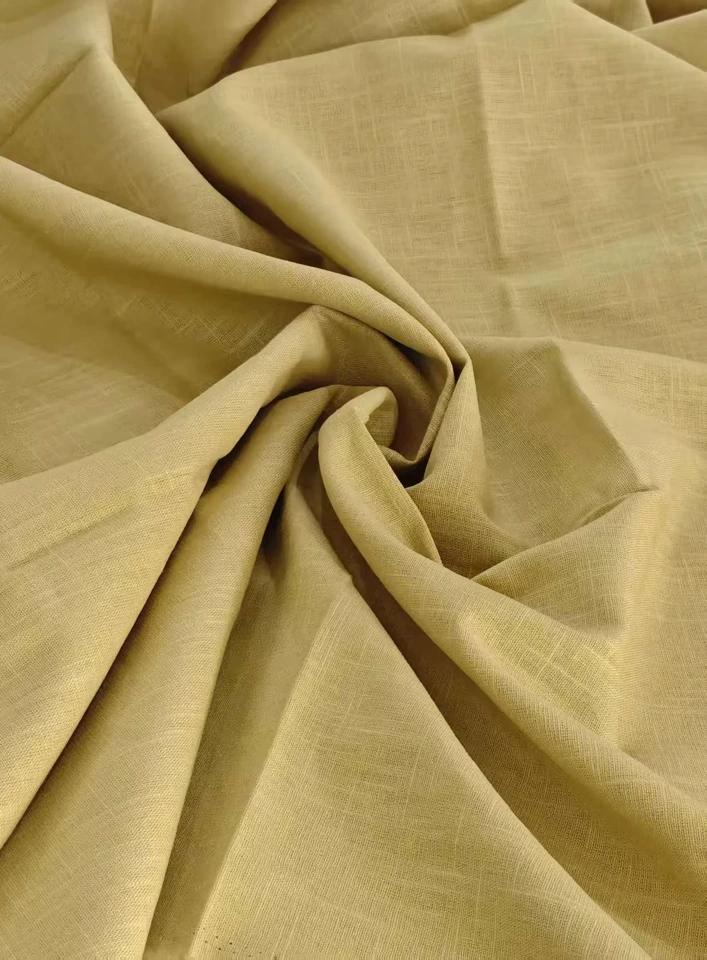
Short answer: A sarong needs opacity and fall; a head wrap needs grip and moisture take-up. Both are met at 220 GSM, which is where our MJ8015 sand-washed linen-viscose sits — 20/80 linen-viscose, 138–140 cm, 211 stock shades. Below about 160 GSM the sarong turns transparent against sun.
Table of Contents
- What a sarong actually needs
- What a head wrap actually needs
- Why 220 GSM sits where it does
- What sand washing changes — and what it does not
- Specification
- 211 shades and a short season
- How to test opacity and drape
- Frequently asked questions
What a sarong actually needs
A sarong is worn outdoors, in strong light, often over swimwear, and it is judged in the first three seconds by whether the person standing behind the wearer can see through it. That single condition rules out most lightweight linen. A 120–160 GSM linen is pleasant against the skin and photographs badly at noon, because the cloth is not dense enough to block direct sun once it is stretched across a hip.
The second requirement is fall. A sarong is tied, not tailored — one knot at the chest or waist, the rest hanging free. A cloth that is too stiff stands away from the body in a cone; a cloth that is too light clings and shows every fold of what is underneath. What you want is a fabric heavy enough to hang in a straight line from the knot and soft enough to move with the body. That is a specific weight band, and it sits well above the "light summer linen" that most catalogues lead with.
The third is behaviour when wet. A sarong spends its life going on and off over damp swimwear in humid air. A fabric that becomes translucent or limp when damp fails at exactly the moment it is being used.
What a head wrap actually needs
Head wraps invert two of those requirements. Opacity still matters — a wrap is worn against the head, and sheerness at the crown reads as cheap immediately. But the dominant requirement is grip: the cloth has to hold a fold without pins, and it has to hold it while the wearer moves, bends and walks through wind.
Grip comes from surface friction, and surface friction comes from texture. A smooth, tightly calendered fabric slides out of a fold; a sand-washed linen-viscose has a slightly brushed, matte surface that catches against itself. That is why sand-washed finishes dominate this category rather than polished ones, and it has nothing to do with the softness claim usually printed on the sample card.
The second requirement is moisture take-up. A wrap sits against the scalp and the forehead, which is where perspiration concentrates. Linen takes up moisture quickly and releases it quickly; viscose adds drape and softness but holds water longer. The 20/80 linen-viscose blend sits between the two, which is why it reads cool without going clammy.
Why 220 GSM sits where it does
At 220 GSM the cloth is dense enough to be opaque in daylight without a lining, heavy enough to hang from a knot in a straight line, and still light enough to tie comfortably at the chest. It is the weight our MJ8015 runs at — 20% linen, 80% viscose, sand washed, 138–140 cm wide.
Wider width matters more than buyers expect here. A sarong is usually cut as a single panel around 110–140 cm by 180–200 cm. At 138–140 cm usable width, one panel runs across the cloth and the length comes off the roll — no piecing, no seam down the middle of a garment whose whole appeal is an uninterrupted fall. At 110 cm width the same sarong needs a join, and the join is visible exactly when the cloth moves.
Our other linen programme, MJ5506, is a 55/45 linen-cotton slub at the same 220 GSM and 140 cm. It has a drier, more rustic surface than MJ8015 and less drape. For a sarong the slub reads as texture; for a head wrap it can read as irregularity. The blend choice is a design decision, not a quality one — the linen blend comparison sets out the differences in full.
What sand washing changes — and what it does not
Sand washing is a mechanical finish: the cloth is tumbled against an abrasive medium, which breaks surface fibres and softens the hand. It changes drape and surface friction. It does not change weight in any meaningful way, and it does not make a light cloth opaque. A 140 GSM sand-washed linen is still a 140 GSM linen when held up to the sun.
This is the most common point of confusion in the category, and it is worth stating plainly: buyers who have been sold "sand washed, so it drapes" often assume the finish has solved the opacity question too. It has not. If a supplier offers you a sand-washed linen sarong at a very light weight, ask for the GSM number, not the finish name.
Specification
| Parameter | MJ8015 (linen-viscose) | MJ5506 (linen-cotton) |
|---|---|---|
| Composition | 20% linen / 80% viscose | 55% linen / 45% cotton |
| Weight | 220 GSM | 220 GSM |
| Width | 138–140 cm | 140 cm |
| Finish | Sand washed | Slub, mill finish |
| Stock shades | 211 colours | 60 colours |
| Hand | Soft, fluid, matte surface | Dry, textured, more body |
| Drape | High — hangs in a straight line | Moderate — holds a fold |
| Best for | Sarongs, wraps, fluid dresses | Sarongs with texture, structured summer |
| Stock MOQ | 300 m | 300 m |
| Custom shade MOQ | 2,000 m | 2,000 m |
The MOQ split is the commercial fact that shapes a seasonal buy. Stock shades open at 300 m per colour; a custom shade runs 2,000 m. For a resort collection that needs eight colourways and will sell each in modest volume, the stock programme is the only route that works — which is what the 211-shade range is for.
211 shades and a short season
Resort and Gulf-season business is seasonal in a way that apparel generally is not: the buying window is short, the colour story is set months ahead, and a late delivery misses the entire season rather than delaying it. A mill that can only dye to order at 2,000 m per shade forces a buyer to commit four times the volume they can sell, in a colour they cannot change.
Holding 211 shades as stock inverts that. A buyer picks from a card, orders 300 m of each of six colours, and the goods ship without a dyeing queue. The cost of that flexibility is paid in the stock programme itself — someone has to carry 211 shades on the shelf, batch after batch, and keep them matching. That is an expensive thing for a mill to do, and it is the reason most mills do not.
For a head wrap and sarong programme, the practical effect is that a colour story can be built from what exists rather than from what can be dyed in time. Our sand-washed linen-viscose guide sets out how the 211-shade programme works in detail, and the linen blend product page carries the shade card.
How to test opacity and drape
Three checks, all of which can be done with a one-metre sample:
- Hold it up to the sun, not to a window. Daylight through a single layer is the test that matters. Then hold it doubled, because a sarong is often worn doubled at the hip.
- Tie a knot in the corner and hang it. The way the cloth falls from a single knot predicts how the garment will hang. A cloth that cones out stiffly at the knot will cone on the body.
- Fold it on the bias and shake it. A head wrap has to hold that fold without pins. Sand-washed surfaces grip; calendered ones slide. This takes ten seconds and settles the question.
One more item worth testing: shrinkage after the first wash. A 220 GSM linen-viscose moves on first wetting, and a sarong cut to 180 cm can finish at 175 cm. Wash the sample before you cut the marker, or add allowance and say so on the spec. Our weight selection guide covers the same trade-off across other categories.
Frequently asked questions
What GSM should a linen sarong be?
Around 220 GSM if it has to be opaque in daylight without a lining. Below roughly 160 GSM a single layer turns transparent against the sun when stretched across the body. Sand washing softens the hand but does not add opacity.
Is linen-viscose or linen-cotton better for a head wrap?
Linen-viscose, generally. The viscose adds drape and a matte, slightly brushed surface that holds a fold without pins. Linen-cotton is drier and more textured, which suits a sarong better than a wrap.
How wide should the fabric be for a one-panel sarong?
At least 138 cm. A sarong is normally cut as a single panel, so the width becomes the garment's length and no join is needed. Our MJ8015 runs 138–140 cm; narrower cloth forces a seam down the middle.
What is the minimum order for stock shades?
300 metres per colour from the 211-shade stock range. A custom shade runs 2,000 metres. For a resort buy with several colourways in modest volume, the stock programme is the only workable route.
Does sand washing make linen softer or lighter?
Softer, and slightly more matte. It does not meaningfully change the weight, and it does not make a light cloth opaque. If opacity matters, specify the GSM rather than relying on the finish name.
Specifying the garment, not the fabric name
Sarong and head wrap programmes fail on specification, not on quality. The fabric that photographs beautifully in a lookbook is often the one that goes transparent at noon or slides out of a fold by mid-afternoon.
Write the requirement as the garment needs it — opaque in daylight, hangs from a knot, holds a bias fold, minimum 138 cm wide — then let the weight and blend follow. At 220 GSM, sand washed, 138–140 cm and 211 stock shades, the MJ8015 programme answers all four without a custom dye lot.
Mujia Textile — running our own air-jet looms in Zhuji since 2012.