MJ 22126 vs MJ 22138: Which Satin, and Why the Gram Weight Decides
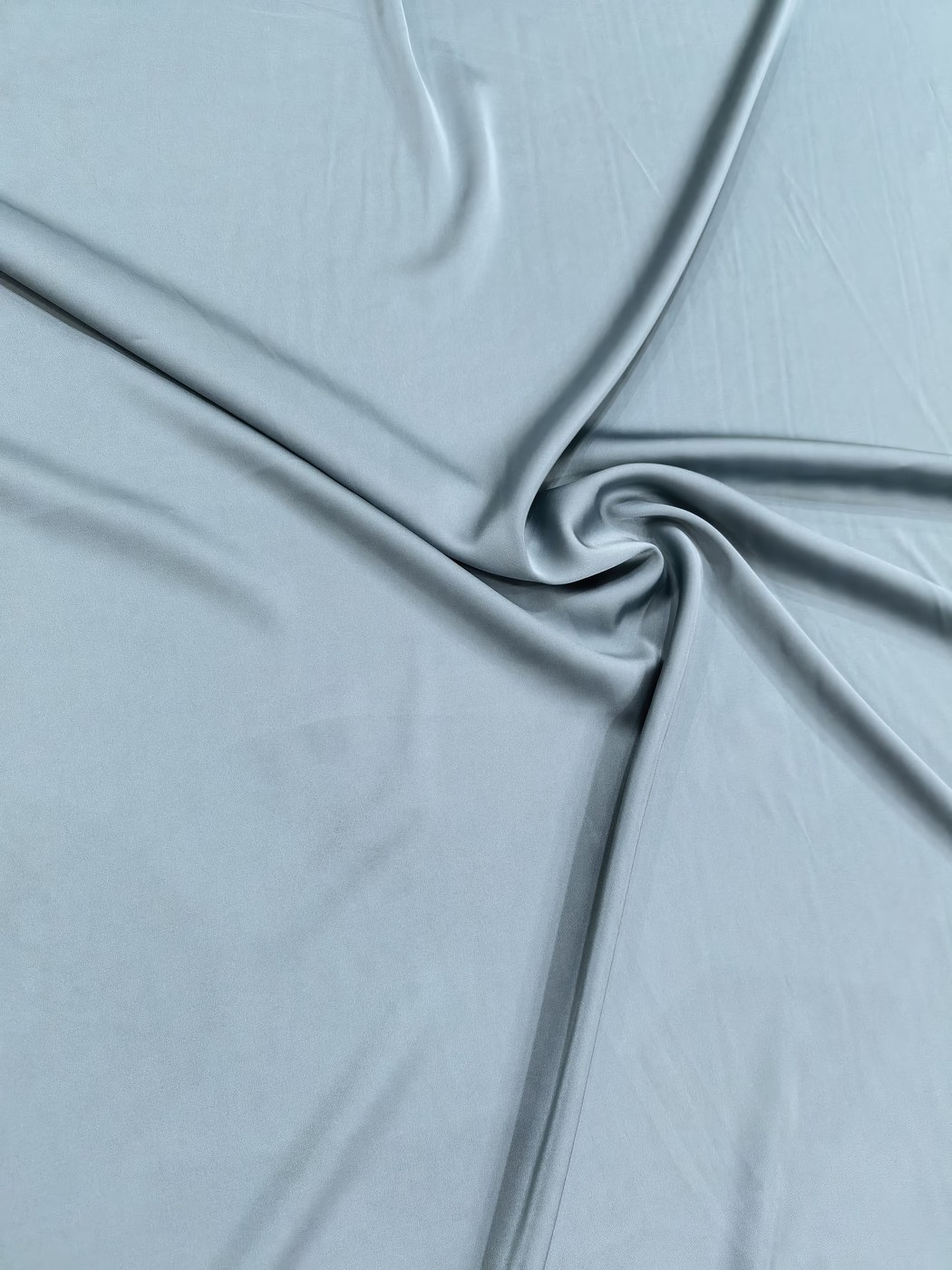
In short: MJ 22126 is a 98 GSM stretch satin, 96% polyester / 4% spandex, MOQ 200 m per colour, FOB USD 1.15–1.30/m. MJ 22138 is a 175 GSM pearl crinkle satin, 100% polyester, MOQ 300 m per colour, FOB USD 1.47–1.62/m. Both are satin weaves at 150 cm. The gram weight and the presence or absence of spandex decide the garment, not the word "satin".
The two satins in five numbers
Buyers compare these two articles constantly because they sit next to each other in our satin range and both are used for dresses. They are not substitutes. Put the five numbers on the table first - weight, composition, width, colour card and minimum - and the choice usually makes itself.
| Spec | MJ 22126 | MJ 22138 |
|---|---|---|
| Weight | 98 GSM (approx. 2.9 oz) | 175 GSM (approx. 5.2 oz) |
| Composition | 96% polyester / 4% spandex | 100% polyester |
| Width | 150 cm (59") roll width | 150 cm (59") cuttable width |
| Construction | Satin weave, piece-dyed, stretch finish | Satin weave, piece-dyed, crinkle finish |
| Colour range | Wide colour card - neutrals, pastels, jewel tones and darks | 30 colours |
| FOB price | USD 1.15–1.30 / metre | USD 1.47–1.62 / metre |
| MOQ | 200 metres per colour | 300 metres per colour |
| Certificate | MTQS-2026-000005 | MTQS-2026-000004 |
Read that table as two cloths for two jobs. 22126 is the lightest satin we weave; 22138 is the heavier pearlescent cloth. Neither is "better satin". One has give, the other has body, and a spec sheet that names only "satin, 150 cm" has said nothing.
98 GSM vs 175 GSM: what the gram weight buys you
The single most useful number on either page is the weight. At 98 GSM (about 2.9 oz), MJ 22126 is light enough to line a bodice or gather into a full skirt without bulk, and the spandex keeps the grain from pulling open at the seams. At 175 GSM (about 5.2 oz), MJ 22138 sits in the light-to-mid dress band: enough body to hang straight without lining, light enough to gather into a full skirt.
The gap is 77 GSM, and it is not a quality gradient. It decides drape. A 98 GSM cloth follows the body and needs the bias cut to read as a dress; a 175 GSM cloth stands away from the body and holds a shaped silhouette. The GSM guide sets out how weight maps to garment, and the two product pages each link to it for exactly this reason.
96/4 stretch vs 100% polyester: recovery against texture
Satin is a weave, not a fibre: the float of the warp over several weft picks gives the face its sheen and keeps the back matte. On MJ 22126 that float carries a fine spandex core, which is what lets a 98 GSM cloth recover after stretching instead of bagging at the elbow or the seat. The four-way give means it moves with the body rather than standing away from it.
On MJ 22138 the float is fine enough to keep the cloth soft for a bias-cut dress, and the crinkle is set in finishing rather than pressed in, so it survives washing and travel. There is no spandex. If a buyer asks which satin "has stretch", the answer is 22126 only - and if the garment needs to recover after sitting, that is the one to specify. For the wider composition picture see fiber content explained.
Smooth satin face vs pearlescent crushed texture
MJ 22126 has a smooth satin face, soft hand, fluid drape and subtle sheen - a clean surface that catches light down the length of a bias-cut dress. MJ 22138 has a pearlescent sheen and a fine crushed texture, so light breaks across the cloth instead of sitting flat on it. That texture does the work a print would do: movement reads as colour shift rather than pattern.
| Property | MJ 22126 | MJ 22138 |
|---|---|---|
| Face | Smooth satin, subtle sheen | Pearlescent, fine crushed texture |
| Hand | Soft, fluid | Soft, fluid |
| Light | Sheen runs along the bias | Light breaks across the cloth |
| Pattern role | Plain face takes dye and print | Crinkle reads as movement, not print |
The practical consequence is in the colour card. On 22138 the strongest shade for bridesmaid and prom is coral red, while pearl white and ivory sell first in the slip dress; champagne and soft gold carry the pearlescent finish best because sheen and colour sit in the same warm range.
Wide colour card vs 30 named colours
MJ 22126 offers a wide colour card - neutrals, pastels, jewel tones and darks - with a physical swatch card available on request. MJ 22138 holds 30 colours, named on the page: pearl white, ivory, champagne, lilac, rose, coral, wine red, burgundy, forest green, teal, navy, black and more. The same 30 colours run across the whole capsule of garments built on that cloth.
Colour is confirmed on a physical swatch, never on a screen, and repeat orders should hold one dye lot per shade. The dye-lot guide explains why a repeat order needs the lot number and not just the colour name.
Four garments from one base cloth
Both product pages make the same argument from opposite directions: one base cloth covers a capsule, not a single style. On MJ 22126 the four styling directions are an ice-blue slip dress cut on the bias and unlined, a soft-shoulder blouse with a gathered sleeve head, a bias midi skirt whose spandex recovers after sitting, and a loungewear robe where the fluid drape does the styling work. The listed applications also include wide-leg trousers, camisoles, shirt dresses, pyjamas and contrast satin lining.
On MJ 22138 they are a pearl-white slip dress, a wine-red blouse, a coral-red occasion gown and a champagne midi skirt, with the same 30 colours across all four. Beyond dresses the page lists bridesmaid, cocktail and prom, plus scarves, hair ties and contrast bag linings. The honest way to choose is to start from the garment: close-fitting and fluid points to 22126, structured and pearlescent points to 22138.
MOQ 200 m vs 300 m per colour
MJ 22126 opens at 200 metres per colour; MJ 22138 opens at 300 metres per colour. That is per colour, not per order - splitting a quantity across shades does not meet the minimum on either cloth. A sample or a swatch card is the route before committing to a dye lot.
The MOQ difference is not a barrier so much as a signal about the production route. The broader rules - why mills set minimums, how payment terms work, what a lab dip costs - are in the MOQ and payment guide.
FOB price and the quantity ladder
MJ 22126 is quoted at USD 1.15 to 1.30 per metre FOB China port, and unlike most cloths it publishes an explicit ladder: 1.30 at 200 m, 1.23 at 1,000 m and 1.15 at 2,000 m and above, depending on design and packing. MJ 22138 is quoted at USD 1.47 to 1.62 per metre FOB China port, and the range reflects design, packing and quantity rather than colour depth - the price is the same from 300 m to 2,000 m.
| Quantity | MJ 22126 | MJ 22138 |
|---|---|---|
| At MOQ | USD 1.30 at 200 m | USD 1.47–1.62 at 300 m |
| Mid volume | USD 1.23 at 1,000 m | USD 1.47–1.62, same range |
| High volume | USD 1.15 at 2,000 m+ | USD 1.47–1.62, same range |
Both are T/T 30/70, with larger orders by agreement and CFR or CIF on request. For how an FOB number is built up, see FOB cost breakdown.
Lead time: stock colours and custom dyeing
MJ 22126 ships stock colours in 7 to 10 days; custom dyeing is quoted after colour approval rather than against a published figure. MJ 22138 ships stock colours in 10 to 15 days, and custom dyeing runs 30 to 35 days after colour approval. The custom-dye window on 22138 is the number most likely to surprise a buyer planning a season.
A mill quoting a fixed lead time for a custom shade before seeing the lab dip is quoting a guess. Ask for the stock figure and the custom figure separately, and count the colour approval as its own step. The full sequence is in sample to bulk timeline.
Certification and quality control
MJ 22126 carries MTQS-2026-000005 and MJ 22138 carries MTQS-2026-000004 under the Mujia Textile Quality Standard. Both are checked with AQL 2.5 in-line inspection and a 4-point roll check before packing, and weaving and finishing run inside the Keqiao textile cluster. Both also carry OEKO-TEX STANDARD 100 Class II through our partner dyehouse, certificate available on request.
Certificate numbers are article-specific, so a buyer ordering both satins should hold two numbers. The certification picture across the range is in sustainable fabric certification.
Washing and ironing: the rule that differs
Both satins want cold hand wash or a gentle machine cycle, hang dry in shade, and no tumble dry. The ironing rule is where they part, and it is the most common source of a avoidable claim. On MJ 22126, use a cool iron on the reverse if needed - a hot iron on the satin face leaves a permanent shine mark. On MJ 22138, do not iron flat at all - heat and pressing are exactly what flatten a crinkle surface.
For both, garment makers should fuse interfacing at low temperature and test on offcuts first, because a satin face shows press marks faster than a plain weave. Puckering and slippage at the seam are the related sewing faults covered in satin sewing problems, and the wider washing rules are in crinkle satin care.
What to write in the PO
A purchase order that says only "satin, 150 cm" invites the wrong cloth. Name the article, the gram weight, the composition, the finish, the colour and the quantity per colour, then attach the test and care requirements that match that article.
| Line | MJ 22126 | MJ 22138 |
|---|---|---|
| Article and weight | MJ 22126, 98 GSM | MJ 22138, 175 GSM |
| Composition | 96% polyester / 4% spandex | 100% polyester |
| Finish | Stretch finish, four-way give | Crinkle finish set in finishing |
| Colour and MOQ | Wide colour card, 200 m/colour | 30 colours, 300 m/colour |
| Certificate | MTQS-2026-000005 | MTQS-2026-000004 |
| Ironing | Cool iron on reverse | Do not iron flat |
Six lines are enough to stop the two satins being confused. Most satin disputes are specification disputes wearing a quality costume; the PO is where they are prevented.
Frequently asked questions
What is the difference between MJ 22126 and MJ 22138?
MJ 22126 is a 98 GSM stretch satin in 96% polyester and 4% spandex, while MJ 22138 is a 175 GSM pearl crinkle satin in 100% polyester. Both are satin weaves at 150 cm width, but that is where the similarity ends: 22126 is the lightest satin we weave and is built for slip dresses, soft blouses and bias skirts, whereas 22138 is the heavier, pearlescent crushed-face cloth for occasion wear, bridesmaid and cocktail. The gram weight is the first thing to write into an inquiry.
Which satin is better for a slip dress?
Both product pages list slip dresses, but for different reasons. MJ 22126 at 98 GSM is cut on the bias and unlined - the spandex keeps the bias from twisting out of shape and gives four-way recovery. MJ 22138 at 175 GSM sits in the light-to-mid dress band with enough body to hang straight without lining, and its crinkle face breaks the light so a flat sheet of shine does not read as a flat sheet. If you want fluid movement and recovery, choose 22126; if you want body and a pearlescent texture, choose 22138.
What are the MOQs on the two satins?
MJ 22126 opens at 200 metres per colour; MJ 22138 opens at 300 metres per colour. The difference follows the dyeing route and the colour programme: 22126 runs a wide colour card of neutrals, pastels, jewel tones and darks, while 22138 holds 30 named stock colours from pearl white and ivory through champagne, lilac, rose, coral, wine red, burgundy, forest green, teal, navy and black.
How do the FOB prices compare?
MJ 22126 is quoted at USD 1.15 to 1.30 per metre FOB China port, with a quantity ladder: 1.30 at 200 m, 1.23 at 1,000 m and 1.15 at 2,000 m and above. MJ 22138 is quoted at USD 1.47 to 1.62 per metre FOB China port, and the range reflects design, packing and quantity rather than colour depth - the price is the same from 300 m to 2,000 m. Both are T/T 30/70, with CFR and CIF on request.
Which satin stretches, and does the stretch affect sewing?
Only MJ 22126 has give: its satin weave carries a fine spandex core so a 98 GSM cloth recovers after stretching instead of bagging at the elbow or seat. MJ 22138 is 100% polyester with no spandex; its crinkle is set in finishing, not pressed in, so it survives washing and travel. Garment makers should test on offcuts first - a satin face shows press marks faster than a plain weave, and on 22126 the recommendation is to fuse interfacing at low temperature.
What certification do the two satins carry?
MJ 22126 is certified to MTQS-2026-000005 and MJ 22138 to MTQS-2026-000004 under the Mujia Textile Quality Standard, both with AQL 2.5 in-line inspection and a 4-point roll check before packing. Both also carry OEKO-TEX STANDARD 100 Class II through our partner dyehouse, with the certificate available on request. Always ask for the certificate number that matches the article you are ordering.
How should each satin be washed and ironed?
Both want cold hand wash or a gentle machine cycle, hang dry in shade, and no tumble dry. The ironing rule is where they part: on MJ 22126 use a cool iron on the reverse if needed, because a hot iron on the satin face leaves a permanent shine mark; on MJ 22138 do not iron flat at all, because heat and pressing are exactly what flatten a crinkle surface.
Where to go next
The full specification of each cloth is on its own page: MJ 22126 stretch satin and MJ 22138 pearl crinkle satin. For the family view, start with the 98 GSM stretch satin guide, the pearl crinkle satin guide, or twill vs satin weave.
Send us your garment, shade and quantity per colour. We will answer with the stock position, lab-dip date and FOB price for your actual packing through the quote request.