A twill trouser that fit in the sample room and wraps around the ankle after six weeks has not been made badly. It has been cut from cloth whose two dimensional numbers were never specified: how much it moves in the warp, and how far its weft has drifted from square. Both are measurable, both are quotable, and both are normally absent from the purchase order.
This is written from the finishing line at our mill in Zhuji, where cotton twill is woven on 30 air-jet looms, mercerised, piece-dyed and mechanically compressed before it is rolled.
Shrinkage and skew get treated as separate problems because they are noticed at different times. Shrinkage is noticed at the first wash, when the hem comes up. Skew is noticed at the tenth wear, when the side seam has travelled around the leg. They are the same phenomenon seen from two directions: cloth that was held under tension during weaving and finishing is relaxing towards the state it wanted to be in all along.
What makes twill different from a plain weave is that the relaxation is not symmetrical. A plain weave releases more or less evenly, so a panel shrinks and stays square. A twill has a continuous diagonal: each end floats over three picks before it dips, and the next end starts one pick later, so the structure has a built-in direction. When the tension comes off, the cloth does not just get smaller — it rotates. That rotation is skew, and it is the reason a twill garment can be dimensionally correct and still hang wrong.
Both effects are decided before the cloth reaches a cutting table, and both can be measured before bulk. The mistake is treating them as a quality argument after delivery, when they are a specification argument before the order.
The warp is the set of yarns held under tension from the loom beam to the cloth roll. It is sized, stretched and kept straight while the weft is inserted across it. When the cloth is wetted, the warp yarns recover the stretch that was built into them, and because there are more of them per centimetre than weft picks in a warp-faced twill, the warp direction moves more.
In practice, an untreated cotton twill moves 5 to 8 percent in the warp after a hot wash, and 2 to 4 percent in the weft. On a 32-inch inseam, the top of that band is close to two inches — enough to turn a full-length trouser into a cropped one. Mechanical compression, the process behind the word sanforised, forces the cloth to shrink before it is sold, and brings the residual figure to about 3 percent or less in both directions.
Two details decide whether a quoted number means anything. The first is whether it was measured on greige or on finished cloth: greige figures are lower and irrelevant, because the cloth has not yet been through dyeing and compression. The second is the number of cycles. A single wash measures the immediate relaxation, which is the larger share; three washes measure the state the garment will actually live in. A mill that quotes one wash is either measuring the easy part or has not thought about it.
MJ 3563 is 250 GSM, mercerised, piece-dyed and compressed, and we quote 3 percent maximum after three washes in both directions. Mercerising matters here for a second reason: it reduces the internal stress in the yarn, so the cloth not only moves less, it moves more evenly, which is what keeps the panel square while it shrinks.
Skew is expressed as a distance, not an angle: how many centimetres the weft has travelled away from perpendicular, over a metre of width. A 150 cm cloth with 3 cm of skew has its weft running at roughly 1.1 degrees off square, which sounds trivial and is not. Over a trouser leg it becomes a seam that rotates, and rotation is far more visible than shrinkage because it never settles.
The measurement is simple and almost never performed. Lay a full-width cutting on a flat table, mark a weft line at one selvedge, follow the same pick across to the other selvedge, and measure the offset in centimetres. Do it at the head, middle and tail of the roll: skew is not constant along a piece, and a roll can pass at the head and fail at the tail. Then repeat after a wash, because relaxation continues.
Three things cause it. Weft insertion tension — an air-jet loom holds the pick under tension while it is beaten up, and if that tension varies across the width the weft arrives crooked. Twill direction — a right-hand twill and a left-hand twill pull opposite ways, which is why they can never be mixed inside one order. And finishing — stentering and drying pull the cloth forward, and without a weft straightener on the line the skew that was woven in stays in.
What a mill can do about it is real but bounded. A weft straightener detects the weft angle and corrects it mechanically before the cloth is set; that removes the visible skew on the roll. What it cannot do is remove the internal stress, so the cloth can drift again after washing if the stress was high to begin with. That is why the number we quote is a limit, not a zero: 2 cm per metre on apparel, 1.5 cm on anything structured.
Skew does not twist a garment by itself. It twists a garment when panels are cut square to the selvedge rather than square to the weft. A marker laid on a roll with 3 cm of skew produces panels whose grain line is correct at one edge and 3 cm out at the other; sew two of those together and the seam has a built-in bias that the wearer feels as a leg that rotates inward.
The effect doubles at the seam and compounds over washes. Each domestic cycle lets the cloth relax a little further towards its natural state, so the trouser that was mildly off at delivery is noticeably off after a season. Consumers do not describe this as skew. They describe it as “the leg twists” or “the seam keeps moving to the front”, and the return reason is recorded as fit.
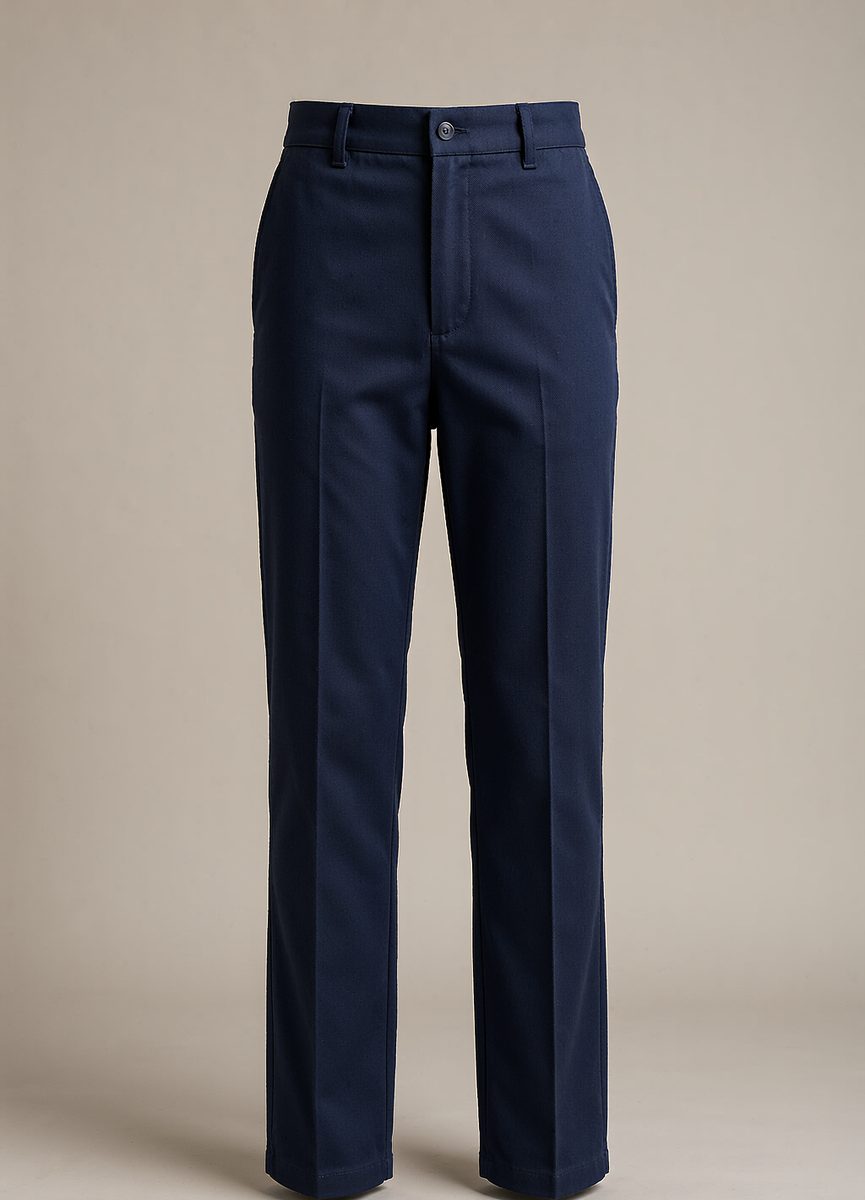
There is a cheap diagnostic in the sample room. Cut one leg, sew it, wash it three times, and hang it by the waistband with a weight on the hem. If the seam line rotates more than a couple of centimetres from where it started, the cloth has more skew than the pattern can absorb — and moving the marker will not fix it, because the problem is in the cloth.
The test below is the one we run, and it follows the same logic as the standard methods without requiring a laboratory. It is deliberately described in a way a buying office can repeat.
Mark. From the middle of the roll, cut a 50 × 50 cm piece. Mark three pairs of points 350 mm apart — one pair along the warp, one along the weft, one diagonally — using a contrasting thread and a steel rule, not a tape measure. Condition the cloth four hours at 20 °C and 65 percent relative humidity before the first measurement, and record each distance to the millimetre.
Wash. Three cycles at 40 °C with 20 g of mild detergent and a 600 rpm spin. Dry one piece on a line and a second in a tumble dryer on low, and keep a third unwashed as the control. Condition again for four hours, then re-measure all three pairs.
Read. Shrinkage is the percentage change in the warp and weft pairs. Skew is measured separately: after the third wash, lay the piece flat and measure how far the weft has moved from perpendicular across the 50 cm width, then express it in centimetres per metre so it is comparable with a mill's figure. The diagonal pair is the cross-check — on a square, unchanging piece it moves by the vector sum of the other two, and a diagonal that moves more than that means the panel has rotated.
Where a formal report is needed, the methods to cite are ISO 6330 for the washing procedure, ISO 5077 for the dimensional change and AATCC 179 for skewness change after laundering. Ask for the report against the production lot, with the lot number on it, rather than against the qualification sample.
Tolerances are not universal. A bag can carry more movement than a structured jacket, and an industrial uniform program can carry less than either, because it will be washed fifty times rather than ten. The bands below are what we would agree to in writing, and they are the bands we quote against.
| End use | Shrinkage limit (3 washes) | Skew limit | Why that number |
|---|---|---|---|
| Chinos, fashion trousers | ≤3% warp and weft | ≤2 cm per metre | Consumers notice leg length before they notice twist |
| Workwear and uniforms | ≤3% warp, ≤2.5% weft | ≤2 cm per metre | Industrial laundering adds cycles, not tolerance |
| Structured jackets, overshirts | ≤2.5% warp and weft | ≤1.5 cm per metre | A twisted front panel shows at the button stance |
| Bags, aprons, home | ≤4% | ≤3 cm per metre | No wearer to notice, but the seam line still shows |
| Anything pre-shrunk and labelled | ≤2% both directions | ≤1.5 cm per metre | The label is a promise, not a description |
The second table is the useful one for a specification argument, because it separates the sources of movement. When a lot fails on shrinkage, the first question is which line of the table it came from — yarn and loom tension, relaxation, or the wash regime — and the answer usually decides who pays for it.
| Where the movement comes from | What it affects | How much | Who controls it |
|---|---|---|---|
| Yarn and loom tension | Warp shrinkage | 3–5% of the 5–8% total | Mill: yarn count, loom let-off |
| Relaxation of the weave | Warp and weft | 2–3% | Mill: finishing, compression |
| Twill diagonal pull | Weft skew | 2–5 cm per metre of width | Mill: weft straightener, relaxation |
| Heat and agitation in the wash | Both, plus recovery | 1–2% additional after 3 washes | Buyer: wash regime, care label |
| Cutting against a skewed weft | Garment twist | Whatever the skew was, doubled at the seam | Cutting room: panel alignment |
One caution on both tables: a limit is only meaningful with the test method attached. “3 percent” measured after one cold wash on greige is not the same cloth as “3 percent” measured after three washes at 40 degrees on finished cloth, even though the number on the PO looks identical.
The split is cleaner than most quality arguments suggest.
The mill controls yarn quality and loom tension, the weft straightener, the compression setting and the relaxation time between finishing and rolling. It also controls the honesty of the quoted number: a mill that measures on greige, or after one wash, is not lying about the cloth so much as describing a different cloth.
The cutting room controls whether the marker is aligned to the weft or to the selvedge, whether panels from the same roll are kept together, and whether the lay is allowed to rest before cutting. Aligning to the weft costs a few centimetres of width and removes most of the twist.
The buyer controls the wash regime, the care label and the pattern allowance. A garment graded with no allowance for relaxation will fail at 3 percent, which is inside every tolerance in this article; a garment graded with the measured figure built in will pass at 5 percent. That is not a cloth problem, and it is the one variable that is entirely in the buyer's hands.
One thing nobody controls: the direction a consumer washes in. A 40-degree cycle with a low spin moves less than a 60-degree cycle with a high spin, and the label is a request rather than a guarantee. That is the argument for specifying a cloth whose worst case is still acceptable, rather than one that only passes under ideal handling.
Five lines, and they replace a paragraph of correspondence later.
Article and weave. MJ 3563, 3/1 right-hand twill, 250 GSM, 150 cm cut width, one direction only for the whole order.
Residual shrinkage. 3 percent maximum in warp and weft after three washes, measured on finished cloth, method ISO 6330 / ISO 5077, report per lot.
Skew. 2 cm or less per metre of width, measured across full width at head, middle and tail, with the AATCC 179 result after laundering attached.
Dye lot. Single lot per shade, lot number on each roll, and no mixing of lots inside one colourway — a lot change is a shrinkage change as well as a shade change.
Rest before cutting. Cloth to be relaxed flat for 24 hours after delivery and before spreading, recorded on the cutting ticket. This costs nothing and removes the most common avoidable failure in the list.
On the commercial side: MOQ is 300 metres per colour, stock shades ship in 7 to 10 days for MJ 3563, and FOB China port runs US $1.95 to $2.10 per metre depending on shade depth, packing and quantity. Payment is T/T 30/70 as standard, with larger orders by arrangement; CFR and CIF quoted on request. The cloth carries MTQS certificate MTQS-2026-000006.
Shaoxing Mujia Textile Co., Ltd. is a fabric manufacturer with its own weaving mill, established in 2012, registered in Zhuji, Zhejiang Province, China, with unified social credit code 91330681052809696P.
An untreated cotton twill moves 5 to 8 percent in the warp after a hot wash and rather less in the weft, because the warp carries the tension of the loom. Mechanically compressed cloth, usually called sanforised, is held to about 3 percent or less in both directions. MJ 3563 is mercerised and compressed, so the figure we work to is 3 percent maximum after three washes, measured on finished cloth rather than greige.
Skew is the angle the weft takes away from square after the cloth relaxes, quoted in centimetres of displacement per metre of width. A twill pulls as it relaxes because the diagonal is continuous, and if the weft is not straightened after finishing the panel is cut square to a selvedge that is no longer perpendicular to the warp. The garment is straight on the table and wraps around the leg after a few wears, because each wash lets the cloth continue to relax.
Partly. A weft straightener on the finishing line pulls the weft back towards square and is the main control a mill has. It cannot remove the internal stress that causes the cloth to move again, which is why the honest answer is control plus a number rather than a promise of zero. Anything below about 2 cm per metre of width is normally accepted for apparel; above 3 cm it will show in a garment.
Only if the programme is high-value and the cloth is not compressed, or if the garment will be washed hot by the consumer. A compressed twill at 3 percent does not justify the cost of a pre-shrink run. What does justify it is a first bulk where the wash test has not been done: one wash cycle before cutting costs less than one size run of returns.
It affects skew, not shrinkage. A right-hand twill and a left-hand twill pull in opposite directions, so mixing the two inside one order produces panels that twist opposite ways and a garment that will not hang straight. Shrinkage is set by yarn, tension and finishing, and does not change with the direction of the diagonal.
The MJ 3563 page carries the full specification, the five-page colour card and the stock position, and the cotton twill buying guide covers weight selection, the twill family and the faults that come back from the wash. If you are comparing this cloth with a heavier construction for bags or aprons, the heavy cotton twill canvas guide covers the 280 GSM end.
On the wider question of why woven cloth moves at all, the fabric shrinkage guide sets out the mechanisms and the test methods, and the fabric testing methods guide maps every standard quoted in this article. The MY 989 canvas page is the right starting point if the end use needs 300 GSM and above rather than 250.
If a specification is already drafted, send it: we will answer with the shrinkage and skew figures we can hold on the lot, or say plainly that we cannot.
Send the garment, the wash regime and the shade number. We will reply with the shrinkage and skew limits we hold on this lot, the test method behind them, and an FOB price against your packing.
Request a QuoteOr read the cotton twill overview · buying guide · general FAQ