Mill Notes · Cotton Twill
Twill Shading: Same Roll, Same Dye Lot, Two Colours
Mujia Textile · Fengqiao, Zhuji · November 20, 2026
A buyer opens a carton, pulls two pairs of trousers from the same lot, and holds them side by side in daylight. One is navy. The other is a slightly lighter navy with a faint bronze cast along the seam. Both were cut from the same roll. Both carry the same dye-lot stamp. The complaint that follows is a shade claim, and the reply that follows that is usually a long argument about dyeing, which is not where the problem is.
It is in the marker. On a twill, the direction of the weave changes the colour you see, and this is the single most common cause of a shade complaint that no dyehouse can answer.
The diagonal has a direction, and light follows it
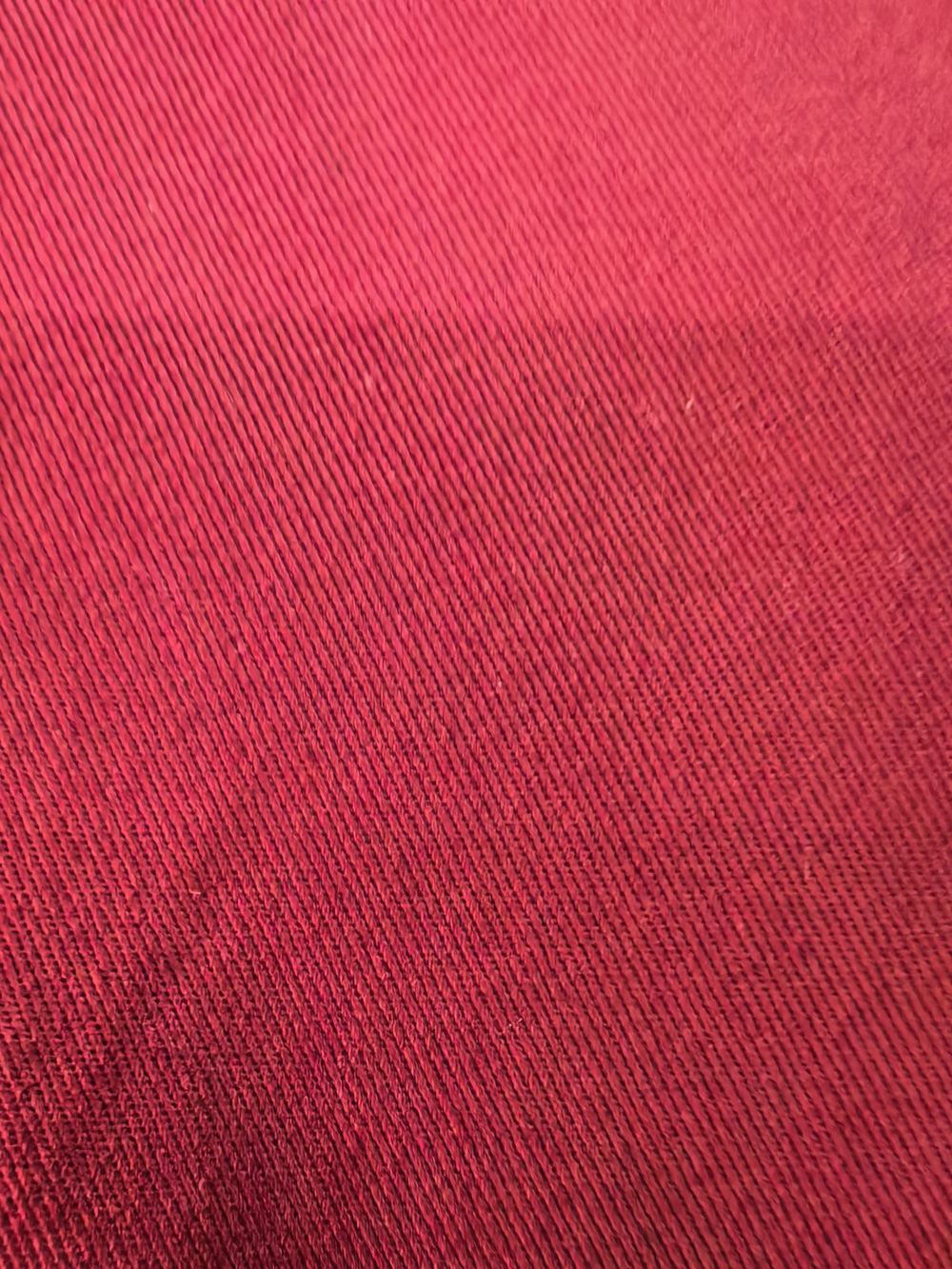
A 3/1 twill is built so that each warp end floats over three wefts before passing under one. Those floats are not scattered — they line up, pick after pick, into a continuous diagonal that runs across the face of the cloth at a constant angle. This is the diagonal a buyer reads as the character of the cloth, and it is also a surface of many small parallel cylinders.
Light hitting a cylinder reflects in a fan, brightest along the line where the angle of incidence matches the angle of view. Tilt the cylinder and the bright line moves. Because every float on a twill is aligned the same way, all those bright lines move together: look along the diagonal and the face reads lighter; turn the cloth through 180 degrees and the same face reads darker and slightly cooler.
Nothing has changed in the cloth. The yarn, the dye, the finishing and the weight are identical. What changed is the relationship between the float direction and the light source, and the eye reads that difference as colour because it has no other way to describe it.
This is not a dye-lot problem, and that decides who pays
The distinction matters commercially because the two failures have different owners. A dye-lot fault is ours: two rolls, two shades, one lot number, and we replace the cloth. Shading is not a fault in the cloth at all; it is a layout decision made after the cloth was delivered. A garment that shades is a garment that was cut both ways.
There is one genuine mill-side version of the problem, and it is worth knowing so it can be ruled out quickly: if the diagonal reverses within a single roll, the loom has faulted and the roll is not shippable. That is a weaving defect, it is visible on inspection, and it should never reach a cutting table. On a sound roll the diagonal runs one way from selvedge to selvedge for the whole length.
Everything else is the marker. Two sleeves cut in opposite directions, a pocket cut from an offcut turned around to save cloth, a yoke laid across the grain of the body — each of those produces a shade line that will be attributed to the mill and paid for by the mill unless the cutting room can show its layout was one-way.
The one-way rule, and why it costs cloth
The rule is simple: every panel in a garment is laid in the same direction, and no panel is rotated to fit. On a plain weave this costs nothing, because the cloth looks the same either way. On a twill it costs yield, because a pattern piece that could have been turned to fit into a gap can no longer be turned.
How much it costs depends on the garment. On a straight-leg trouser with a two-piece leg the loss is small, often inside the allowance you would carry anyway. On a garment with many small pieces — work jackets with patch pockets, flaps, epaulettes, belt loops — the loss is real and it has to be priced in before the order is quoted, not discovered at the cutting table. A factory that quotes one-way layout at the same consumption as two-way is either going to lose money or is going to quietly turn a piece.
Two practical consequences. First, ask your factory whether their quoted consumption assumes one-way layout, and get the answer in writing. Second, if the answer is no, decide whether you would rather pay the extra two or three percent of cloth or accept a shade risk — because those are the only two options, and the default when nobody decides is the second one.
What it looks like when a piece goes the other way
The failures are predictable, and each has a signature.
Left leg against right leg. The most visible, because the two panels sit next to each other in wear and in the shop. The difference is usually small and reads as a slightly different shade rather than a different colour, which is exactly why it survives inspection and fails at retail.
Sleeve against body. The sleeve is a small piece and the temptation to turn it into a gap is high. When it goes the wrong way the sleeve reads lighter or darker than the body at the armhole seam, and the line of the seam makes the difference look deliberate.
Pocket against panel. Patch pockets, flaps and cuffs are cut from offcuts, and offcuts are where pieces get rotated. A pocket that shades against its panel is the most common complaint on work jackets, and the one most easily blamed on the cloth.
Anything cut across the grain. A yoke or a waistband cut on the cross makes the diagonal run at ninety degrees to the body. The shade difference here is large enough to look like a different fabric rather than a different direction, and no amount of pressing corrects it.
Banding: when the seam draws the line itself
There is a second-order version of the problem that catches even factories with a one-way rule, and it appears when a panel is too long for the piece available and has to be joined.
Join two lengths of twill end to end around the correct way and the diagonal runs continuously across the seam — a good join, invisible from a metre away. Join them with one length turned and the diagonal reverses at the seam, meeting itself in a shallow V. The eye reads that V as a change of shade even when both lengths came from the same roll, because on one side the light is catching the float and on the other it is running along it.
This matters on trousers more than on any other garment, because the inside leg is the longest single piece in the style and the first place a cutting room runs short. It also matters on work jackets with a long body panel and on anything with a centre-back seam. The visible signature is a horizontal band of slightly different tone at hip height on one leg but not the other, which is exactly the pattern that gets reported as a dye fault.
The rule for joins is the same as the rule for panels: one direction throughout the garment, and if a join cannot be made continuous, move the join to a place where a seam already runs across the panel rather than adding a new one. A join hidden under a waistband or a pocket bag costs nothing. A join in the middle of a leg costs the order.
Why the inspection table never catches it
A four-point inspection on a rolling machine will find holes, oil, slubs, broken picks and the reversed diagonal inside a roll. It will not find ordinary shading, and it is worth understanding why, because a buyer who expects the mill's inspection report to cover this will be disappointed every time.
On a rolling machine the cloth passes one way, under one set of lights, at one angle. Every metre is seen from the same direction as the metre before it, so there is nothing to compare against. Shading only becomes visible when two pieces of the same cloth lie side by side at different angles — which is a condition that exists on a cutting table and almost nowhere else in the supply chain.
That is the structural reason this problem survives every checkpoint between the loom and the finished garment. The weaver cannot see it, because the roll is consistent. The inspector cannot see it, because the view never changes. The dyehouse has nothing to do with it. It becomes visible for the first time when a cutter lays a second panel next to the first, which is the last moment anyone can do anything about it — and only if the marker says so.
For a buyer, the useful consequence is this: do not ask for a shading guarantee in an inspection report, because no inspection can produce one. Ask for the one-way layout rule instead, which is a promise about the cutting room and can actually be kept.
Which shades show it, and which hide it
Shading is a reflectance effect, so it scales with how much light the surface sends back off the float rather than out of the body of the cloth. That makes it predictable from the colour and the finish.
| Shade or finish | How much it shades | Why |
|---|---|---|
| Navy, black, deep olive, burgundy | Most | Dark surface sends proportionally more light off the float |
| Mercerised mid-tones | Noticeable | Lustre sharpens the highlight along the diagonal |
| Sand, stone, ecru, pale grey | Slight | High body reflectance swamps the float highlight |
| Brushed or peach-finished surface | Almost none | The raised fibre diffuses light in all directions |
The practical reading: a programme built on pale shades can get away with a two-way marker and nobody will notice, while the same programme in navy cannot. If the colour card runs from ecru to black, the rule has to be written for the black end and applied to all of it, because switching layouts by shade inside one order is how a mixed carton gets built.
How to see it in five minutes, before anything is cut
Do this on the sample table, not on a screen.
Cut two squares of about 30 cm from the same roll. Lay them face up, one rotated through 180 degrees against the other, and butt their edges together without overlapping. Step back and look at the pair from the side, at roughly the angle a customer would see a hanging garment, under daylight or a window.
If a soft line appears where the two pieces meet, the cloth shades. If the two pieces read as one continuous surface from every angle you try, the cloth does not shade enough to matter for that colour, and a two-way layout is defensible. Try it a second time with the pieces rotated 90 degrees for the cross-grain case.
The lamp matters. A shop lamp directly overhead flattens the effect, because the highlight bounces back into the eye whichever way the floats run. Day from a window, at a low angle, is the test that matches what the customer will see.
Writing the rule where it will be read
Put it in three places, because each of them is read by a different person at a different time.
On the purchase order, as a line: all panels laid one direction, no piece rotated. That is read by the buying office when the order is placed.
On the marker itself, as a note in the margin with an arrow showing the direction. That is read by the cutter every time a lay is made, which is the only moment the rule can be broken.
In the tech pack, next to the fabric note, so that a factory quoting the style for the first time prices the consumption correctly rather than discovering the rule at the cutting table.
None of these is a substitute for the others. The order is the legal record; the marker is the working instruction; the tech pack is what keeps the next quote honest.
Where our responsibility ends
What we control: the diagonal runs one way for the full length of every roll, the shade is consistent within a dye lot, and the lot number is stamped on every roll so a claim can be traced to cloth rather than to a carton.
What we do not control, and will not pretend to: how the marker is laid in your cutting room. A roll that shades cannot be delivered un-shaded, because the shading is the weave. The most useful thing we can do is tell you, on the swatch, how strongly your chosen shade will show it — and that is a judgement we are happy to give in writing before you commit to the colour.
MJ 3563 is a 3/1 twill, 250 GSM, 150 cm cut width, 143 colours, mercerised and mechanically compressed. The diagonal is the point of the cloth, and the same diagonal is why it has to be cut one way.
Frequently asked questions
Why do two garments from the same roll look like different colours?
Because the panels were cut in different directions. A 3/1 twill lays its floats on a diagonal, and light reflects off those floats differently depending on whether you look with the diagonal or against it. The cloth is the same; the angle is not. This is called shading, and it is not a dye-lot fault.
Is this a defect I can claim against the mill?
Only if the cloth was delivered with the pile or the diagonal running in both directions within the same roll, which is a weaving fault and rare. If the roll is consistent and the garment shows two shades, the marker was laid both ways and the cost sits in the cutting room, not the dyehouse.
How do I check for it before cutting?
Cut two pieces about 30 cm square, turn one through 180 degrees so the diagonals oppose, and butt them together on a flat table. Look at them side-on under daylight rather than straight down under a lamp. If a line appears where they meet, the cloth shades and the marker has to be laid one way.
Which colours show it most?
Dark, saturated and lustrous shades show it most, because a dark surface reflects proportionally more of its light off the float and less from the body of the cloth. Pale and matte shades show almost nothing, which is why a buyer who approved a natural swatch can be surprised by navy.
Does a different weave solve it?
A 2/2 twill shades less because the float is shorter and balanced front and back, and a plain weave hardly shades at all. But a 2/2 is a lighter-duty cloth and a plain weave has none of the abrasion resistance workwear needs. You are trading a cutting-room rule for a performance loss, and the rule is the cheaper of the two.
What goes on the purchase order?
One line: all panels to be laid in one direction, no piece rotated to save cloth. Put it on the marker as well, because the order is read once and the marker is read every time a lay is made.
Send the colour, and ask us how strongly it shades. We will answer on the swatch, before you commit to the shade — a navy and an ecru on the same construction do not carry the same layout cost.
Or read the cotton twill overview · buying guide · shrinkage and skew