Eyelet Lace on Children’s Wear: A Safety Checklist
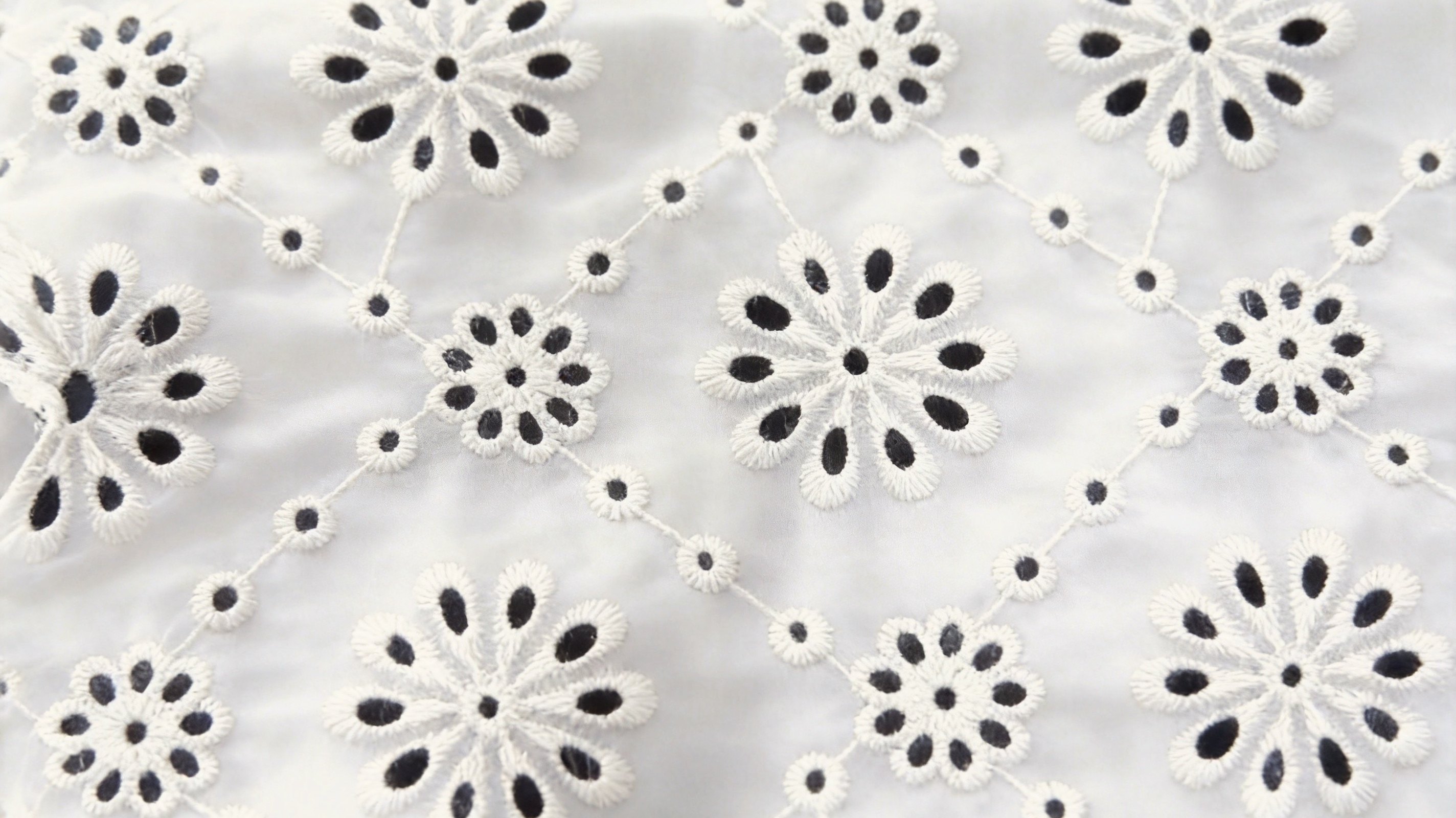
Table of Contents
- Introduction
- Why Eyelet Is Different From Plain Cotton
- The Four Gateways Every Order Passes Through
- Small Parts: The 31.7 mm Cylinder
- Sharp Edges and the Hole Rim
- Formaldehyde, Azo Dyes and the Chemistry Question
- Cords, Drawstrings and the Eyelet Row
- Flammability and Sleepwear
- What to Put in the Purchase Order
- How to Test Without Burning a Season
- What We Supply, and What We Do Not Claim
- Frequently Asked Questions
- Standards and Regulations Cited
Introduction
Eyelet — broderie anglaise, in the older trade language — is one of the few fabrics that is bought for a hole. The pattern is not printed onto the cloth and it is not woven into it. It is embroidered, then the enclosed areas are cut or punched away. What remains is a cotton ground held together by a ring of satin stitch around every opening.
That construction is the reason childrenswear buyers treat it differently from plain cotton. A plain cotton shirt has one mechanical failure mode worth discussing: the seam. An eyelet dress has three. The embroidery thread can be picked or pulled. The hole rim can be cut sharp. The ground between two adjacent holes can be narrow enough to tear. None of these are dyeing or weaving problems, and none of them will be caught by a standard four-point inspection, because the fabric can be perfectly free of weaving defects and still fail a child-safety test.
This guide is written from the mill side of that conversation. It sets out what the regulations actually ask, which of them the fabric can influence and which it cannot, and how to write the requirement into a purchase order so that the answer arrives before the container does rather than after.
Why Eyelet Is Different From Plain Cotton
If you are new to the construction, the related guide on how eyelet fabric is bought covers the commercial basics. What matters here is the geometry.
An eyelet pattern is a lattice. Between any two holes there is a bridge of ground cloth, and that bridge carries the stress of the garment. When designers supply artwork, the two numbers that decide whether the fabric is safe to cut for children are the hole diameter and the minimum bridge width. A pattern with generous bridges behaves like a normal woven fabric with decorative openings. A pattern with narrow bridges behaves like a perforated sheet, and it tears along the perforation line — usually at the seam allowance, where the bridge is already carrying load.
Embroidery thread adds the second variable. The satin stitch ring that finishes each hole is a continuous filament or staple yarn looping through the ground. It is anchored, but it is anchored by tension, not by a knot. A determined three-year-old can find the end of a broken stitch and pull. What comes away is a length of thread, and a length of thread is a component.
The point buyers miss: a fabric can pass every colourfastness and shrinkage test you specify and still be unsuitable for the infant band, because the limiting factor is the pattern geometry, not the cloth quality. Ask for the hole diameter and the minimum bridge before you ask for the price.
The Four Gateways Every Order Passes Through
Childrenswear compliance is usually discussed as a single subject, which is why it feels opaque. In practice an eyelet order passes through four separate gateways, and each one is answered by a different party.
| Gateway | What it asks | Who answers it |
|---|---|---|
| Mechanical safety | Can anything separate and be swallowed? Is any edge sharp? Does a cord create a strangulation or entanglement risk? | Garment maker, using fabric data from the mill |
| Chemical safety | Formaldehyde, azo dyes, heavy metals, pH, extractable substances. | Mill and finisher, with third-party reports |
| Flammability | Does the fabric burn faster than the market allows, and is it sleepwear? | Mill for the base fabric, garment maker for trims |
| Labelling and traceability | Fibre content, care claims, origin, batch traceability. | Mill for composition and batch, brand for the rest |
The reason to separate them is commercial. If a shipment is rejected, the conversation is far shorter when everyone already knows which gateway failed. Most disputes that run for weeks are disputes about category, not about facts.
Small Parts: The 31.7 mm Cylinder
The best-known mechanical rule in the United States is the small parts requirement for children under three, set out in 16 CFR 1501. The test apparatus is a cylinder 31.7 mm in diameter and 57.1 mm deep, which approximates the fully expanded throat of a small child. A component that fits entirely inside that cylinder, without being compressed, fails.
For eyelet fabric the question is not whether the fabric fits — it does not — but whether anything attached to or generated by the fabric does. In our experience the candidates are:
- Applied decoration on top of the embroidery. Beads, sequins, pearls, small bows. These are chosen by the designer, not by the mill, and they are the most common failure in the category.
- Loose embroidery thread. A satin stitch ring that has been abraded until the thread breaks and hangs free. The rule addresses components that can be separated, not only components that are already detached, so a design where the stitch ring is easily picked is exposed.
- Cut-out circles that were punched but not removed. A production defect rather than a design one: if the punching station misses a hole, the plug can remain attached by a few fibres and later fall free.
Two practical consequences. First, if the garment is for the infant band, it is worth specifying no applied decoration as a line in the purchase order, because it removes the entire category of risk at zero cost to the fabric. Second, ask the mill what happens at the punching station when a plug fails to detach — the good answer is that it is caught at inspection and removed, not left for the customer to discover.
Sharp Edges and the Hole Rim
The sharp edge and sharp point rules (16 CFR 1500.48 and 1500.49 in the United States, and equivalent provisions in most other markets) exist because a cut edge on a rigid material can lacerate. Textile is not rigid, so eyelet fabric rarely fails on this basis by itself. The risk appears at two places.
The first is the hole rim after a heat-based cutting process. Laser cutting and hot punching seal the edge, which is excellent for fraying and poor for softness: the sealed rim is a hardened ring of melted fibre. On a collar or a cuff, where the rim sits against the neck or wrist, a hardened rim is a comfort complaint at best. It is worth asking which cutting method the mill uses, because the two produce visibly different edges — a cold-punched rim is soft and slightly fibrous, a laser rim is smooth and hard.
The second is the applied trim: metal eyelets, grommets, hook-and-eye closures, snap fasteners. These are hardware and they are governed as hardware. If any hardware is used on the eyelet garment, it needs its own sharp-edge check and its own nickel-release statement in markets that require one.
The fabric-side answer is straightforward: specify that holes are punched or embroidered-and-cut, not laser-sealed, unless the design brief genuinely requires a sealed edge. On childrenswear it usually does not.
Formaldehyde, Azo Dyes and the Chemistry Question
Chemistry is where the mill carries the most responsibility and where buyers ask the fewest specific questions. Three figures are worth knowing by heart, because they come up in every infant order.
| Substance | China — GB 18401 | Notes |
|---|---|---|
| Formaldehyde, category A (infants) | ≤ 20 mg/kg | Applies to textile products for infants 36 months and under |
| Formaldehyde, category B (direct skin contact) | ≤ 75 mg/kg | The category most childrenswear falls into above the infant band |
| Formaldehyde, category C (non-direct contact) | ≤ 300 mg/kg | Outerwear, decoration |
| Decomposable carcinogenic aromatic amines (azo) | Not permitted, 20 mg/kg | REACH applies a comparable restriction in the EU |
| pH | A: 4.0–7.5 · B: 4.0–8.5 · C: 4.0–9.0 | Relevant because resin finishing can shift pH |
Why this matters specifically for eyelet: the fabric usually goes through a finishing route that includes a softener and, for some constructions, a resin or anti-crease step to keep the embroidery from collapsing in the wash. Formaldehyde is one of the chemistries that can appear in that step. A mill that does not control its finishing recipe can produce a fabric that is visually perfect and chemically out of spec for the infant band.
OEKO-TEX Standard 100 Class I is the usual commercial shorthand for the infant band, and its limits are stricter than the Chinese national standard in several categories. If your customer's label requires Class I, say so at enquiry stage, not at shipment, because the certified route may use a different softener system and the cost difference is real but small.
Ask for the number, not the assurance. “Formaldehyde-free” is a marketing phrase. A report number with a measured value against a named standard is evidence. If a mill cannot produce one for the batch you are buying, that is information too. For a broader map of which certificates mean what, see our guide to sustainable fabric certifications in China.
Cords, Drawstrings and the Eyelet Row
This is the failure that catches experienced buyers, because it is created by the garment design rather than by the fabric, and it is created after the fabric has been approved.
A row of eyelet holes at a neckline is a classic childrenswear detail. It is also, functionally, a set of ready-made cord channels. The moment a cord is threaded through them, the garment enters the scope of EN 14682 in the EU and the corresponding US rule for drawstrings in the hood and neck area of upper outerwear. Those rules restrict cord length, free ends, toggles, and whether a cord is permitted at all in the hood and neck region for given age bands.
The distinction to hold on to: an eyelet row with no cord is decoration; the same row with a cord is a regulated component. Both are legitimate products. They are not the same product. If you are developing a style, decide which one it is before the fabric is ordered, because the answer changes the pattern, the trim list and the testing scope, and changing it later means re-testing.
Two practical checks:
- Age band first. The cord rules tighten sharply for younger children. A style that is compliant at size 10 may not be compliant at size 2 even in the same fabric.
- Free-end length. If a cord is used, the free ends are measured, not estimated. Specify the finished length in the tech pack and verify it on the first sample rather than on the shipment.
Flammability and Sleepwear
Flammability is the gateway most often ignored until the first test report arrives. In the United States, ordinary clothing textiles fall under 16 CFR 1610, which classifies fabrics by burn rate into three classes; Class 3 fabrics are generally not permitted for apparel. Children's sleepwear has its own, stricter standards (16 CFR 1615 and 1616) with a different test method and a mandatory requirement that the garment self-extinguish.
Cotton eyelet, being a cellulosic fabric with an open structure and a high surface area around each hole, burns readily. It is not a fabric that passes sleepwear requirements without flame-retardant treatment, and a flame-retardant treatment on an infant garment raises chemistry questions of its own. This is worth stating plainly because it saves time: eyelet is a daywear fabric. If a customer asks for eyelet sleepwear, the honest answer is that it needs a different construction or a treated fabric with the corresponding documentation, not simply a different label.
For daywear, the practical requirement is a valid 16 CFR 1610 report for the base fabric, renewed when the finishing recipe changes. A change of softener can change the burn result, which is why reports tied to a batch and a finishing recipe are worth more than reports tied to a fabric name.
What to Put in the Purchase Order
The commercial value of this article is concentrated in this section. Below is a clause list that has survived actual audits. It is not legal advice, and it does not replace your compliance team, but it does remove the ambiguities that cause most delays.
- Destination market and age band. One line each. “US, 0–3” is a specification. “Childrenswear” is not.
- Named standards and test items. List them, and list the limits where you know them. Vague references to “meeting all applicable regulations” shift the argument rather than settling it.
- Hole geometry tolerance. Nominal hole diameter plus a tolerance, and the minimum bridge width. This is the fabric-side specification that governs mechanical strength.
- Cutting method. Punched, embroidered-and-cut, or laser-sealed. State it if the rim softness matters.
- No applied decoration, or a specified decoration with its own test route. On the infant band, the simpler clause is better.
- Formaldehyde and pH values with report numbers. Batch-referenced, not sample-referenced.
- Laboratory and recognition. If the market requires a recognised lab, name the recognition in the PO. A report from an unrecognised lab is an expensive document that proves nothing.
- Report age at shipment. Twelve months is a common and sensible bar.
- Sampling plan. Which lots are tested, how often, and who pays for a failure. Tests are cheap relative to a rejected container; allocate the cost in the contract rather than arguing later.
- Traceability. Batch or lot code on the roll label, linked to the test report. Without this, a passing report cannot be tied to the cloth in the carton.
How to Test Without Burning a Season
Buyers new to the category often commission a full battery on the first sample and then discover that the result is not transferable to bulk, because the bulk used a different finishing batch. A more efficient sequence:
- Development stage: chemistry only. Formaldehyde, pH, azo dyes. These are cheap, fast, and they tell you whether the mill's finishing route is fundamentally capable of serving the market you are selling into. There is no point testing mechanical properties of a fabric whose chemistry you are about to change.
- Pre-production stage: mechanical and flammability. Hole geometry on the actual production artwork, bridge strength, and 16 CFR 1610 on the finished recipe.
- During production: in-line checks on hole punching and thread anchoring, plus a retained sample per lot. Retained samples are what make a dispute resolvable.
- At shipment: verify the report references the shipped lot. This single step catches most documentation failures.
One more economy that experienced buyers use: test the extremes. If a style exists in three colourways and two hole sizes, test the darkest colour and the largest hole, because those are usually the worst cases for chemistry and for bridge strength respectively. That is not a substitute for a testing plan, but it is a rational way to reduce the number of lots.
What We Supply, and What We Do Not Claim
To be precise about the boundary, because precision here is more useful than enthusiasm.
Our eyelet fabric is 100% cotton, 100–130 g/m², 135 cm usable width, FOB US$2.3–2.7 per metre, MOQ 300 metres per design, around 10 working days after approval. The embroidery and the punching are done as one process, with the hole rim finished by satin stitch so that the edge is soft rather than sealed. We can supply the hole diameter and the minimum bridge width for any design you are considering, and we will say plainly when a design is too open to be sensible for childrenswear.
What we do not do is certify your garment. A fabric mill can provide test data for the cloth it made, and can tell you which laboratory produced it and which standard was used. It cannot tell you that a dress made from that cloth is compliant, because compliance depends on the pattern, the trims, the cords, the labelling and the age band — none of which the mill controls. Any supplier who offers to certify your finished garment is describing something they cannot do.
Where a customer needs a specific certificate, the useful conversation happens at enquiry stage: tell us the market, the age band and the standard, and we will tell you what we can document for the batch and what you will need to test yourself. That conversation costs one email. Skipping it costs a season.
Frequently Asked Questions
Q1: Is eyelet lace considered a choking hazard on children’s clothing?
The fabric itself is not. The risk comes from what the eyelet construction adds: embroidery thread that can be pulled loose, small decorative pieces applied on top of the embroidery, and cut-out circles that create finger-hold points. Under the US small parts rule (16 CFR 1501), any component that separates from garments intended for children under three must not fit entirely inside the test cylinder. Loose embroidery thread that has been torn away is exactly the kind of component that gets tested.
Q2: Which regulations apply to eyelet fabric used in children’s clothing?
It depends on the market and the age band, not on the fabric. In the United States the usual gateways are the small parts rule, the sharp point and sharp edge rules, lead and phthalate limits under CPSIA, drawstring requirements for upper outerwear, and the clothing flammability standard. In the EU they are REACH restrictions, the cords and drawstrings standard EN 14682, and the General Product Safety Regulation. In China, GB 31701 sets out the A, B and C safety categories for infants and children. A fabric mill can supply test data but cannot certify a finished garment.
Q3: Does formaldehyde matter for eyelet cotton?
Yes, because eyelet fabric usually goes through a finishing route that includes a resin or anti-crease step, and formaldehyde can be part of that chemistry. China’s GB 18401 caps formaldehyde at 20 mg/kg for category A (infants), 75 mg/kg for category B (direct skin contact) and 300 mg/kg for category C. OEKO-TEX Standard 100 Class I applies the strictest limits to articles for children under three. If you are buying for the infant band, ask for the formaldehyde figure in writing with a report number, not a verbal assurance.
Q4: Can eyelet holes be used for drawstrings?
They can be used as a design feature, but a cord threaded through them changes the compliance picture completely. EN 14682 restricts cords and drawstrings in the hood and neck area of children’s clothing, and the US has a separate rule for drawstrings in the hood and neck of upper outerwear. A decorative eyelet row at the neckline with no cord through it is usually fine. The same row with a cord running through it is a different product with different obligations. Decide which one you are making before the fabric is ordered.
Q5: What should the purchase order say about eyelet safety testing?
Name the destination market, the age band, the standard, the test items, the sampling plan and who pays. Also require the report to be issued by a laboratory accepted in that market, to be less than twelve months old at shipment, and to reference the actual production batch rather than a development sample. Finally, state the hole geometry tolerance, because a hole that drifts in size between sampling and bulk is a change to the product, not a cosmetic variation.
Related Guides
- Cotton Eyelet Fabric: A Buyer’s Guide
- Eyelet Artwork and Hole Specification: How to Brief a Mill
- Eyelet Finishing: What It Does to Hole Shape
- Double Gauze for Babies: Which Certificates Actually Apply
- Sustainable Fabric Certifications in China
- Fabric Quality Control & Inspection Guide
- Fabric Testing Methods: The Complete Map
- How to Read a Fabric Specification Sheet
Standards and Regulations Cited
The instruments behind the requirements described in this guide:
- 16 CFR 1501 — Method for identifying toys and other articles intended for use by children under 3 years which present choking, aspiration or ingestion hazards — the small parts cylinder test.
- 16 CFR 1500.48 and 1500.49 — Sharp point and sharp edge test methods — the mechanical safety tests referenced above.
- 16 CFR 1610 — Standard for the flammability of clothing textiles — the daywear burn test.
- 16 CFR 1615 and 1616 — Flammability of children’s sleepwear — the stricter sleepwear standards.
- US CPSC — Business guidance on CPSIA — lead, phthalate and testing obligations for children’s products.
- GB 31701-2015 — Safety technical code for infants and children’s textile products — the Chinese A/B/C safety categories.
- GB 18401-2010 — National general safety technical code for textile products — formaldehyde, pH and azo limits quoted in this article.
- OEKO-TEX Standard 100 — product classes I to IV and their limit values.
- EN 14682 — Safety of children’s clothing: cords and drawstrings — the European cord and drawstring standard.
- REACH Annex XVII — Restrictions on hazardous substances — the EU chemical restrictions including azo dyes.
Eyelet Artwork and Hole Specification — Hole diameter, bridge width and repeat determine whether the fabric is usable. How to brief the mill so the first sample is the right one...