Gingham Matching Loss: Where 15–25% of Your Cloth Actually Goes
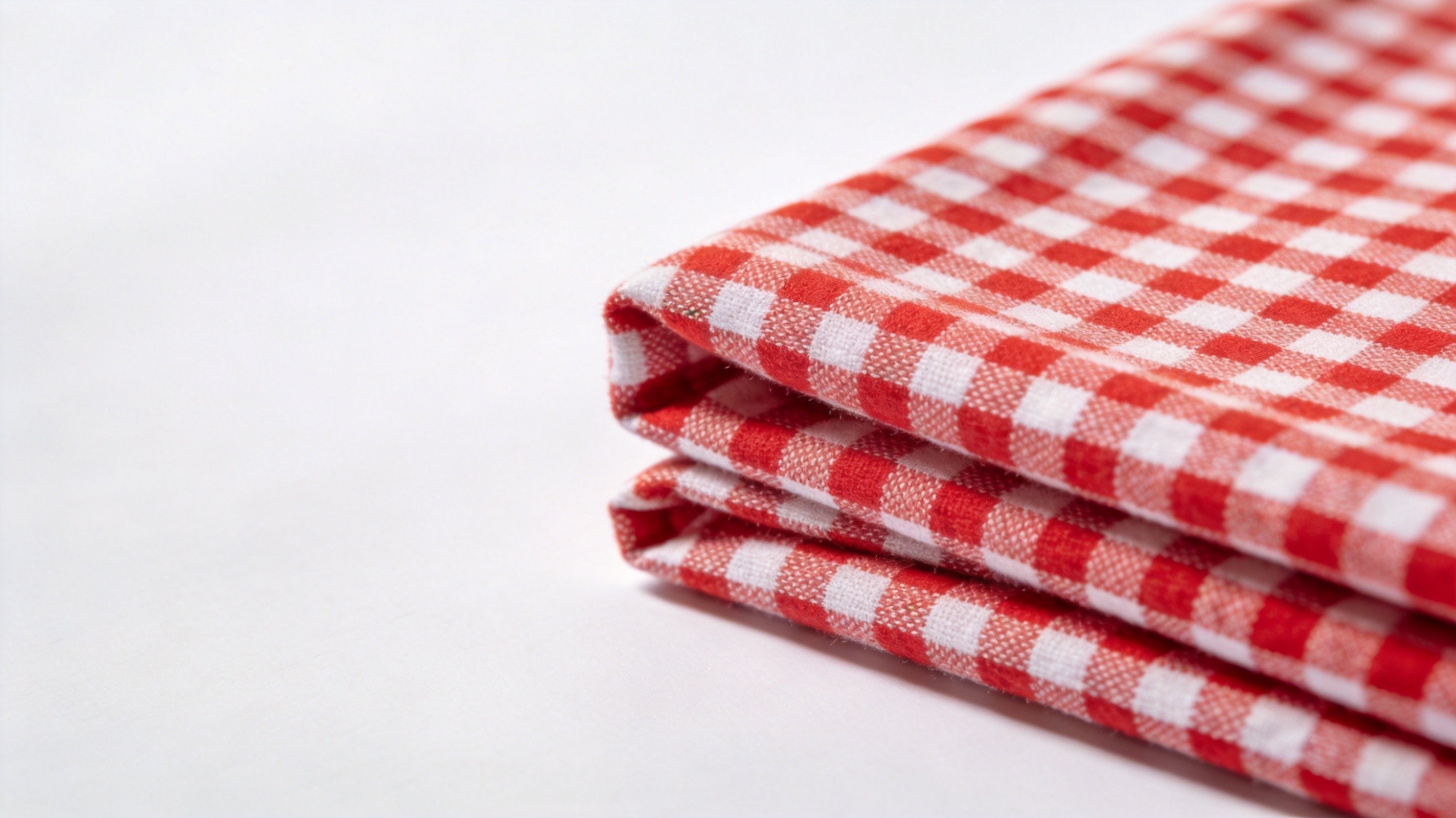
Short answer: A check must line up across every seam, so the repeat distance — not the fabric weight — sets your marker loss. On a 100 GSM yarn-dyed gingham the typical penalty is 15–25% over a plain cloth. Symmetric panels and mirrored nesting recover roughly 5–8 points of that before a single metre is cut.
Table of Contents
- Why a check costs more than a plain cloth
- The repeat is the unit of waste
- The three places loss actually occurs
- Four cutting choices that pull it back
- Specification: the 7702 programme
- What to ask before you cut
- Frequently asked questions
Why a check costs more than a plain cloth
Two fabrics at the same weight and the same width do not cost the same to cut. A plain cloth can be laid and cut wherever the marker fits. A check cannot: the horizontal and vertical lines have to meet at the seam, or the garment reads as a mistake from three metres away. That constraint is what buyers are paying for when a gingham programme comes in above the plain-cloth budget, and it is almost never written into the costing sheet.
The loss is real but it is not random. It is a function of three things — the repeat distance, the size of the panels, and the way the marker is nested — and all three are knowable before the order is placed. A buyer who asks for the repeat distance and the panel dimensions can estimate the loss within a few points, which is the difference between quoting a margin and discovering one.
The repeat is the unit of waste
A yarn-dyed check is built from repeating blocks of colour in both warp and weft. The distance from one block boundary to the next is the repeat, and the repeat is the smallest unit that can be aligned. Panels cannot be shifted by half a repeat; they shift by whole repeats, or the lines break at the seam.
That single rule generates most of the loss. A panel whose length is not a whole multiple of the repeat has to be cut at a repeat boundary anyway, so the remainder between the last boundary and the panel edge is discarded. Short panels waste proportionally more than long ones, because the remainder is a larger fraction of the whole.
The same logic runs across the width. A gingham has to be matched horizontally as well as vertically at side seams, centre-front, centre-back and any yoke or pocket. Each of those seams is a matching constraint, and each constraint narrows where the pattern pieces can sit.
The three places loss actually occurs
When a buyer sees a 15–25% penalty on a costing sheet, it comes from three distinct sources. Separating them makes the number negotiable.
One: repeat remainder. The offcut between the last usable repeat line and the end of the lay. This is the largest single component and the one most affected by panel length.
Two: matching allowance at seams. Each matched seam needs enough cloth on both sides to position the pattern before stitching. On a check with four or five matched seams per garment, those allowances accumulate.
Three: directional and structural constraints. If any panel is cut on a single direction — and on a check, panels cut in opposite directions look different under light because the weave direction changes — then the marker cannot mirror those pieces, and mirroring is exactly the tool that saves cloth.
Naming which of the three dominates a given style is the first step to reducing it. A long-panel dress with two matched seams behaves nothing like a short-panel top with five.
Four cutting choices that pull it back
- Design panels to the repeat. If the tech pack is still open, adjust panel lengths so they divide cleanly by the repeat. A 2 cm change in a hem length can remove an entire remainder band from every panel in the marker.
- Mirror the symmetric pieces. Left and right fronts, sleeves and pocket pairs can usually be cut in mirrored pairs, which fills the lay with no extra matching constraint. This is the single largest recovery available on most styles.
- Group by repeat tier. Where a range uses two or three checks, cut each check as a separate lay rather than mixing them. Mixed lays force the marker to satisfy every constraint at once.
- Accept an unmatched seam where the customer will not see it. Underarm seams, inside facings and linings are usually invisible in wear. Specifying them as unmatched removes constraints at no visual cost — but it has to be written into the tech pack, because the cutting room will otherwise match everything by default.
Together these typically recover 5–8 percentage points of the penalty. They do not eliminate it, because a check that lines up at every visible seam genuinely needs more cloth than a plain one. What they do is turn an unexplained surcharge into a number that can be planned and quoted.
Specification: the 7702 programme
| Parameter | 7702 cotton gingham |
|---|---|
| Composition | 100% cotton, yarn dyed |
| Construction | Plain weave check |
| Weight | 100 GSM |
| Width | 145 cm |
| Designs | 7 classic check patterns (A–G) |
| Colourways | Approx. 13 per design, 91 in total |
| FOB price | USD 1.72–1.82 per m |
| MOQ | 300 m |
| Matching loss (typical) | 15–25% over plain cloth, repeat-dependent |
The 91-colour stock range is the commercial counterweight to the matching problem. A buyer building a coordinated range — same check, several colourways — can pull from stock without a dye lot minimum per colour, which means the loss is calculated on the cloth actually used rather than on a minimum order that has to be absorbed. How those terms work is set out in the MOQ and payment guide.
It also matters that 7702 is yarn dyed rather than printed. On a yarn-dyed check the pattern is in the yarn, so it cannot shift or fade in the way a printed check can, and the reverse of the cloth carries the same pattern. That is why it is the right base for a garment where the inside of a cuff or a turned hem will be seen. A printed check is a different product with a different cost structure — the distinction is set out in the gingham sourcing guide.
What to ask before you cut
Three questions to the mill, and two to your own pattern room, settle the loss before it is incurred:
- What is the repeat distance in both directions? In centimetres, warp and weft separately. Without this number the loss cannot be estimated at all.
- Is the repeat symmetric or offset? An offset repeat constrains nesting differently from a symmetric one.
- Are there any direction-specific panels? Ask your pattern room which pieces cannot be mirrored, because those are the pieces that consume the lay.
- Which seams must match? Write the answer into the tech pack as an explicit list, not as "match all seams."
- What is the shrinkage on first wash? A check that moves 2% on washing will no longer align at the seam it was cut to, so the loss calculation has to include the allowance.
The shrinkage point catches buyers more often than the matching point. A gingham cut to match perfectly at the cutting table can be visibly out of register after the first domestic wash if the cloth was not pre-shrunk or the allowance was not carried. Our shrinkage guide covers the testing side, and the inspection guide covers what to check on the lot before cutting.
Frequently asked questions
How much extra fabric does a gingham need?
Typically 15–25% over a plain cloth of the same weight. The figure depends on the repeat distance, the panel sizes and how many seams must match. It is not a fixed property of gingham as a category.
Why does a check waste more cloth than a stripe?
A stripe only has to match in one direction. A check has to match horizontally and vertically at every visible seam, so each seam narrows where the pattern pieces can be placed in the lay.
Can the loss be reduced after the design is set?
Partly. Mirroring symmetric panels, separating lays by repeat tier and specifying invisible seams as unmatched typically recovers 5–8 percentage points. The remainder is inherent to matching.
Is yarn-dyed gingham more expensive than printed gingham?
They are different products with different cost structures. Yarn-dyed carries the pattern through the cloth and does not fade or shift like a print, which is why it is used where the reverse side will be seen. Compare them on the garment requirement, not on price per metre alone.
Does gingham shrink after washing?
Cotton gingham will move on first wetting unless it has been pre-shrunk. Wash a sample before cutting and build the marker from the washed dimensions, otherwise a seam that matched at the cutting table will be out of register after the first wash.
Cost the check, do not discover it
Gingham matching loss is the most predictable cost in a check programme and the one most often left out of the quotation. It comes from the repeat, the panels and the seam list — three things that are known before the order is placed.
Ask for the repeat in centimetres, write the matching seam list into the tech pack, mirror what can be mirrored, and cost the loss deliberately. At 100 GSM, 145 cm and 91 stock colourways, the 7702 programme gives a buyer enough colour depth to build a range without a dye lot minimum per shade — which leaves the matching problem as the only variable worth optimising.
Mujia Textile — running our own air-jet looms in Zhuji since 2012.