Short answer. Seersucker fabric is a two-layer cotton gauze where the crinkle is locked in by tie points woven between the two layers. It is structural, so the texture returns after washing. Our M4011 runs 125 GSM, 135 cm cuttable width, 100% cotton, GB 18401 Class A (infant-safe), 182 colours woven ahead, MOQ 300 m per colour, FOB USD 1.40–2.20/m, 15 days after colour approval.
The cheaper alternative — caustic shrinking a flat woven cloth after printing — looks identical on a sample card and goes flat within 10–15 washes. Ask which one you are being quoted before you compare prices.
What seersucker fabric is, and why the crinkle type decides everything
Seersucker is not a fibre and not a print. It is a construction: two light cotton gauze layers are woven together with periodic tie points, and the slack between those ties puckers into the permanent ridges buyers recognise. Because the puckering comes from the weave, nothing has to be added to the surface to create it, and nothing can wear off.
Our style is M4011: 100% cotton, 125 GSM, 135 cm cuttable width, two-layer gauze with tie-point crinkle. The cloth is light enough for summer dresses, blouses, childrenswear and bedding, and opaque enough at 125 GSM to be used unlined for most shirting and dress applications. The crinkle is a structural property. It returns after washing, and it cannot fade, because there is no surface treatment to lose.
The other route: caustic shrink
A large share of what is sold as seersucker in the market is ordinary flat woven cotton that has been caustic-shrunk after printing. Caustic soda attacks the fibre unevenly and pulls the cloth into a crinkle. It is cheaper, it can be applied to almost any base cloth, and on a folded sample it is hard to tell apart from a woven crinkle.
The behaviour in bulk is not the same. Caustic crinkle relaxes progressively: typically the hand flattens over 10–15 home washes and the garment starts to look like a plain cotton dress that has been badly ironed. Woven crinkle does the opposite — it tightens slightly on the first wash and then holds. If your program is a repeat order or a retail line with a wash-care claim on the label, this is the single specification that matters more than price.
We wrote the technical comparison separately, including how the two routes behave in the wash and what to put on the care label: woven tension versus caustic shrink in seersucker crinkle.
Three names, one cloth: seersucker, double gauze and bubble gauze
The naming is the second place buyers lose money, because the name in the inquiry often decides which factory quotes and at what price.
In the US and UK trade, the cloth is seersucker fabric. In continental Europe and Japan the same construction is normally called double gauze. In the childrenswear and bedding trade it is frequently sold as bubble gauze fabric or muslin. Chinese mills call it shuang ceng zou bu — double-layer crinkle cloth.
In our range these are one fabric, not three: the same M4011, the same 125 GSM, the same tie-point crinkle. What changes is the buyer's market and therefore the end use — seersucker is asked for in shirting and dresses, double gauze in babywear and swaddles, bubble gauze in bedding and layette programs. Knowing that saves a sourcing round: if a supplier tells you they stock seersucker but not double gauze, ask them what the construction is, not what the name is.
The product page carries the full colour range and the technical sheet: M4011 seersucker fabric at 125 GSM.
Choosing a seersucker fabric manufacturer: five questions before you approve a sample
Most sourcing decisions on this fabric are made on a swatch that looks right and a price that looks low. Five questions separate a mill that weaves from a trader that resells, and each one has a checkable answer.
1. Is the crinkle woven in, or applied after?
Ask for the construction, not the name. “Two-layer gauze, tie-point crinkle” is a woven answer; “crinkle finish” usually means caustic. If the supplier cannot answer in construction terms, the price you are comparing is not for the same product.
2. Is the weight measured or quoted?
125 GSM is a measured figure on finished cloth, not a nominal one from a yarn count. Ask for the weight of the finished, washed piece. A fabric quoted at 120 GSM that arrives at 108 GSM will read as thin in the garment and will not hold the crinkle as tightly.
3. Which colour card version am I looking at?
Colour ranges get re-dyed. Ask for the card revision and the dye lot for the shades you plan to use, and keep the physical card you approved. A digital range on a website is a reference, not a colour standard.
4. What is the shrinkage, measured how?
Crinkle cloth moves. Ask for shrinkage after one wash to a named method (ISO 6330 or AATCC 135), warp and weft separately, and cut a test garment before bulk if the fit is tight. Our test reports are available per order.
5. Which safety class, and can I see the report?
For childrenswear and bedding this is not optional. M4011 is GB 18401 Class A — infant-safe. Ask for the report number and the product class on it, and check that the class matches the item you are making, not the item the mill usually makes.
Payment terms, deposit practice and how the balance is settled are the other half of the same conversation; we keep them in one place: MOQ and payment terms for mill-direct fabric orders.
Crinkle fabric wholesale: weight, width and colour minimums
The commercial shape of this fabric is set by three numbers.
125 GSM. Light enough that 300 m makes roughly 120–160 dresses depending on style and lining, heavy enough to be used unlined. Below about 110 GSM the cloth starts to read as muslin rather than seersucker in garments; above about 140 GSM it stops puckering cleanly at the same tie spacing.
135 cm cuttable width. That is the usable width after finishing, not the greige width on the loom. For a 150 cm marker the difference decides your yield, so quote from the cuttable figure.
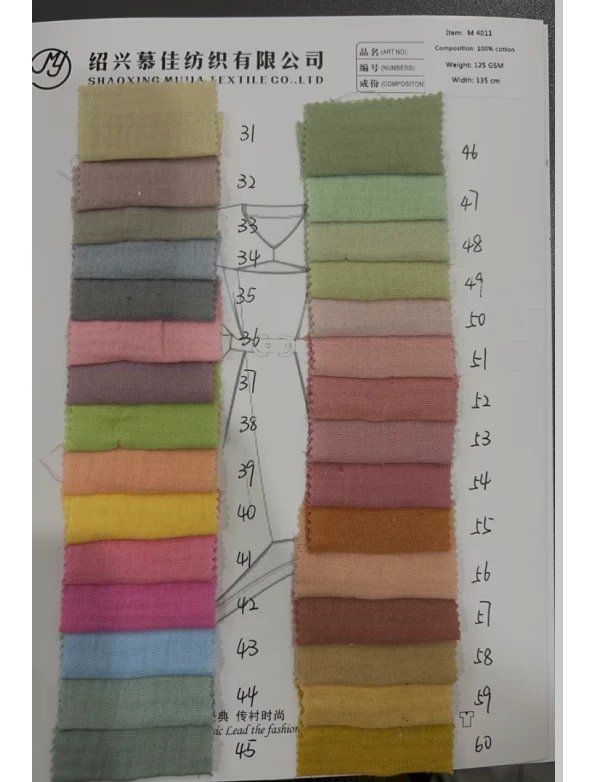
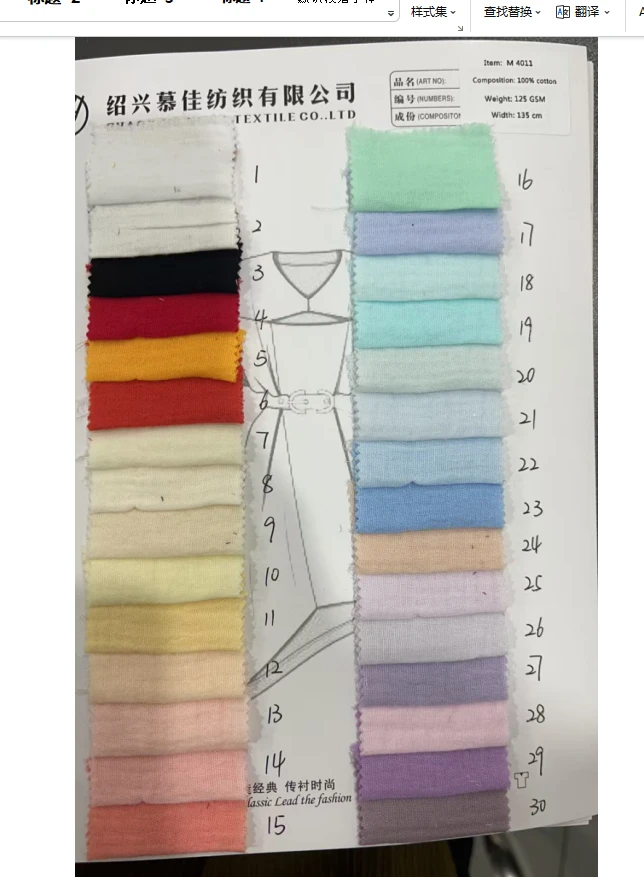
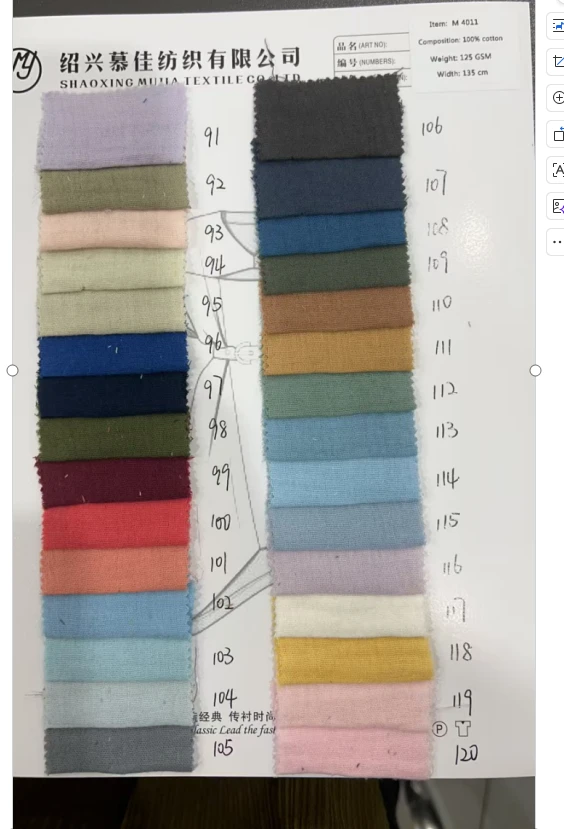
182 colours woven ahead. The range is dyed ahead in six colour-card blocks rather than held as finished rolls of every shade. That means a colour you see on the card is a colour we can weave; it does not mean a ready bale is sitting in the warehouse waiting for a one-roll order. Say “woven ahead” in your own internal notes too — it keeps your planning honest about the 15-day window.
What sets the price between USD 1.40 and 2.20/m
The range is real, not a negotiating margin. Colour depth and dye class move it (deep shades and reactive blacks sit at the top), packing and roll length move it, and quantity moves it. Custom colour development against your Pantone reference is priced separately from the 182-colour range and carries its own minimum.
Same price from 300 m to 2000 m. There is no volume ladder to argue down inside that band; the price you are quoted at 300 m holds to 2,000 m per colour.
Trade terms are FOB, with CFR or CIF quoted on request. Lead time is 15 days after colour approval, and the colour approval step is the one that most often slips a schedule — a lab dip needs your sign-off before the dyehouse can start.
Buying seersucker by the yard: what small brands should plan for
Small labels often ask whether they can buy seersucker by the yard, and the honest answer is: you can buy a sample by the metre, but production starts at 300 m per colour. The reason is physical rather than commercial — a dyeing vessel has a minimum liquor volume, and below roughly 300 m the shade repeatability between lots breaks down. A mill that sells you 50 m of a dyed colour either dyed it in a larger batch and cut it, or cannot guarantee the next 50 m matches.
So the practical route for a first season looks like this. Order the physical colour card first and choose from the 182 shades rather than developing a custom colour. Take an A4 or one-metre sample to cut and wash. Place a 300 m order in one or two colours rather than 150 m in four. If the style sells, the repeat order runs at the same price, because the band starts at the minimum.
What is genuinely not available: splitting one 300 m dye lot across four colours, or mixing 75 m of four shades to reach the minimum. Those requests come up every week and the answer is the same each time.
What goes on the purchase order
Write the construction into the PO, not just the trade name. A specification line that cannot be argued about later looks like this:
| Style | M4011 |
| Construction | Two-layer cotton gauze, tie-point crinkle |
| Composition | 100% cotton |
| Weight | 125 GSM, finished and washed |
| Cuttable width | 135 cm |
| Safety class | GB 18401 Class A, infant-safe |
| Colour | From the 182-colour range, woven ahead; approved lab dip reference |
| MOQ | 300 m per colour |
| Price | FOB USD 1.40–2.20/m, same price from 300 m to 2000 m; CFR or CIF on request |
| Lead time | 15 days after colour approval |
| Payment | T/T; L/C accepted for larger programs |
How to get a swatch and a price
Three steps, and none of them require a commitment.
One. Tell us the end use and the shade you are aiming at — dress, shirt, childrenswear or bedding, and a colour reference if you have one. We will tell you which of the 182 shades is closest and whether the weight suits the construction you described.
Two. We send the physical colour card, or an A4 swatch of the specific shades you shortlisted. Wash it, cut it, show it to your pattern maker. If the crinkle type is the open question, ask for both a woven-crinkle and a caustic sample from any supplier you are comparing — the difference appears after five washes.
Three. Send quantity per colour and destination port. You get a FOB price inside 24 hours on a working day, plus CFR or CIF if you ask for it, and a lead-time date that starts from colour approval rather than from the PO date.
Requests go to our contact page or straight to the M4011 product page, where the six colour cards are laid out by shade block.