Muslin for Bath Towels and Nappies: Absorbency, Layers and Edges
Digital printing has no design limit: any artwork, any colour count, no plate fee.
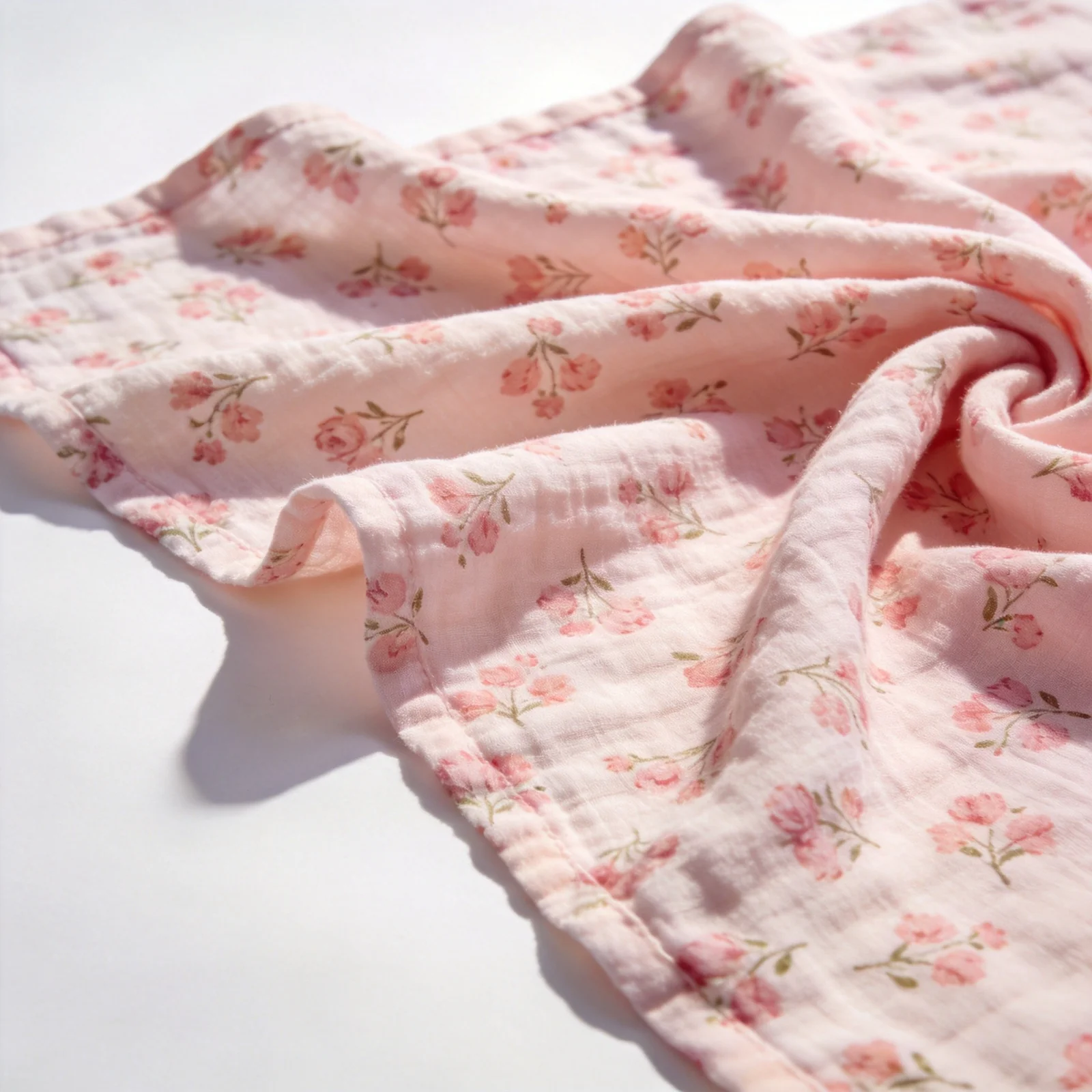
Short answer: Double gauze absorbs because cotton is hydrophilic and the cloth carries no sizing — not because it is heavy. A 125 GSM muslin folded to six layers gives roughly the absorbent mass of a 750 GSM single cloth with far faster wicking. What fails first in bath and nappy use is the edge, not the middle.
Table of Contents
- Why muslin absorbs — and why weight is the wrong question
- What 125 GSM means in a bath towel
- Nappies: absorbency is not containment
- Where these products fail: edges and size change
- Specification
- What to test before bulk
- Frequently asked questions
Why muslin absorbs — and why weight is the wrong question
Absorbency in cotton comes from the fibre, not the fabric. Cellulose carries hydroxyl groups along the polymer chain, water is attracted to them, and the fibre takes water into the amorphous regions of its structure rather than merely wetting the surface. That property is present in every cotton fabric ever woven.
What suppresses it is finishing. A sized, calendered, resin-finished cotton can be almost water-repellent on first contact, because the surface is sealed. Muslin is the opposite case: it is a light, open, unsized weave, so water reaches fibre quickly and moves through the cloth by capillary action along the yarns. That is also why muslin gets more absorbent after the first few washes — residual processing aids wash out and the fibre opens up.
The consequence for a buyer is that "which GSM absorbs more" is the wrong question. A tight 200 GSM cotton with a resin finish can absorb more slowly than a loose 125 GSM muslin. What matters is fibre, sizing, weave openness and the number of layers in the finished article.
What 125 GSM means in a bath towel
Our double gauze programme runs 125 GSM in the solid range and 140 GSM printed, at 135 cm — two layers of fine gauze joined at interlocking tie-points. As a single layer it is a swaddle, a liner, a summer wrap. As a bath towel it is used folded, and the fold count does the work the weight cannot.
Six layers of 125 GSM muslin carry roughly the same mass per square metre as a 750 GSM single-layer terry, but they behave differently: the layers slide slightly against each other, which spreads water laterally instead of holding it in one saturated spot, and the whole assembly dries much faster because each layer presents two exposed faces to the air. For a baby towel, that combination — absorbs fast, dries fast, stays soft — is the actual product requirement, and no single heavy cloth delivers it.
Practically, a hooded baby towel in 125 GSM muslin is usually built from two panels of double gauze, giving four layers through the body and more where the hood doubles back. Specify the finished layer count, not the fabric weight, because the layer count is what the customer experiences.
Nappies: absorbency is not containment
A nappy is a system, and muslin is the absorbent part of it, not the whole thing. Cotton muslin takes up liquid and holds it against the skin; it does not stop liquid passing through. Any nappy design that relies on muslin alone will leak, and that is a design decision rather than a fabric defect.
What muslin contributes is fast uptake and good washability. Flat muslin nappies are folded to build thickness where it is needed, which lets one cloth serve several absorbency levels, and they survive high-temperature washing far better than most absorbent synthetics. The trade-off is that cotton holds water longer than a synthetic wicking layer, so a muslin nappy stays wet against the skin once saturated — which is why the nappy system pairs it with a stay-dry layer.
For the specification, that means the muslin's job is defined: fast uptake, high wash tolerance, softness after repeated boiling. Weight and layer count set how much it holds; the system design sets whether it leaks.
Where these products fail: edges and size change
In bath and nappy products, the middle of the cloth almost never fails. The edge does. Two mechanisms account for most complaints:
Edge ravel and roll. A double gauze is two layers tied at intervals, and the cut edge is where those layers are not tied at all. A narrow overlock that does not capture both layers fully will let one layer escape, and the garment develops a rolled, frayed edge after a few washes. The fix is construction, not fabric: a wider seam allowance, a folded hem, or a bound edge, specified before cutting.
Size change on first wash. Cotton gauze moves on first wetting — the weave opens and the cloth relaxes. A towel or nappy cut to finished dimensions before washing will finish smaller. This is normal and predictable, but only if it is planned. Wash the sample, measure, and set the marker from the washed dimensions.
Both failures are invisible on a flat sample and obvious after three domestic washes. That is why the sample test matters more than the inspection report for this category.
Specification
| Parameter | M4011 solid | M4011-1 printed |
|---|---|---|
| Construction | Two-layer cotton gauze, tie-pointed | Two-layer cotton gauze, tie-pointed, printed |
| Weight | 125 GSM | 140 GSM |
| Width | 135 cm | 135 cm |
| Stock shades | 182 colours | 20 designs x 3 colourways |
| FOB price | USD 1.40–2.20 per m | USD 1.77–2.57 per m (tiered) |
| Plate fee | n/a | None on digital |
| Best for | Swaddles, bath layers, nappy flats, liners | Hooded towels, printed swaddles, gift sets |
| Layer count in finished towel | 4–6 layers typical | 4–6 layers typical |
Two specification habits prevent most of the problems in this category. First, write the finished layer count into the tech pack rather than the fabric weight alone, because a towel is judged by how it feels in the hand and a layer count is what produces that. Second, write the edge construction explicitly — overlock width, folded hem depth, or bound finish — because the edge is where these products fail.
The 182-shade stock programme matters here for a commercial reason: bath and nappy ranges are usually sold in colour-coordinated sets, and a stock range lets a brand build six or eight coordinated colours without a dye lot minimum on each. How the tie-points themselves are judged before the cloth delaminates is covered in the tie-point guide.
What to test before bulk
- Drop test. Place a measured drop of water on the surface and time until it is fully absorbed with no reflective film left. Run it on the greige sample and again after three washes — the washed sample should be faster.
- Wash-and-measure. Cut a 50 x 50 cm square, wash three times at the temperature your care label will carry, dry flat, measure again. Build the marker from the washed dimensions.
- Edge test. Sew the intended edge construction on a 30 cm sample, wash it three times, then pull. If one gauze layer escapes the seam, the construction is wrong regardless of the fabric.
- Pilling and hand after washing. Muslin softens with washing, which is desirable, but low-grade gauze can also fuzz. Compare the washed sample against the unwashed one by hand; a buyer can feel the difference even without a lab.
None of these four requires equipment beyond a ruler, a washing machine and an hour. They answer the questions that actually generate returns in this category, and they cost one sample per colourway.
Frequently asked questions
Is muslin absorbent enough for a bath towel?
Yes, when it is layered. A single 125 GSM layer is a swaddle, not a towel; four to six layers give the absorbent mass of a much heavier cloth with faster drying. Specify the finished layer count rather than the fabric weight.
Does double gauze get more absorbent after washing?
Usually yes. Residual processing aids wash out and the fibre opens, so a muslin that has been through three washes generally takes water faster than the same cloth straight off the roll.
Can muslin be used as a nappy on its own?
Muslin is the absorbent layer, not a complete nappy. It takes up liquid quickly and washes at high temperature, but it does not contain liquid. A nappy system pairs it with a waterproof outer and usually a stay-dry inner layer.
Why do the edges of muslin towels fray?
Because a double gauze has two layers that are tied in the body of the cloth and free at the cut edge. A narrow overlock that does not capture both layers lets one escape. Use a wider seam allowance, a folded hem or a bound edge, specified before cutting.
Does 140 GSM printed gauze behave the same as 125 GSM solid?
Close enough for most uses, but the print adds handling and slightly reduces the openness of the weave. For a printed towel or swaddle, test absorbency on the printed sample rather than assuming it matches the solid.
Specifying the article, not the fabric
A muslin towel and a muslin nappy are articles built from a fabric, and the fabric specification alone does not determine whether they work. Layer count decides absorbent mass, edge construction decides whether the product survives washing, and the washed dimension decides fit.
Write those three into the tech pack alongside the 125 GSM and 135 cm, and the category stops producing returns. Our guide to baby-grade double gauze covers the compliance side that sits on top of these construction decisions.
Mujia Textile — running our own air-jet looms in Zhuji since 2012.