Muslin Fabric Sourcing: Layers, Weight, Cost and Inspection
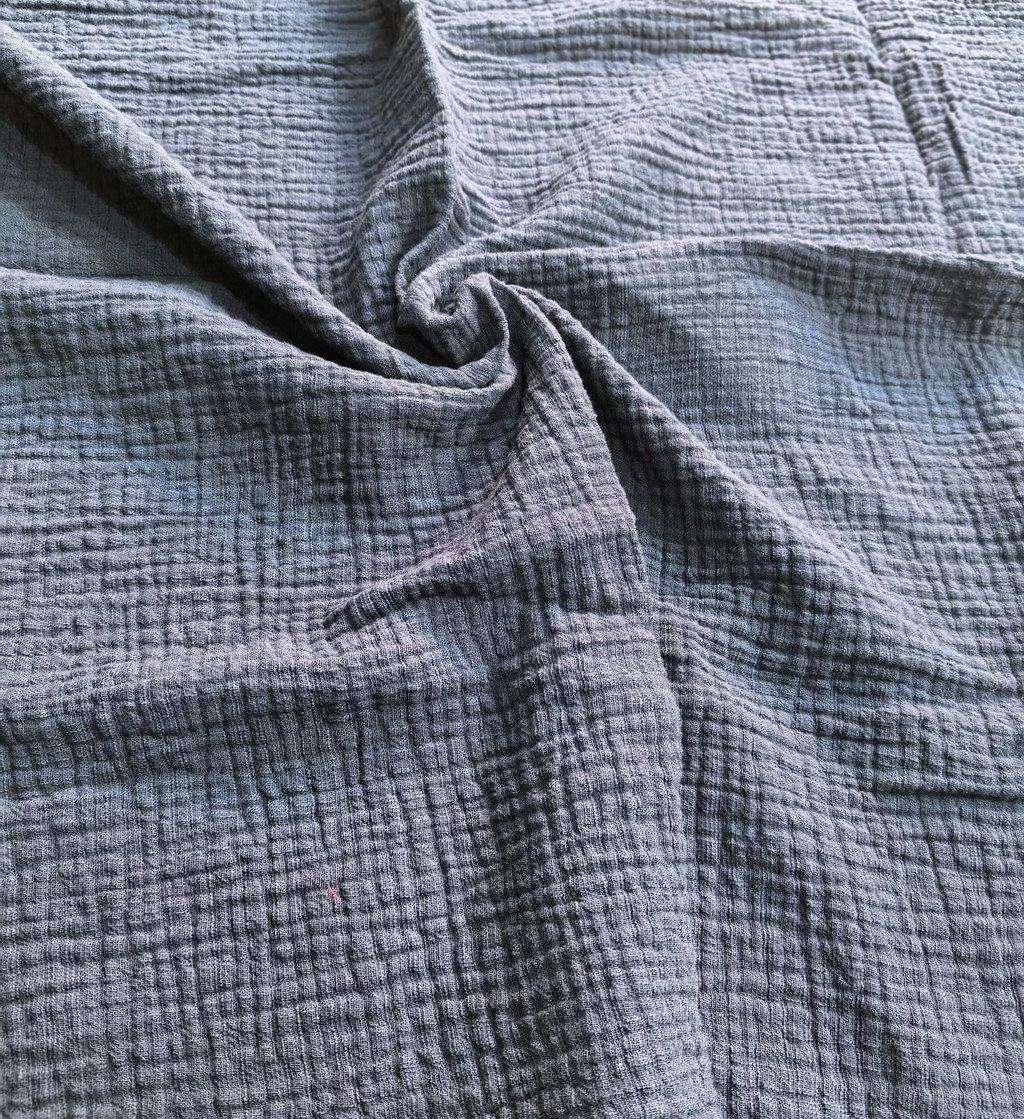
Muslin is the fabric category where buyers most often order the right word and the wrong cloth. The word covers a 125 GSM crinkle swaddle and a 300 GSM towel-weight gauze, and everything a buyer cares about — drape, absorbency, how the edge behaves after ten washes, what the roll weighs when it lands — changes between those two ends. This guide is the sequence we walk a new buyer through before we quote: fix the finished product, choose the layer count before the weight number, specify the surface finish by what was done to it rather than by the adjective, cost the order honestly including the colour decision, and agree the test battery before the bulk lot is woven rather than after it arrives.
Table of Contents
- Start with the finished product, not the GSM number
- Layers before weight: what 2, 4 and 6 actually change
- The four weights we hold, and what each is for
- Slub, plain and sand-washed: reading the surface
- Shrinkage and crinkle: specify the finish, not the word
- Colour: what the stock range buys and what custom costs
- MOQ, price and how FOB moves with volume
- Testing: the battery to require before bulk
- Inspection: what to check when the rolls arrive
- Five mistakes that cost a muslin order
- Sourcing timeline, realistically
- The one-paragraph version
Start with the finished product, not the GSM number
The first question a muslin supplier asks should be “what is it going to be”, and if it is not, that is already information about the supplier. Four variables decide almost everything downstream, and none of them is the fabric name:
- What the cloth has to do: wrap a newborn, absorb water off a wet body, sit on a bed as a top layer, hang as a scarf, or cover a nursing mother. A swaddle needs drape and give; a bath sheet needs mass and absorbency; a crib blanket needs body so it does not bunch. These pull in opposite directions on layer count.
- Who touches it and how often: baby-adjacent goods carry a different test battery and a different pH expectation than a decorative throw. If the answer is “baby”, the certification path is part of the spec, not an afterthought, and it belongs in the conversation on day one.
- How it is washed: a muslin that will be machine-washed at 60 degrees twice a week by a hospital laundry and a muslin that will be hand-washed cold by a consumer are not the same cloth even at the same weight. Wash temperature drives the shrinkage requirement, and the shrinkage requirement drives how much finishing the mill has to do.
- What the edge will be: a double-fold hem, a rolled hem, a raw sand-washed edge, a bound edge with tape. Gauze frays readily before finishing, so the edge decision affects how the cloth must be cut and how much wastage the order carries.
A buyer who writes “2-layer muslin, 140 GSM, 3,000 m” and nothing else will get three different cloths from three suppliers, all of which technically match the brief. A buyer who writes “baby swaddle, 120 × 120 cm finished, must stay soft after 20 washes at 40 degrees, rolled hem, OEKO-TEX Standard 100 Class I” will get one cloth from three suppliers, and the quotes will be comparable. The spec sheet is what makes quotes comparable, and it is the buyer's job to write it.
Layers before weight: what 2, 4 and 6 actually change
Almost every muslin argument online is really a layers argument wearing a weight costume. A double gauze is two gauze cloths woven separately and joined at intervals, so the layers are a structural fact, not a marketing tier:
- 2 layers: the classic. Two thin gauze cloths tacked together, which gives drape, breathability, and a soft crush in the hand. The air trapped between the two cloths is what makes it warm for its weight and cool when it is hot. This is the structure for swaddles, receiving blankets, nursing covers, scarves, and light summer throws.
- 4 layers: two 2-layer cloths joined, or a 4-layer woven construction. The added mass gives body, so the cloth stops clinging and starts holding a shape. It is the structure for crib blankets, play mats, light quilting, and the heavier end of baby blankets.
- 6 layers: towel territory. Enough mass and air to absorb and to feel substantial against skin. It is the structure for bath sheets, hooded towels, tummy-time mats, and the kind of gauze blanket that gets used as a floor mat.
The practical consequence: layer count and GSM move together but are not interchangeable. Two mills can both quote 240 GSM, one as 4 layers of 60 GSM gauze and one as 2 layers of 120 GSM gauze, and the cloths will behave nothing alike. The 4-layer version has more internal structure and less drape; the 2-layer version is heavier per layer and hangs more. Ask for both numbers. If a supplier quotes only total GSM and cannot tell you the layer structure, they are either reselling or guessing.
There is a second consequence that shows up at the sewing machine rather than in the hand. Gauze layers can shift against each other during cutting, and a 6-layer cloth cut on a single-ply table will skew more than a 2-layer cloth. If you are cutting in-house, ask how the mill tacks the layers and whether the tacking survives your cutting process. If the mill does the cutting, ask what their tolerance is on the finished panel. This is the kind of question that separates a mill that runs gauze every week from one that runs it occasionally.
If the product line spans more than one end use — a baby brand that wants a swaddle, a crib blanket and a bath towel in the same visual language — the sensible route is usually to hold one surface finish across all three and vary only the layer count. That keeps the brand consistent while letting each SKU do its job. Our own range is built that way: the same cotton, the same 135 cm width, the same sand-washed or plain finish family, at 2, 4 and 6 layers.
The four weights we hold, and what each is for
Concrete numbers beat categories, so here is what we actually run. All four are 100% cotton, 135 cm cut width, and priced FOB China port:
| Item | Construction | Weight | Width | Stock colours | MOQ | FOB |
|---|---|---|---|---|---|---|
| M4011 | 2-layer solid crinkle | 125 GSM | 135 cm | 182 | 300 m per colour | on request |
| M4011-1 | 2-layer, digital print | 140 GSM | 135 cm | 3 colourways | 300 m per colour | on request |
| MJ4015 | 2-layer slub, sand-washed | 155 GSM | 135 cm | 24 | 300 m stock / 2,000 m custom | US $1.82–1.97 / m |
| MJ4014 | 4-layer gauze | 240 GSM | 135 cm | 24 | 300 m stock / 2,000 m custom | US $2.95–3.10 / m |
| MJ4016 | 6-layer gauze | 300 GSM | 135 cm | 24 | 300 m stock / 2,000 m custom | US $3.35–3.50 / m |
Stock colours ship in 7–10 days because the greige is already woven and dyed. Custom shades move to a 2,000 m minimum per colour and a longer lead time. Full specifications for each line are on the MJ 4015, MJ 4014 and MJ 4016 product pages; the category overview with the full construction range is on muslin fabric.
Reading the table by application:
- 125 GSM, 2-layer crinkle: the lightest thing we make. Swaddles, receiving blankets, burp cloths, nursing covers, and the light scarf weight. The crinkle finish is what makes it look like gauze rather than like a thin sheet.
- 155 GSM, 2-layer slub sand-washed: the middle. Slub yarns give the surface an irregular grain; sand-washing softens it further. This is the weight that works for both baby goods and adult accessories — light blankets, scarves and shawls, summer throws, homewear layering.
- 240 GSM, 4-layer: crib blankets, play mats, light quilting, and the heavier baby blanket. Enough body to hold a shape, still breathable enough to use year-round.
- 300 GSM, 6-layer: bath sheets, hooded towels, tummy-time mats, and floor blankets. The mass is the point.
One caution on the lightest end: 125 GSM 2-layer is genuinely light, and a buyer who has only seen 240 GSM gauze in a showroom will be surprised by how little cloth arrives on a roll. That is not a defect, it is the product, but it does mean the packing and the shipping cost per finished piece behave differently. Ask for the roll weight and the metres per roll before you cost the freight.
Slub, plain and sand-washed: reading the surface
Three surface variables get confused constantly, and they are independent of each other:
- Slub is a yarn property. A slub yarn has deliberate thick-and-thin variation along its length, which shows up as irregular horizontal grain lines in the finished cloth. It is a visual and tactile effect, and it is decided at spinning, not at finishing. Slub cannot be added later, and it cannot be removed.
- Plain means the yarn is regular. The surface reads even. Most 182-colour crinkle gauze is plain yarn with a crinkle finish.
- Sand-washed is a finishing process, usually a physical abrasion or a wash with an abrasive medium, that raises a very short fuzz and softens the hand. It is applied after dyeing. It changes how the cloth feels and how it photographs, and it also changes the pilling behaviour, which is why a sand-washed cloth needs a different pilling test than an unsanded one.
So “slub sand-washed” is a yarn decision plus a finishing decision. A supplier who cannot separate the two in conversation is describing a look, not a spec. Ask three questions and the answers will tell you whether they actually run the cloth: what is the slub frequency or the slub yarn ratio, is the sand-wash before or after dyeing, and does the sand-wash change the GSM.
The surface also drives the visual consistency of a bulk order. Slub is random by nature, so two rolls will never have identical grain placement. What you can and should specify is the range: the thickest point and the thinnest point of the yarn, and the visual density of the slub lines. On a sand-washed cloth, specify the target hand and accept a tolerance, because abrasion is a distribution, not a fixed value. Buyers who demand “identical” on a slub cloth are asking for a woven fabric with a printed slub effect, which is a different and usually more expensive product.
For the full colour and surface range on the plain crinkle base, see the 182-colour double gauze piece; for how the two cloths are physically joined and where that join can fail, see the tie point guide.
Shrinkage and crinkle: specify the finish, not the word
Crinkle is not a weave. It is what happens when a gauze cloth is allowed to shrink unevenly under controlled conditions, and the resulting texture is locked in by the finishing route. That has three consequences buyers routinely miss:
- The crinkle is dimensional shrinkage you have already paid for. A crinkled cloth has already given up some of its length. If you compare a crinkled 135 cm width against a flat 135 cm width by the metre, you are not comparing like with like, because the crinkled one has more cloth in the same metre. This is why crinkle gauze quotes sometimes look expensive per metre and cheap per finished piece.
- Residual shrinkage is the number that matters, not total shrinkage. Ask for the figure after one wash at the customer's temperature, and ask whether the measurement was taken before or after the sand-wash or tumble pass. A mill that measures, then tumbles, will ship a cloth that shrinks again.
- Wash temperature changes the answer. A cloth specified at 30 degrees may not hold at 60. If your customer base includes hospitals, hotels or anyone washing hot, say so at enquiry stage and get the figure at that temperature.
A reasonable requirement for consumer baby and apparel goods is residual shrinkage at or below 3 to 5 percent after one wash at the declared temperature, measured on the bulk lot rather than the development sample. For anything that will be cut into fixed panels — a 120 cm swaddle, a fitted crib sheet — add the cutting allowance to the spec sheet explicitly, because the pattern room and the mill will otherwise each assume the other has accounted for it.
There is a related behaviour that is not shrinkage but gets reported as a complaint: the crinkle relaxing. A crinkled gauze softens and opens up over the first several washes. That is the product working as intended, and it is why the category is marketed on getting softer. But it does mean the “after 1 wash” dimension is not the “after 20 washes” dimension. If your product is sold with a size claim, test at 20 washes, not 1. For how the hand actually evolves over repeated washing, see the softness after washing study.
Colour: what the stock range buys and what custom costs
The colour decision is where a muslin order most often doubles in cost and lead time without the buyer noticing it happened. Three tiers, and the gap between them is not small:
- Stock colour: the shade is already dyed and sitting on a roll. 300 m per colour, 7 to 10 days. On our 2-layer slub and the 4-layer and 6-layer gauze the stock range is 24 shades; on the plain crinkle base it is 182. You take the shade as it is, and the only variable is whether the roll you get matches the card you approved.
- Custom shade on a stock construction: the greige is on the shelf but has to be dyed to your reference. This moves to 2,000 m per colour and a longer lead time, and it involves lab dip rounds. Budget two to three rounds, and budget the calendar time for them, because a lab dip that goes back twice is a two-week addition that nobody put in the plan.
- Custom colour plus a custom construction: not usually worth it below a container. The setup cost is spread across the whole run, and at a few thousand metres it dominates the price.
Two practical notes. First, a stock colour is only as good as the card. Ask for a physical swatch of the actual dyed lot, not a printed card and not a screen rendering, and keep the approved swatch. Gauze takes dye differently from a flat cotton because the yarn structure scatters light, so the same dye recipe on a 125 GSM crinkle and a 300 GSM 6-layer will read as two different shades. If you need the light and heavy weights to sit next to each other in one product line, say so, and ask the mill to dye them against each other rather than against a generic reference.
Second, metamerism. A shade that matches under daylight in the showroom can look different under a shop's warm LED. For anything sold at retail, ask for the shade to be checked under at least two light sources and note the result. This is a two-minute conversation that prevents a shipment dispute.
For the full plain-crinkle colour range and how it was built, see the 182-colour double gauze piece. For printed gauze — digital print on a 2-layer base — the base cloth is the M4011-1 printed muslin, and the print adds a fixation and washing stage that the plain route does not have.
MOQ, price and how FOB moves with volume
Our own FOB range across the muslin family is 1.82 to 3.50 US dollars per metre at 300 m per colour, and the spread is almost entirely cotton consumption plus finishing passes. The 155 GSM 2-layer sits at the bottom because it uses the least cotton and the fewest tumbling passes; the 300 GSM 6-layer sits at the top because it uses roughly double the cotton and needs the heaviest sand-wash and tumble to bring the hand down. There is no trick in that spread, and a quote that inverts it deserves a question.
Three cost mechanics are worth understanding before you negotiate:
- Below-MOQ surcharge is per colour, not per metre. If the minimum is 300 m and you want 150 m in four shades, you are not buying 600 m, you are buying four colour setups. The surcharge covers the dye setup and the machine time, so it does not scale down with the metres. The cheapest way to test colours is usually to fold them into a larger order in one construction rather than to place a small multi-colour order on its own.
- Packing and rolling change the price. Roll length, roll diameter, whether the rolls are bagged, whether they are palletised — these show up in the quote because they are real labour. A buyer who specifies “100 m per roll, bagged, palletised, labelled per SKU” will get a different number than one who says nothing, and the difference is legitimate. Specify it up front rather than being surprised at the invoice.
- Volume discounts are real but shallow below a container. At 300 m per colour the price is essentially the stock price. Moving to 2,000 m per colour on a custom shade does not reduce the per-metre price much, because you are paying for a dye setup that the stock route already absorbed. The volume break that matters is on repeat orders of a shade the mill now holds, not on the first order.
Payment terms in this trade are commonly 30 percent deposit and 70 percent against the bill of lading copy, with the balance settled before telex release. Anything materially outside that structure — full payment in advance, or open account on a first order — is a signal worth reading. The mechanics of minimums and payment structures across fabric categories are covered in more depth in the MOQ and payment terms guide.
One number buyers forget to cost: wastage. Gauze frays at the cut edge before finishing, and a 2-layer cloth cut on a single-ply table loses more to the edge than a stable woven. On a swaddle programme, budget 3 to 8 percent cutting wastage depending on the hem type and the cutting method, and get the mill's own figure for your specific panel. A quote that assumes zero wastage will be the cheapest quote and the most expensive order.
Testing: the battery to require before bulk
The point of testing is to catch the bulk lot, not the sample. A development sample is made on purpose, often on a different machine, often by a different operator, and it is not evidence about what will arrive in six weeks. Require the battery on the bulk lot, and require the laboratory name and the test date on the report.
For a consumer baby or apparel muslin, the working battery:
- Colourfastness to rubbing, dry and wet: grade 4 dry and grade 3 wet minimum. This is the test that catches a shade that will transfer onto a baby's skin or a white sheet.
- Colourfastness to washing: the shade must not bleed onto itself or onto a white adjacent fabric. On dark and saturated shades this is the one that fails most often.
- Colourfastness to light: required for anything used outdoors, near a window, or as a stroller cover. Not always required for a swaddle, but cheap to add to the same report.
- Dimensional stability after one wash at the declared temperature, on the bulk lot. This is the number that decides whether your finished panel still measures what the pattern says.
- pH for baby-adjacent goods. Cotton that has not been rinsed properly after dyeing can sit outside the skin-friendly range, and this is a cheap test that catches a real problem.
- Pilling or surface change after five washes for anything described as sand-washed, peached or brushed. The abrasion that creates the soft hand also creates the potential for fuzz and pills, and a five-wash check is the honest way to find out.
- Formaldehyde and azo dyes where the destination market requires them, and the relevant OEKO-TEX class if the product is baby-adjacent. Certification is a separate track from testing but they belong in the same conversation, and the baby certification walk-through covers which documents actually travel with a shipment.
Two things to insist on beyond the list. Ask which lot the report covers — a report on a different dye lot is not a report on your order. And ask for the raw data, not just the pass line: a “pass” at grade 3.1 and a “pass” at grade 4.8 are the same word and not the same cloth. For how grading actually works on this category, the pilling test grades piece goes through the scale and what each step means in use.
Inspection: what to check when the rolls arrive
Inspection is where a muslin order is won or lost, because most gauze problems are visible on the roll and invisible on the sample. A workable incoming check, in the order that finds problems fastest:
- Count and measure before you cut anything. Roll count against the packing list, metres per roll against the label, and actual width on three places per roll. Gauze relaxes and the width can drift across a long roll; a 2 cm loss on a 135 cm width is a 1.5 percent cloth loss on every panel you cut.
- Weigh a sample of rolls. Metres per roll can be mislabelled; weight per roll is harder to fake. GSM times width times length gives you the expected weight, and a roll that is 8 percent light is either short or thinner than specified.
- Check the shade across rolls, not within a roll. Open two rolls from the beginning, middle and end of the shipment and compare them side by side under the same light. Within-roll variation is usually acceptable; between-roll variation is what shows up as a seam in the finished product.
- Look for the specific gauze defects: skipped tuck points (where the two layers are joined), layer separation at the selvedge, slub lines that stop abruptly, sand-wash patches that read lighter or darker than the body, and holes or thin places near the selvedge where the tenter pins gripped.
- Wash a metre. Cut a metre from two rolls, wash at the declared temperature, dry flat, and measure. This one test catches shrinkage surprises, colour bleed, and surface change all at once, and it costs you twenty minutes and one metre of cloth.
Agree the inspection standard before the order, in writing: what defect density per 100 m is acceptable, what counts as a major versus a minor, and what the remedy is — a credit, a replacement roll, or a price adjustment. A supplier who will not put a defect standard in writing is telling you something. The industry default for first-quality woven goods is usually expressed as points per 100 square yards on a four-point system; for gauze, ask specifically how tuck-point failures and layer separation are counted, because they are not in the standard four-point table and different mills handle them differently.
Five mistakes that cost a muslin order
- Specifying GSM without layers. The single most common error. 240 GSM as 2 layers and 240 GSM as 4 layers are different products with different drape, different cutting behaviour and different prices. Always write both numbers.
- Approving a lab dip on a screen. Gauze scatters light, and a screen rendering of a dyed gauze is a guess. Approve on a physical swatch of the actual dyed lot, keep it, and reference it in the purchase order.
- Forgetting the wash temperature. A shrinkage figure without a temperature is not a figure. State the temperature the end consumer will use, and if there are several, state the worst one.
- Ordering the lightest weight for a heavy job. 125 GSM 2-layer is a beautiful swaddle and a poor bath sheet. Buyers who fall in love with the hand of the light cloth and then specify it for a towel programme end up with a product that wets through. Match the layer count to the job, then choose the surface.
- Testing the sample instead of the bulk. A development sample proves the mill can make the cloth once, on purpose. It proves nothing about the lot that ships. Put the test requirement on the bulk lot in the purchase order, and make payment of the balance conditional on the report.
There is a sixth that is not a mistake so much as a missed opportunity: not asking what the mill runs every week. A mill that runs gauze daily will have stable greige, predictable shrinkage and a stock colour range worth using. A mill that runs it occasionally will quote competitively and then discover the tuck points on your order. The question “how many metres of gauze did you run last month, and on how many machines” is answerable by anyone who actually runs it, and evaded by anyone who does not.
Sourcing timeline, realistically
A realistic calendar for a stock-colour muslin order, from first enquiry to goods on the water:
- Week 1: brief and spec sheet, swatch request, first quotes. If you cannot write the spec sheet, this week is where the order goes wrong, and no amount of supplier goodwill fixes it later.
- Week 2: swatches arrive, hand and surface assessed, one or two suppliers shortlisted. Ask for the test report on the construction you are considering, not on a sister construction.
- Week 3: sample panel made and washed. This is where the shrinkage number becomes real and where the hem decision gets tested. Do not skip it to save a week.
- Week 4: order placed, deposit paid, greige allocated. On a stock colour, production is 7 to 10 days from confirmation.
- Weeks 5–6: production, inspection, packing. Book the inspection before production ends, not after.
- Weeks 6–7: shipping documents, balance, and sea freight depending on destination.
For a custom shade, add two to three weeks in front of week 4 for lab dips and approval, and expect the dyeing to sit in a queue. For a custom construction, add four to six weeks for greige weaving. The full calendar including lab dip rounds and finishing queues is in the sourcing timeline guide.
The honest summary: a stock-colour muslin order can be on the water in six to seven weeks, and a custom-shade order takes nine to eleven. Any quote that promises a custom shade in three weeks is either quoting a stock shade or planning to skip the approval.
The one-paragraph version
Write the spec sheet before you write to a supplier: what the cloth does, who touches it, how it is washed, what the edge is. Specify layers and GSM together, because the same weight in a different layer count is a different product. Choose the surface by process — slub is a yarn, sand-wash is a finish — and ask for the residual shrinkage after the finish at the customer's wash temperature, not before it. Take a stock colour if you can, because custom shade triples the minimum and adds weeks; if you must have your own shade, budget the lab dip rounds. Require the test battery on the bulk lot with a laboratory name and a date, and make the balance conditional on the report. Inspect width, weight, shade across rolls, tuck points and a washed metre before you cut. Then the cloth you ordered is the cloth you get.
Frequently Asked Questions
Q1: What GSM is muslin fabric?
Muslin sits roughly between 120 and 300 GSM in the constructions we run, and the number is the sum of the layers, not a property of the word muslin. A 2-layer gauze at 125 GSM is a swaddle cloth; the same 2 layers at 155 GSM is a slub sand-washed cloth for blankets and scarves; 4 layers reach 240 GSM and 6 layers reach 300 GSM, which is bath and towel territory. Ask a supplier what the GSM is per layer as well as in total, because two mills can quote the same 240 GSM with different layer counts and different behaviour.
Q2: How much does muslin fabric cost per metre?
On our own lines the FOB range runs from 1.82 to 3.50 US dollars per metre at 300 metres per colour: 155 GSM 2-layer slub at 1.82 to 1.97, 240 GSM 4-layer at 2.95 to 3.10, and 300 GSM 6-layer at 3.35 to 3.50. The spread between the lightest and heaviest cloth is close to double, and almost all of it is cotton consumption plus the extra sand-washing and tumbling passes the heavier goods need. Below 300 metres the surcharge is per colour, not per metre, so the cheapest way to test a colour is usually to take it inside a larger order rather than as a standalone small lot.
Q3: What is the minimum order for muslin from a Chinese mill?
Industry-typical minimums for cotton double gauze run at 1,000 metres per colour for a fully custom shade, with below-minimum surcharges charged per colour. Our own standard is 300 metres per colour on the 24 colours we hold in stock, and 2,000 metres per colour for a custom dyed shade. The gap between those two numbers is the real cost of wanting your own colour, and it is worth deciding early, because the colour decision changes both the minimum and the lead time.
Q4: Should I buy 2-layer, 4-layer or 6-layer muslin?
Decide from what the cloth has to do, not from what sounds premium. Two layers give drape, breathability and a soft edge, which suits swaddles, scarves, nursing covers and light summer throws. Four layers add body and surface stability, which suits crib blankets, play mats and light quilting. Six layers hold enough air and mass to work as a bath sheet, a hooded towel or a tummy-time mat. Buying 6-layer for a swaddle gives you a cloth that is too stiff to wrap; buying 2-layer for a bath towel gives you a cloth that wets through in one use.
Q5: How much does muslin shrink, and what should I require?
Cotton gauze shrinks, and the crinkle finish is partly built on that shrinkage, so the number to ask for is residual shrinkage after the finish, not shrinkage before it. Ask for the tested figure after one wash at the temperature your customer will use, and specify the test method. If the cloth is sand-washed or tumbled, ask whether the shrinkage was taken out before or after that pass, because a mill that tumbles after measuring will ship a cloth that shrinks again in the customer's machine.
Q6: Which tests should I require on the bulk lot rather than the sample?
Colourfastness to rubbing, dry and wet, at grade 4 dry and grade 3 wet minimum; colourfastness to washing and to light for anything that will be used outdoors or near a window; dimensional stability after one wash; pH for baby-adjacent goods; and pilling or surface change after five washes for anything described as sand-washed or peached. Ask for the bulk figures, not the development sample figures, and ask which laboratory ran them. A test report without a laboratory name and a date is a marketing document.