Chinese Jacquard Fabric: A Buyer's Guide to Construction, Colourways and Cutting
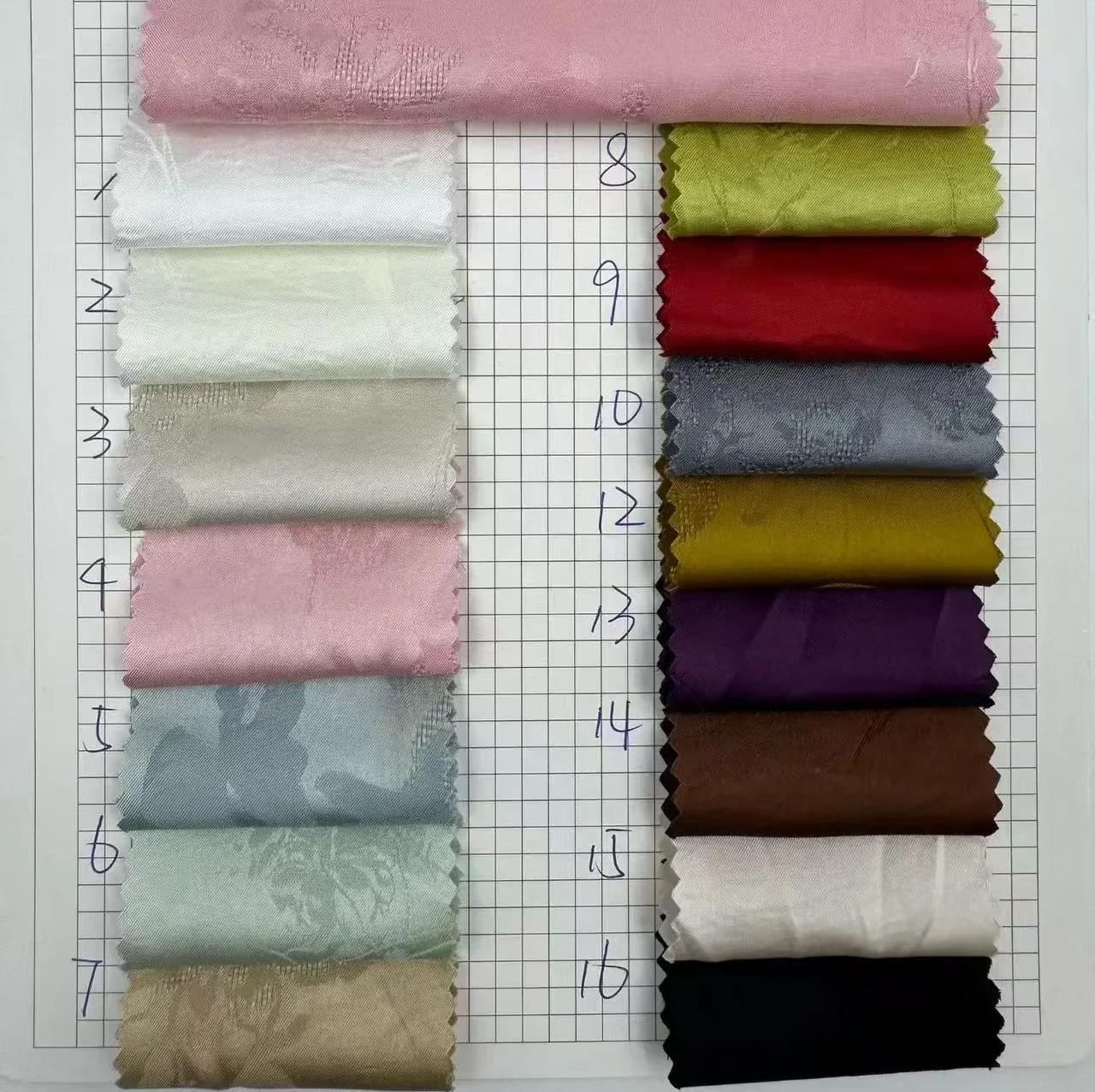
Short answer: a Chinese jacquard is a woven pattern, not a printed one — the motif is built into the cloth on a jacquard loom, so it cannot peel, crack or fade off the surface. Our range is a 97% polyester / 3% spandex crepe jacquard at 150 gsm and 150 cm, from 300 m per colour, in four construction groups (ST 9901, ST 9903, ST 9904 and ST 9905).
Table of Contents
- Why This Guide Exists
- Part 1: What Makes a Jacquard a Jacquard
- Part 2: The Four Design Families, ST 9901 to ST 9905
- Part 3: Specifications, and What Each Number Costs You
- Part 4: How to Judge a Jacquard on the Roll
- Part 5: Pattern Repeat and Cutting Loss
- Part 6: What 150 GSM Can and Cannot Do
- Part 7: Choosing a Family by Market
- Part 8: Care and Maintenance
- Frequently Asked Questions
- Next Steps: Swatches and a Quote
- Data Sources Cited
Why This Guide Exists
A jacquard is the one fabric category where the buyer's biggest risk is not price, not lead time, and not certification. It is that the cloth in your hand does not look like the cloth on your screen. A printed pattern photographs flat and honest. A woven pattern does not: the motif lives in the difference between two weave structures at the same height, and that difference only resolves when light rakes across the surface at an angle. Photograph it head-on and a good jacquard looks like plain cloth; photograph it badly and a mediocre one looks rich.
This guide is written from the mill side of that problem. Mujia Textile weaves its Chinese jacquard range on its own air-jet looms in Zhuji, Zhejiang — twelve designs in four families, item numbers ST 9901 to ST 9905, all on the same base construction. Every specification quoted below is the specification we actually run, not a catalogue range: 150 gsm, 150 cm usable width, 97% polyester with 3% spandex, MOQ 300 metres per colour, 7–10 days after colour confirmation, FOB US$1.88–2.05 per metre.
What this guide will not do is quote a market size for jacquard fabric. Numbers like that get repeated across the internet without a traceable source, and a buyer who is about to commit 300 metres per colour deserves better than a figure someone else made up. What it will do is explain what each number in the specification actually costs you, so you can tell which line item to push back on.
Part 1: What Makes a Jacquard a Jacquard
The word gets used loosely. In the trade it means one specific thing: a fabric whose pattern is created by individually controlling which warp threads lift on each pick, so that the pattern is a difference in weave structure rather than something applied to the surface afterwards. Everything else about how a jacquard behaves — how it wears, how it photographs, why it costs what it costs — follows from that one fact.
1.1 The Loom Does the Drawing
On a plain weave, every other warp thread lifts, every pick, forever. On a jacquard, the loom reads a pattern and lifts a different combination of warp threads on every single pick. A 150 cm wide cloth at a normal jacquard sett runs well over 5,000 warp ends; the pattern decides, pick by pick, which of them are up.
Two consequences follow, and both matter commercially:
The pattern is at the same depth as the ground. There is no layer sitting on top of the cloth. Where a motif appears, the yarns are simply interlaced differently. Rub the surface, fold it, wash it — the motif has nowhere to come off, because it is not on the cloth, it is the cloth.
You cannot judge it flat-on. Because the motif is a structure difference rather than a colour difference, it reads most strongly when light hits it at a shallow angle and casts small shadows across the weave. This is why the photographs on our Chinese jacquard overview page are shot on the roll under raking studio light rather than laid flat. It is also why a buyer who approves a jacquard from a head-on photo is taking a real risk, and why we send swatches before any dye lot is committed.
1.2 Crepe Jacquard: What 3% Spandex Does to the Hand
All twelve designs share one base construction: 97% polyester, 3% spandex, crepe jacquard, acetate-like hand. Each of those three choices is doing a job, and it is worth knowing which, because a supplier quoting you a cheaper jacquard is usually changing one of them.
Why crepe and not a flat jacquard. A crepe weave introduces a small, controlled irregularity into the ground. That irregularity is what gives the cloth its dry, slightly granular surface — the thing buyers describe as "not shiny polyester". A flat jacquard in the same yarn looks slick and cheap under retail lighting, and the motif edges read hard.
Why 3% spandex and not 100% polyester. Crepe structure depends on yarn torque and recovery. Without a small elastic component, the crepe crimp collapses after finishing and the cloth goes flat, taking the motif's edge definition with it. Three percent is enough to hold the structure through dyeing and finishing without turning the fabric into a stretch material — it is not a stretch fabric, and it should not be sold as one.
Why "acetate-like hand" is a finishing claim, not a fibre claim. There is no acetate in this cloth. The hand comes from the finishing route applied after weaving. It is a useful description because it tells you what the cloth feels like, but a buyer writing a tech pack should specify the actual composition (97/3 polyester-spandex) rather than the descriptive phrase.
1.3 Jacquard vs Print vs Embroidery: Three Ways to Put a Pattern on Cloth
These three are constantly confused in sourcing conversations, and the confusion costs money because their cost structures are completely different.
| Jacquard (woven) | Print (surface) | Embroidery (stitched) | |
|---|---|---|---|
| Where the pattern sits | Inside the cloth, same depth as ground | On the surface, ink bonded to yarn | On top of the cloth, raised |
| What wears first | Nothing pattern-specific; the cloth wears as a whole | The ink at folds and high-friction points | The stitch threads, by abrasion and snagging |
| Colour count limit | Set by loom capability and pattern complexity, not by screens | Rotary: one screen per colour. Digital: effectively unlimited | One thread per colour, no practical limit |
| Where the cost sits | Loom time — every pick is a decision | Plate or screen cost (rotary) or ink and machine time (digital) | Stitch count — machine minutes per piece |
| Minimum sensible run | 300 m per colour (loom set-up and warp) | 300 m per colourway (screen) or from 1 m (digital) | Piece-based, not metre-based |
| How it fails in sampling | Looks flat in a head-on photo | Colour shifts between screen and strike-off | Handles and drape change where the stitching is dense |
The practical takeaway: if a buyer's brief says "we want a floral that will not fade", the answer is jacquard. If it says "we want sixteen colourways and only need 80 metres of each", the answer is digital print, not jacquard — 300 metres per colour is a loom constraint, not a commercial policy. If it says "we want texture and depth on a plain ground", embroidery may be cheaper than jacquard at low volume.
Part 2: The Four Design Families, ST 9901 to ST 9905
Twelve designs, four families, one base cloth. The families are not marketing tiers — they are four different answers to the question "how much should the cloth assert itself". Reading them in that order makes selection much faster than browsing twelve product pages.
2.1 ST 9901 — The Lightest, Made to Sit Under Something Else
Three designs: butterfly and brushwork floral in three colourways, butterfly floral in a cool palette, and a tonal floral running to sixteen colourways.
This is the family for buyers who want the ground to have structure without competing with what goes on top of it. The motifs are small, they sit close to the ground tone, and at normal viewing distance the cloth reads as a textured solid rather than a pattern. The brushwork florals are deliberately loose — stems that curve without resolving into a botanical illustration — so the eye registers movement rather than subject matter.
Where it earns its place: as a base for a print or an embroidery, as a tonal dress or blouse where the interest is in the light rather than the design, and anywhere a buyer has been told "we want texture but our customer does not wear patterns". The sixteen-colourway card exists because this is the family that gets bought as a colour programme rather than as a single design.
2.2 ST 9903 — The Densest, the Most Traditional
Three designs: a dragon with auspicious objects, a brocade ball with auspicious motifs, and a scrolling vine running to nineteen colourways.
This is the opposite end of the range. Motif density is high and there is very little plain ground between motifs — the cloth announces itself rather than sitting back. The dragon design is the clearest example of how the family works: a long curled body with whiskers drawn out from the head and no legs visible within the repeat, so it reads as movement through the cloth rather than as a creature standing still. Around it sit a coin, a teapot and a lattice grid — the objects a traditional composition uses to fill space meaningfully.
Where it earns its place: flat goods where the fabric is the whole object — cushions, runners, wall panels, bag panels — and statement outerwear in a deliberately simple cut, where a complicated silhouette on top of a complicated cloth would be one idea too many. It is the wrong choice for anything that needs to be cut into many small pieces and matched, which is a cutting-loss point covered in Part 5.
2.3 ST 9904 — Peony and Butterfly
Three designs: peony and butterfly in three colourways, a peony in a bean-green palette, and a tonal floral running to nineteen colourways.
The middle of the range, and the easiest family to sell into a market that wants something recognisably decorative but not culturally specific. Peony and butterfly is the most legible pairing in the whole collection: two motifs, one large and one small, one static and one moving, which is why it survives being scaled down for accessories as well as up for panels.
Where it earns its place: womenswear where the fabric is a feature but not the entire story, occasion pieces, and home textiles for buyers who want floral without going into botanical print territory. The bean-green colourway and the nineteen-colour tonal card between them cover both the "we want one strong colour" and the "we want a colour programme" briefs.
2.4 ST 9905 — Landscape, and the Only Family with Architecture
Three designs: bird and blossom in three colourways, a garden pavilion with rockery, and a rose tonal running to nineteen colourways.
This is the family a buyer picks when the fabric is meant to be the subject. The pavilion design is the only one in the range with a building in it: an upturned eave at the centre of the repeat, framed by rockery and trees, with butterflies scattered through the open space above. It is composed the way a garden view is composed — there is a foreground, a middle distance and air — rather than as a repeating motif grid.
Where it earns its place: dresses and ceremonial garments where the cloth carries the design, wall panels, and large cushions. It also has the largest repeat in the range, which has a direct cost consequence at the cutting table that Part 5 deals with. A buyer who wants the pavilion design in a small accessory should expect to lose a meaningful share of the metreage to pattern matching.
Part 3: Specifications, and What Each Number Costs You
The specification sheet for all twelve designs is identical, which makes it easy to skim and easy to misread. Each number is a decision that was made for a reason, and each one is something a buyer can either work with or negotiate — but only if they know which way the cost runs.
3.1 150 GSM: Why This Weight, and What It Rules Out
Fifteen hundredths of a kilogram per square metre is not a round number chosen for the catalogue. It is the point where three requirements stop fighting each other.
Below roughly 130 gsm, a crepe jacquard stops holding motif definition. The yarns are too fine relative to the weave crimp, the structure collapses slightly in finishing, and the edges of the motif go soft. You get something that looks like a textured voile with a shadow on it.
Above roughly 170 gsm, the cloth stops behaving like a dress fabric. Drape goes, the hand goes from dry to stiff, and a garment made from it stands away from the body instead of following it.
At 150 gsm the cloth has enough body to hold a dense motif like the dragon or the pavilion, and enough drape to be cut into a dress. That is the whole argument for the number. It also means the fabric is not a substitute for upholstery-weight jacquard — a point covered properly in Part 6.
One arithmetic that buyers find useful: at 150 gsm and 150 cm usable width, one running metre weighs about 225 grams. A 300 metre colour run is therefore roughly 67.5 kg, which is what you should expect on the packing list and what freight quotes should be built on.
3.2 97% Polyester / 3% Spandex: What It Means at the Contract Stage
Part 1 explained why the 3% spandex is there structurally. At the contract stage it matters for three practical reasons.
It is not a stretch fabric. Three percent elastane in a crepe weave holds the structure; it does not give the cloth meaningful elongation for fit. If a tech pack specifies stretch percentages, this fabric will not meet them, and it should not be sold as if it will.
Care labelling follows the polyester, not the spandex. The dominant fibre governs the care instruction. A 97% polyester cloth is washed cool, dried low, and does not need the delicate handling a high-elastane fabric would.
Composition claims must be literal. "Acetate-like hand" is a description of how the cloth feels after finishing. It is not a fibre content. A buyer who writes "acetate blend" into a purchase contract on the strength of that phrase has written something the mill cannot certify, and the resulting argument is avoidable.
3.3 150 cm Usable Width and What It Costs at the Cutting Table
150 cm usable is a standard apparel width and it suits most womenswear markers. The word that matters is usable: the figure excludes selvedge, so a marker built on 150 cm will fit.
Where width starts to cost money is in flat goods. A 150 cm cushion panel yields one panel per width with waste at the edge, where a 280 cm upholstery width would yield two. This is one of the structural reasons the range is positioned at apparel and accessories rather than at furniture, and it is worth checking against the marker before quoting a large flat-goods programme.
3.4 MOQ 300 Metres per Colour: The Arithmetic of Thirty-Six SKUs
Three hundred metres per colour is a loom constraint. Setting a jacquard warp and programming the pattern costs the same whether you run 300 metres or 3,000; below 300 metres the set-up cost per metre stops making sense for either side.
The number that surprises buyers is what it does to a colour programme. Twelve designs, each available in three colourways at minimum, is thirty-six SKUs. Thirty-six SKUs at 300 metres is 10,800 metres — about 2.4 tonnes. Very few first orders should be that size, and the sequence that works is:
| Stage | What to order | Metres | What you learn |
|---|---|---|---|
| Swatch | Cut samples of 2–4 designs in the colourways you are considering | 0 | Whether the motif resolves under your lighting; whether the hand suits the garment |
| Sample run | 1 design, 1 colourway | 300 | Cutting behaviour, repeat loss on your actual marker, finishing response |
| First production | 2–3 designs, 1–2 colourways each | 600–1,800 | Sell-through by design; which family your customer actually buys |
| Programme | The designs that sold, across the colour card | 1,800+ | Whether the sixteen- and nineteen-colour cards earn their keep |
The mistake to avoid is treating the colour card as an order form. The sixteen- and nineteen-colourway cards exist so that a buyer can hold a full programme in one design; they are not a suggestion to order all of them at once.
3.5 Seven to Ten Days, and Where US$1.88–2.05 Comes From
Seven to ten days is measured from colour confirmation, not from enquiry, and it is a weaving time. A jacquard is not printed — there is no plate to make and no ink to mix, but there is a warp to beam, a pattern to load, and a first-off to check before the loom runs the order. A buyer planning a launch date should count from colour confirmation and add greige availability, which is normally immediate on the stocked colourways.
FOB US$1.88–2.05 per metre is a range rather than a price because two variables move inside it: motif density and colourway count in the run. A dense design like the dragon takes more picks per centimetre than a tonal floral, and a run split across three colourways carries more loom set-up per metre than a single-colour run. The lightest ST 9901 designs sit at the bottom of the range; the densest ST 9903 designs sit at the top. Anything quoted materially below the range should be interrogated on composition or sett, because something has been changed to get there.
Part 4: How to Judge a Jacquard on the Roll
This part is the reason the guide exists. Jacquard is the fabric category where inspection method changes the verdict more than any other, and where a buyer who inspects like they are inspecting a print will approve the wrong cloth.
4.1 Raking Light, Not Overhead Light
Lay the cloth flat and light it from a low angle — a desk lamp held near the surface, raking across it, is enough. What you are looking for is whether the motif resolves into a crisp structure difference or turns into a soft grey smudge.
A well-woven jacquard at 150 gsm should show clean transitions where one weave structure meets another, with no bleeding of one into the other. A soft, blurred edge usually means the sett is too loose for the motif, or the finishing has pulled the structure. Under flat overhead light both cloths look acceptable, which is exactly why the flat look is not a test.
4.2 Turn It Over
The back of a jacquard tells you things the face cannot. You should see the pattern as a reversed structure — floats, or a mirror of the face — not as an absence. If the back is completely plain where the face has a motif, you are not looking at a woven jacquard; you are looking at a print on a textured ground, or a jacquard-faced laminate.
On the back you can also see float length. Long floats on the reverse are where a jacquard snags. Dense designs like the dragon and the brocade ball will have more float than a tonal floral, and that is a property of the design, not a defect — but it does tell you the cloth needs a lining or a bound edge in garments that see friction.
4.3 Repeat and Selvedge
Measure the repeat on the actual roll, in both directions. Two things to check:
Consistency. The repeat should be identical at the beginning, middle and end of the piece. A repeat that drifts means the loom was not holding tension, and it will destroy a matched marker.
Selvedge integrity. Look for pulled or distorted selvedge. On a crepe jacquard the selvedge carries the crimp, and a distorted selvedge will show as a wavy edge after washing that no amount of pressing fixes.
4.4 What You Cannot Judge from a Photograph
Be explicit with yourself about this list, because it is the source of most jacquard disputes:
- Motif definition — a head-on photo flattens it, a raking photo exaggerates it
- Colour — screens shift colour, and a tonal jacquard is the hardest of all categories to photograph because the colour difference is deliberately small
- Hand — the dry, acetate-like surface is a tactile property and does not survive a JPEG
- Drape — a photograph on a roll shows the cloth hanging, not behaving
- Float and snag risk — invisible from the face
This is why the practical answer to "can you send me a photo of design 04 in the wine red" is: yes, and it will not tell you what you need to know. Ask for the swatch. Every colourway in the range is stocked as a cut sample for exactly this reason, and a dye lot committed on the strength of a photograph is a dye lot the buyer owns.
Part 5: Pattern Repeat and Cutting Loss
Cutting loss is the cost line buyers most often forget to model, and on a jacquard it is larger than on a plain or a print. The reason is structural: on a print you can cut anywhere, because there is no weave structure to match. On a jacquard, every piece that carries a motif has to be placed so the motif lands where the design intended and the repeat aligns across seams.
5.1 Why a Larger Repeat Costs More
The repeat is the length over which the pattern completes and starts again. A small tonal motif might repeat every 8–12 cm; the pavilion scene in ST 9905 is far larger because it is composed as a scene with foreground, middle distance and sky. Every centimetre of repeat is a centimetre of cloth that cannot be used for a piece unless the piece fits within it or can be positioned to match.
In practice, a marker built on a large-repeat jacquard will show a higher percentage of unusable cloth between pattern pieces. That loss is real metreage, invoiced at the same FOB price as the cloth that becomes the garment.
5.2 A Rough Way to Estimate It Before You Order
You do not need CAD to get a first-order estimate. Take the repeat length, take your longest pattern piece, and work out how many pieces fit in one repeat vertically. If a repeat yields two pieces and your marker needs an odd number, you lose roughly half a repeat per garment. Multiply by your order quantity and you have the metreage that never becomes product.
Two rules of thumb that hold up in practice:
- Small repeat, many small pieces — loss is modest, and small accessories are viable. ST 9901 and the tonal florals in ST 9904 and ST 9905 behave this way.
- Large repeat, few large pieces — loss is high but predictable, and flat goods are the natural fit. The pavilion in ST 9905 and the dragon in ST 9903 behave this way.
The combination that hurts is a large repeat cut into many small matched pieces. That is where a buyer discovers after the fact that a 300 metre order produced fewer garments than the marker suggested.
5.3 The First-Order Strategy That Avoids It
For a first order, sample on a small-repeat design and cut a real marker from it. You will learn the mill's actual repeat consistency, your own cutting room's behaviour on crepe jacquard, and your true loss percentage — all on the cheapest design in the range. Then apply that number when you move to the dense or large-repeat designs, where the loss will be higher but no longer unknown.
Buyers who skip this step and open with a large-repeat design at 300 metres are, in effect, paying to discover their loss percentage on the most expensive cloth in the range.
Part 6: What 150 GSM Can and Cannot Do
Most sourcing mistakes on jacquard happen at the brief stage, not at the mill. A buyer sees a dense, rich-looking cloth, writes "upholstery" into the brief, and discovers three months later that the fabric was never built for that duty. This part is a straight list.
6.1 What It Does Well
| Application | Why it works | Watch out for |
|---|---|---|
| Dresses and skirts | Enough body to hold a motif, enough drape to move | Large-repeat designs need a considered marker |
| Blouses and shirts | Dry hand, no shine under retail light | Usually wants a lining or a camisole where the cloth is dense |
| Statement outerwear, simple cut | Holds shape; the cloth supplies the interest | Dense designs read as heavy — keep the silhouette plain |
| Occasion and ceremonial wear | Motif has depth; photographs richly on a body in motion | Float on the reverse needs a bound or lined finish |
| Cushions and large panels | Fabric is the object; density is an asset | One panel per 150 cm width — check the marker |
| Wall panels, runners, bag panels | Flat goods where the cloth is the whole product | Needs a backing or interlining for dimensional stability |
| Lampshades | Motif resolves beautifully in transmitted light | Test with the actual bulb for heat and colour shift |
6.2 What It Does Not Do
It is not a sofa body cloth. Domestic upholstery has an abrasion requirement that a 150 gsm crepe jacquard does not meet, and no amount of backing changes the yarn mass. It is fine for a decorative cushion, a throw, or a panel — the places a sofa is touched least. If a brief says "contract upholstery", this is the wrong fabric and no negotiation fixes it.
It is not a curtain fabric. At 150 gsm the cloth is translucent under strong light and has no dimensional stability for a long drop. It works for a decorative panel or a valance, not for a functioning curtain.
It is not workwear. Tear and tensile strength are set by yarn mass and weave density, and a crepe jacquard at this weight is built for appearance and drape, not for durability under load.
It is not a stretch material. Three percent spandex holds the crepe structure. It does not deliver fit elongation. Any brief specifying stretch percentages should be tested against a physical sample before it is signed.
6.3 The Judgement Call: Apparel vs Home
The dividing line is not weight, it is what the product is asked to survive.
Apparel asks for drape and hand. A garment is worn, cleaned, and worn again, but any single point of the cloth sees limited abrasion. 150 gsm is well inside the range.
Home asks for dimensional stability and abrasion. A cushion is sat on, a panel is against a wall for years, a runner is washed repeatedly. Here the question is not whether the cloth is beautiful but whether it will still be square in two years. That is a different specification, and it is why the range is positioned where it is.
The useful test before committing to a home application: wash a 30 cm square three times at the temperature the end product will be washed at, dry it the way it will be dried, and measure it. If it is no longer square, the application is wrong regardless of what the specification sheet says.
Part 7: Choosing a Family by Market
This section is written from what we see in enquiries and orders, not from a market research report, and it should be read that way. It is a starting hypothesis for a buyer, not a rule.
7.1 Europe: Floral, Tonal, Restrained
European buyers most often land on ST 9901 and ST 9904. The tonal designs in 9901 sell because they read as texture rather than pattern, which suits a market that buys quiet luxury and puts the interest in the cut. The peony and butterfly designs in 9904 sell because they are decorative without being culturally specific — a European customer reads flowers, not a Chinese reference.
ST 9903 is the harder sell here. The dragon is legible as decoration but it carries meaning a European buyer may not want to claim, and the density is high for a market that has been moving toward plainer surfaces. That is a positioning question, not a quality question.
7.2 Middle East and Southeast Asia: Dense, Warm, Figurative
The opposite reading. ST 9903 does well: dense compositions, warm colourways, figurative motifs, and a preference for cloth that announces itself. The dragon, the brocade ball and the auspicious-object compositions are read as richness rather than as cultural specificity. The nineteen-colour scrolling vine is the workhorse here, because it carries a colour programme in one design.
ST 9905's pavilion also travels well in these markets for occasion wear, where a scene on the cloth is an asset rather than a distraction.
7.3 North America: Tonal, Contemporary, Low Motif Density
Closest to the European reading, with less appetite for floral. ST 9901 tonal designs, and the tonal florals inside ST 9904 and ST 9905, are the natural entry. The sixteen- and nineteen-colourway cards matter more here than the individual designs, because North American buyers tend to buy a colour programme for a season rather than a single statement design.
7.4 A Note on How to Test This
Do not take the above as a market verdict. The honest way to test it is to order swatches across all four families in the same colourway family, show them to your actual buyers or your actual merchandising team, and see which one they reach for. The cost of that test is a set of cut samples. The cost of getting it wrong is 300 metres per colour of the wrong family.
Part 8: Care and Maintenance
Care instructions for this range follow the dominant fibre — 97% polyester — and the crepe structure.
8.1 Washing
Machine wash cool, gentle cycle. Hot water is the main risk: it relaxes the crepe crimp and the cloth will not fully recover, which shows up as a loss of motif definition rather than as shrinkage. Wash inside out where the reverse has long floats.
8.2 Drying
Tumble dry low, or line dry away from direct sun. High heat is the second risk to the crepe structure. Do not wring.
8.3 Ironing
Iron on the reverse at a moderate setting, or use a press cloth on the face. Direct high heat on the face will flatten the weave structure and produce a shine that is permanent. This is the single most common way a jacquard garment is ruined at the care stage.
8.4 What Not to Do
- Do not bleach — the colourways are dyed to a card and bleach will not return them
- Do not dry clean with a standard solvent cycle unless the care label specifies it; test on an offcut first
- Do not store folded under weight for long periods — crepe jacquard takes a fold and holds it
- Do not press a crease into a tonal design — the structure difference makes the crease more visible than it would be on a plain cloth
Frequently Asked Questions
Q1: What is the minimum order quantity for Chinese jacquard fabric?
300 metres per colour across the whole range. This is a loom constraint rather than a commercial policy: setting the warp and loading the pattern costs the same at 300 metres as at 3,000. Cut samples for evaluation carry no minimum.
Q2: What is the difference between jacquard and printed fabric?
A jacquard's pattern is a difference in weave structure, created pick by pick on the loom, so it sits at the same depth as the ground and cannot wear off. A print is ink bonded to the surface of the yarn, so it wears at folds and high-friction points first. The five-second test is to turn the cloth over: a jacquard shows the pattern reversed on the back, a print shows a plain back.
Q3: How long is the lead time?
Seven to ten days after colour confirmation. This is weaving time — there is no plate to make and no ink to mix, but there is a warp to beam and a first-off to check. Add transit time from Ningbo or Shanghai for your planning.
Q4: What is the price range?
FOB US$1.88–2.05 per metre. The range moves with motif density and with how many colourways a run is split across. The lightest ST 9901 designs sit at the bottom, the densest ST 9903 designs at the top.
Q5: What is the fabric weight and width?
150 gsm, 150 cm usable width, on all twelve designs. One running metre weighs about 225 grams, so a 300 metre colour run is roughly 67.5 kg.
Q6: What is the composition?
97% polyester, 3% spandex, crepe jacquard construction with an acetate-like hand from finishing. There is no acetate in the cloth — that phrase describes the hand, not the fibre content, and contracts should specify the actual composition.
Q7: Can I have my own design woven?
Colourway changes on the existing twelve designs are straightforward. A new motif is also a normal request, not a special case: the twelve shown here are the selection published on the site, not the limit of what the loom can be programmed to weave. A new motif is priced per design — programming time and yarn density both move the figure — and the quote states the minimum, so there is nothing to assume about it.
Q8: How do I judge the quality from photographs?
You cannot, reliably. A head-on photograph flattens a jacquard and a raking-light photograph exaggerates it, and a tonal design is the hardest of all categories to photograph because the colour difference is deliberately small. Ask for cut samples and inspect them under raking light.
Q9: What certifications are available?
Ask for the current certificate set for the specific colourway you are ordering, and check that the certificate covers the colour, not just the base cloth. Certification scope varies by colourway and by dye lot, so a certificate on file for one colour is not automatically valid for another.
Q10: Can this fabric be used for upholstery?
For decorative cushions, throws and panels, yes. For a sofa body cloth or any contract upholstery, no — 150 gsm crepe jacquard does not meet the abrasion requirement, and backing it does not change the yarn mass. See Part 6.
Next Steps: Swatches and a Quote
The fastest way to evaluate this range is a swatch set across all four families in the colourways you are considering, inspected under your own lighting on your own cutting table. Cut samples carry no minimum order.
Tell us which market you are buying for and which end product you have in mind, and we will send the families that fit rather than the whole card. If you already have a marker, send the repeat requirements and we will tell you which designs will cost you the least at the cutting table.
Data Sources Cited
Every specification in this guide is the specification we run, taken from the production sheet for the ST 9901–ST 9905 range and from the individual product pages linked in Part 2. No market-size figures are quoted, because the figures commonly repeated online for jacquard fabric have no traceable primary source.
Where test methods are referenced in the text, they are the standard methods rather than in-house ones:
- Colour fastness to washing — ISO 105-C06
- Colour fastness to rubbing — ISO 105-X12
- Abrasion resistance (Martindale) — ISO 12947 / ASTM D4970
- Conditioning and testing atmospheres — ISO 139
- Harmful substance testing — OEKO-TEX® STANDARD 100
Product pages for the twelve designs: ST 9901-01, ST 9901-02, ST 9901-03, ST 9903-04, ST 9903-05, ST 9903-06, ST 9904-07, ST 9904-08, ST 9904-09, ST 9905-10, ST 9905-11, ST 9905-12.
Mujia Textile — running our own air-jet looms in Zhuji since 2012.