Jacquard vs Printed Fabric: Three Tests That Settle It
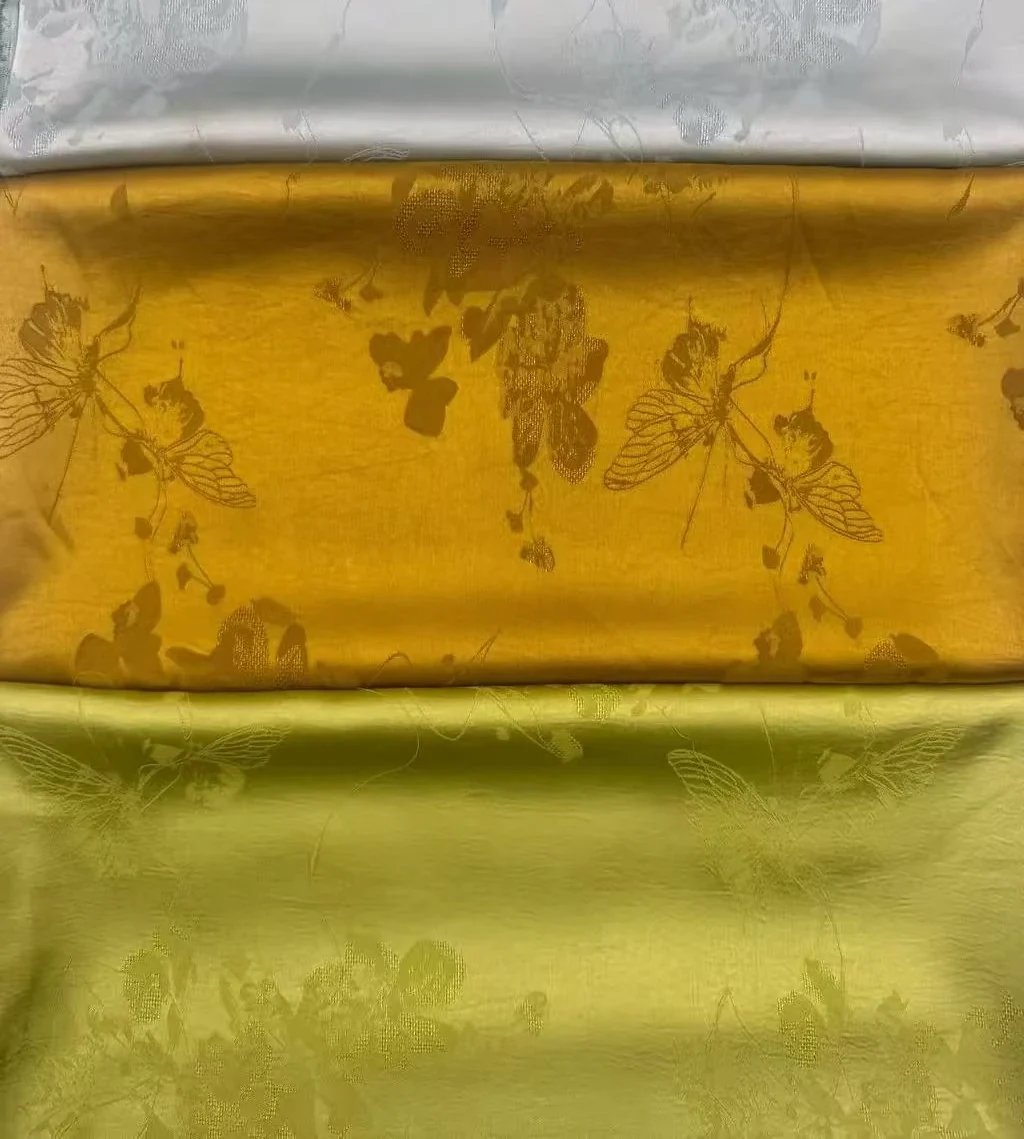
Short answer: three tests settle it in under a minute. Turn the cloth over and look at the back — a jacquard carries its pattern in the weave, a print sits on one face. Rake a light across the surface at 10–15 degrees — a jacquard’s pattern changes intensity, a print’s does not. Fold it twenty times along the same line — a print will show a white line at the crease, a jacquard will not.
Written for buyers who have already been shown a "jacquard" that turned out to be a print, or who suspect they are about to be.
Why This Question Gets Asked Wrong
Most buyers asking "jacquard or print?" are not asking an academic question. They are asking it because something already went wrong, or because a price came back that did not fit the pattern they were shown.
Three situations account for nearly every time this question gets asked:
One. A supplier quoted "jacquard" at a price that is 40% below every other quote. The buyer wants to know whether the cheap one is real before committing to 3,000 metres.
Two. Goods arrived, and the pattern looks flat, or the buyer's own QC manager said "this is printed" and now nobody agrees.
Three. A designer specified "jacquard" in a tech pack, the factory sourced something that technically satisfies the word, and the garment now photographs badly under studio light.
All three come down to the same thing: the word "jacquard" does not describe an appearance. It describes a manufacturing method. Two cloths can look identical in a photograph and be completely different objects on the roll, with different cost structures, different wear behaviour, and different reasons to exist.
This guide is about telling them apart with your hands, not with a spec sheet. The tests below need no equipment beyond a phone torch and the ability to fold a piece of cloth.
Part 1: The One Physical Difference Everything Else Follows From
1.1 Woven In Versus Laid On
A woven jacquard is made on a loom fitted with a jacquard head — a mechanism that lifts individual warp threads, or small groups of them, on every pick. The pattern is created by which threads are up and which are down at each pass of the weft. Nothing is added to the cloth afterwards. The motif is the structure of the cloth itself.
That single fact produces everything else:
- The pattern has the same depth as the ground, because it is the ground, organised differently.
- The pattern cannot crack, flake, or wear off at a fold, because there is no film to crack. The yarn that makes the motif is the same yarn that makes the rest of the cloth.
- The pattern is not visible from straight on under flat light, because the colour difference is created by weave geometry — light has to strike at an angle for the geometry to resolve.
- The reverse face is not a copy of the front. It is the wreckage of the front: the yarns that were held down while the motif was being formed have to go somewhere.
A print is the opposite in every one of those four points. The cloth is woven first — usually a plain weave — and then pattern is applied to the surface by rotary screen, digital inkjet, or transfer. The pattern is a layer on top of a finished object.
The one sentence to remember: in a jacquard, the pattern is made of the cloth; in a print, the pattern is made on the cloth.
1.2 Why the Two Are Easy to Confuse on a Screen
A photograph flattens exactly the cue that distinguishes them. On a phone screen, a jacquard is lit head-on and reduced to a colour field, which is precisely the condition under which a jacquard looks least like itself. A print under the same lighting looks its best, because a print's pattern is a colour difference and colour differences survive flat lighting perfectly.
This is why the confusion is so common in the sampling stage and so obvious at the roll stage. The buyer approves a photo, the cloth arrives, and the two do not match — not because anyone lied, but because the photograph was taken in the one lighting condition that hides the difference.
Our own product pages state it plainly, because it is the single most useful thing a buyer can be told about this cloth: a jacquard has to be judged on the roll rather than on a screen — the motif only resolves when light rakes across it.
1.3 What Jacquard Is Not
Three things get called jacquard that are not, and the distinction matters because the price should be different in each case.
| Term you will hear | What it actually is | Why the name is used |
|---|---|---|
| Jacquard knit | Weft-knitted fabric where different yarns are selected at each needle. A real jacquard technique, but a knitting one. | Legitimate use of the word, but a completely different product: stretchier, lighter, cheaper per metre, different drape. |
| Embossed jacquard | Plain cloth run through an engraved roller under heat and pressure to press a pattern into the surface. | The pattern is a deformation, not a structure. It relaxes with washing and steam. |
| Jacquard print / printed jacquard | Plain cloth with a pattern printed on it, where the pattern was designed to look woven. | Borrows the word to borrow the price. This is the case the rest of this guide is about. |
There is also dobby, which is a small-pattern relative of jacquard made with a dobby head rather than a jacquard head. Dobby patterns are limited to a small number of harnesses, so the motifs are geometric, small, and repeat over short distances. Dobby is a real woven structure and should be priced as woven — but it cannot produce a 19-colour floral, so anyone offering a 19-colour floral as "dobby" is using the word loosely.
Part 2: Three Tests You Can Run at the Inspection Table
Each test takes under two minutes. Run all three, because each one has a known failure mode where it gives the wrong answer on its own. The three together are close to conclusive.
You need: a 30 cm square of the cloth, a phone torch, and a flat surface. That is all.
2.1 Test One: Turn It Over
What to do. Lay the sample face down. Look at the reverse. Do not look at it as a whole — look for structure: threads that run across the back without entering the face.
What a jacquard shows. Floats. Long, irregular, wandering threads on the reverse, and their path traces the motif on the front. Where the front has a solid block of colour, the back has a bundle of that colour's yarn carried across. Where the front is a fine line, the back has a short jump. The more colours in the design, the messier the back — a 19-colourway design has eighteen colours' worth of yarn hidden on the reverse at any given point.
This is not a defect. It is arithmetic. To bring a colour to the face, the loom has to hold that yarn out of the way everywhere else, and "out of the way" means the reverse.
What a print shows. A back that is either uniformly the ground colour (pigment print, which sits on one face) or a faint mirrored ghost of the front pattern (dye print, where the colour penetrated). No floats. No thread paths. The back is a flat field with, at most, a soft blur of the front.
What a print can fake. A print can be given a brushed or peach-finished back to look "textured". What it cannot fake is a float path that follows the motif. Look for the correspondence between back structure and front pattern, not just for texture.
How this test fails. Double-cloth jacquard. If the cloth is woven as two layers joined at intervals — a real and common jacquard construction for upholstery and heavier apparel — the reverse is a complete second face with its own pattern, and there are no long floats. A double cloth will still pass Tests Two and Three, so do not stop here.
The principle to carry: a multi-colour single-layer jacquard cannot avoid floats on the reverse, because yarn held out of the face has to travel somewhere. Whether those floats are plainly visible on a given quality depends on the construction and on how tightly the back is bound in. Check the sample rather than the description — and if the reverse of a single-layer cloth is completely clean, ask how the colour reached the face.
Verdict rule. Float paths that trace the front motif → woven. Uniform or ghosted back → printed. Clean back with a second complete pattern → double cloth, run Tests Two and Three.
2.2 Test Two: Rake the Light
What to do. Lay the sample flat on a table. Hold a phone torch almost parallel to the surface — around 10 to 15 degrees above the cloth — and sweep it slowly across. Then bring the torch up to straight overhead and compare.
What a jacquard does. The motif changes intensity as the angle changes. At raking angle the pattern is at full strength, sometimes almost three-dimensional. At overhead it flattens, and on tonal designs it can nearly disappear into a textured solid.
This happens because a jacquard's pattern is a difference in weave geometry: satin floats reflect light in one direction, plain intersections scatter it, twill runs it along a diagonal. Change the light angle and you change which of those surfaces is throwing light at your eye. The pattern is not a colour difference, so it does not survive flat lighting — and it does not need to, because it is not trying to be seen flat.
What a print does. The pattern looks the same at every angle. Slightly brighter at overhead, slightly duller at raking, but the pattern itself — the shapes, the edges, the contrast between motif and ground — does not change. Ink on a surface is a colour fact, and colour facts are angle-independent.
How this test fails. Low-contrast woven designs. A single-colour tonal jacquard where the motif is formed by two weaves of the same yarn, in the same dye, can be subtle enough that raking light produces only a gentle shimmer rather than a clear pattern. This is a real limitation, not a trick. If the design is genuinely tonal and the test is inconclusive, Tests One and Three carry the decision.
Conversely, a print on a textured ground — printed onto a crinkle or a slub base cloth — will show some angle-dependent shimmer from the base texture. The shimmer will follow the cloth's texture, not the motif. Watch which of the two is moving.
Verdict rule. Motif strength rises sharply at raking angle → woven. Motif strength constant while only overall brightness changes → printed. Shimmer follows the base texture rather than the motif → printed on textured ground.
2.3 Test Three: Fold and Crease
What to do. Fold the sample sharply along a line that crosses the motif, press the fold hard with a thumbnail, unfold, and look at the crease line under good light. Then do it again in the same place, twenty times, and look again.
What a jacquard does. The crease line is a crease line. The cloth is bent, the yarns are displaced, and if the fibre is thermoplastic the crease may be sharp — but the pattern crosses the crease intact. There is no edge to break, because there is no layer.
What a print does. The pigment film breaks along the crease. On a pigment print over a white base, the crease line goes pale or white — the classic "cracked print" signature. On a dye print, the crease line abrades slightly lighter, and after twenty folds it can look faded in a narrow band.
How this test fails. Good pigment printing with a crosslinker and a soft binder can survive twenty folds without visible cracking, especially on a dark ground where any exposed base is invisible. And a print on a very dark ground over a dark base will not show white at all. So: a print can pass this test. A jacquard cannot fail it — if the pattern is intact but Tests One and Two said printed, trust One and Two.
Verdict rule. Crease line pale, white, or faded in a band → printed. Crease line intact with pattern crossing it → consistent with woven, but not proof on its own.
2.4 Running All Three Together
No single test is decisive on its own. The pattern of answers is what decides:
- Floats on the back, motif jumps at raking light, pattern survives folding — woven jacquard. This is the normal signature and needs no further argument.
- Clean or ghosted back, motif constant at all angles, crease line pale — printed. Three for three, no ambiguity.
- Clean back, but motif jumps at raking light — this is the interesting case. It means the cloth is woven but is probably a double cloth, or the sample is a jacquard whose floats are buried in a tight construction. Ask the mill for the construction: number of layers, warp and weft count, and whether a jacquard head was used. A mill that cannot answer those three questions in writing is not weaving.
- Floats on the back, but motif flat at all angles — usually a jacquard in a low-contrast colourway, occasionally a jacquard with a print over the top. Both exist. The second is worth asking about explicitly, because it is a legitimate product sold under an ambiguous name.
Part 3: A Judgement Table
The three tests, side by side, with what each one can and cannot tell you. Print this and take it to the inspection table.
| Test | Woven jacquard shows | Print shows | What this test cannot tell you |
|---|---|---|---|
| Reverse face | Float threads whose path follows the front motif; more colours means messier back | Uniform ground colour, or a faint mirrored ghost of the pattern; no float paths | Cannot see through a double cloth, where the back is a complete second face |
| Raking light | Motif strength rises sharply as the light goes low; pattern can vanish at overhead | Motif strength unchanged at any angle; only overall brightness shifts | Cannot resolve a genuinely tonal single-colour weave, where contrast is low by design |
| Fold and crease | Crease line intact; pattern crosses it without interruption | Crease line pale, white, or faded in a narrow band after repeated folding | Cannot catch a well-bonded pigment print on a dark ground over a dark base |
Two more cues that cost nothing to check:
Selvedge. A woven jacquard's selvedge is a woven edge with visible weft turning points. If the pattern runs to the very edge with a cut, sealed line, the cloth was printed and then cut from a wider piece — normal for print, and a hint worth noting.
Hand versus weight. At 150 gsm a woven jacquard has a density that a print on a plain 90 gsm base cannot match: it holds a fold, it does not collapse, and it has a slight body in the hand. A "jacquard" that feels like a shirt poplin with a pattern on it is a shirt poplin with a pattern on it.
Part 4: The Words Suppliers Use That Mean Nothing
This section exists because most disputes about jacquard are not disputes about cloth. They are disputes about a word. The word was never defined, both sides read it their own way, and the goods are technically compliant with one reading.
Here is what each phrase actually commits the seller to.
4.1 "Jacquard" on Its Own
Commits to: nothing enforceable. In trade usage "jacquard" can mean a woven jacquard, a jacquard knit, an embossed cloth, or a print designed to look woven. A supplier using the bare word is not lying — they are leaving the meaning open.
What to do: never accept it alone. Add woven. Add the construction. Add the composition. The word "jacquard" is a category, not a specification.
4.2 "Jacquard Print" and "Printed Jacquard"
Commits to: a print. Both phrases say so in plain words. There is no ambiguity here, and no deception — the phrase is honest.
Why it still causes trouble: the word "jacquard" in front of "print" is doing commercial work. Buyers scan the phrase, register "jacquard", and anchor their price expectation to woven goods. A quote of US$1.10 per metre then reads as a bargain rather than as the price of a print.
What to do: if the phrase appears in a quotation, re-read the price against print benchmarks, not against woven benchmarks. Then decide whether the visual imitation is good enough for the end use. It often is — a printed jacquard-look cloth is a perfectly reasonable product for a garment with a six-week life. It is just not a jacquard.
4.3 "Digital Jacquard"
Commits to: usually a digital print. Occasionally a genuinely digital-jacquard loom, which exists but is rare, expensive, and not what a general supplier means.
What to do: ask one question — "is the pattern formed by the loom or applied after weaving?" The answer takes ten seconds and settles it. If the answer is "after weaving", it is a print and should be priced as a digital print: no plate cost, 1 metre minimum, higher per-metre ink cost.
4.4 "Jacquard Effect" and "Jacquard Look"
Commits to: an appearance, not a method. These phrases are honest and are the ones to look for when a supplier is being straight with you. "Jacquard effect" means "we made something that looks like jacquard".
What to do: treat it as a print unless told otherwise, and price it as a print. Then judge it on whether the effect is good — because for some end uses an effect is all that is needed.
4.5 "Embossed Jacquard" and Jacquard Versus Embroidery
Embossed is a heat-and-pressure deformation of a plain cloth. The pattern is a dent. It relaxes with steam and washing, and it cannot hold a fine multi-colour design. Legitimate product, wrong word.
Embroidery is a fourth thing entirely — stitching on top of a finished cloth. It is easy to distinguish from jacquard: embroidery has raised thread on one face and a stiffened, sometimes scratchy back with stitch-lock evidence. It is also piece-based rather than metre-based, so it is quoted per garment, not per metre. Anyone quoting embroidery per metre is quoting something else.
4.6 The One Question That Settles All of It
If you only ask one thing, ask this, in writing, and require a written answer:
"Is the pattern formed during weaving on a jacquard head, or applied to the cloth after weaving?"
A weaving mill answers this in one sentence without hesitating, because the answer is the first thing they know about their own product. A trader who is reselling print and calling it jacquard will either answer evasively or answer "after weaving" — which is fine, as long as the price follows.
Part 5: Why the Difference Costs What It Costs
Buyers often assume the price gap between jacquard and print is a margin decision. It is not. The two products have cost structures that do not resemble each other, and understanding where the money goes tells you which quotes are plausible.
5.1 Where Jacquard Cost Sits: Loom Time
A jacquard head has to select and lift warp threads on every single pick. On a plain weave, the loom does the same thing every time and can run fast. On a jacquard, every pick is a different decision, and the mechanism pays for it in speed.
Three things push the cost up, and all three are physical:
- Design complexity. More colours and finer detail mean more selections per pick and slower running.
- Pattern repeat size. A large repeat requires more warp control across a wider width.
- Colourway count. Each colourway is a separate warp beam or a separate dye lot. Sixteen colourways off one weave is not sixteen times the loom time, but it is sixteen set-ups, sixteen dye lots, and sixteen quality risks.
This is why the minimum order in woven jacquard is what it is. Our own range runs at 300 metres per colour, and that number is not a commercial policy — it is the cost of putting a warp on the loom and getting a clean run out of it. Below that, the set-up cost per metre dominates and the price stops making sense for either side.
The practical consequence: when a quote for woven jacquard comes in far below the market, one of four things is true. The design is much simpler than you think. The colourway count is lower. The construction is lighter. Or it is not woven jacquard. Ask which, and the answer will usually be the fourth.
5.2 Where Print Cost Sits: Screens or Ink
Print has the opposite cost shape. The cloth is cheap because it is usually a plain weave running fast. The pattern cost is front-loaded:
- Rotary screen print: one engraved screen per colour, a fixed set-up cost per colourway, then a low and falling per-metre cost as the run gets longer. Excellent economics above a few thousand metres; painful below 500.
- Digital print: no screens, no set-up, viable from 1 metre. The per-metre cost is high because ink and machine time are high, and it barely falls with volume.
So print does not have a single price point. It has a curve that crosses the jacquard price at different places depending on colourway count and run length. A buyer comparing one print quote to one jacquard quote is comparing two points on two different curves.
5.3 The Honest Comparison
The fair way to compare is not price per metre. It is cost per finished garment that still looks right after the customer has worn it twenty times.
A print at US$1.10 that fades at the collar by week six has a different cost than a jacquard at US$1.95 that does not. Whether that difference is worth it depends entirely on the garment's price point and intended life — which is the subject of the next section, and the reason this guide does not end with "always buy woven".
Part 6: When Print Is the Right Answer
This section is here because a guide written by a jacquard mill that concludes "always buy jacquard" is not a guide, it is a sales page. There are real situations where print is the correct choice and specifying jacquard would be a mistake. Knowing which is which is the actual skill.
6.1 Five Cases Where Print Wins
| Situation | Why print wins | What it costs you |
|---|---|---|
| You need 80 metres to sample a collection | Woven jacquard has a 300 m per colour floor because of warp set-up. Digital print has no floor. | Higher per-metre price, but you only buy what you need. |
| You need 30 new designs a season | Each jacquard design needs a new harness or jacquard-head programme. Each print design needs a new file. | Print design changes are almost free; jacquard design changes are not. |
| The design is photographic or needs smooth gradients | Jacquard resolution is bounded by warp and weft density — you cannot render a gradient finer than the thread grid. Digital print has no such limit. | Woven cannot do it at any price. This is a hard boundary, not a cost issue. |
| The garment has a six-week commercial life | The jacquard premium buys durability at folds. A fast-fashion piece will be discarded long before folds matter. | You paid for a property the customer never tests. |
| You need 20+ colours in one design | Each colour in a jacquard is a yarn position. Twenty colours is a very heavy construction and a very expensive cloth. | Possible, but rarely economic below luxury price points. |
6.2 The Four Cases Where Jacquard Earns Its Premium
One: the pattern has to survive being worn. Collars, cuffs, seat, elbows, bag straps. Anywhere a print will crack is somewhere a jacquard will not. If your garment's pattern is in a high-abrasion zone, the premium is buying a real property.
Two: the cloth has to be the product. Occasionwear, ceremony dressing, wall panels, large cushions, statement outerwear. In these uses the customer looks at the cloth, not through it, and a woven surface reads as quality in a way a print does not — particularly in photographs under directional light, which is how the garment will be sold online.
Three: the design needs to read as tonal. A jacquard in a single dye, where the motif comes from weave geometry rather than colour, produces an effect print cannot reproduce: it is quiet head-on and strong in motion. That "only resolves at an angle" quality is the whole point of the cloth, and it is why tonal designs exist in this range at all.
Four: the buyer is selling to a market that checks. Some markets — and some retail buyers — inspect the reverse face as a matter of routine. A print presented as jacquard fails that inspection, and the reputational cost of one failed shipment exceeds the entire margin on the order.
6.3 A Decision Rule
Ask three questions in order. Stop at the first "yes".
- Does the design need photographic detail or smooth gradients? Yes → print. Woven cannot do it.
- Is the total order under about 300 metres per colour? Yes → print, unless you can consolidate colourways.
- Will the pattern sit in a high-wear zone, or is the cloth itself the selling point? Yes → jacquard, and the premium is justified.
If all three are "no", the decision is commercial rather than technical, and either answer is defensible. That is when price and lead time should decide.
Part 7: What to Write in the Tech Pack and the Purchase Order
Everything in this guide is worthless if the purchase order says "jacquard" and nothing else. The specification is the only thing that is enforceable. Write it so that a print cannot satisfy it.
7.1 The Specification Block
Do not write: Jacquard fabric, floral, 150 gsm.
Write this instead, filling in your own values:
Fabric: Woven jacquard, [single layer / double cloth — specify].
Composition: 97% polyester / 3% spandex.
Construction: Crepe jacquard, pattern formed on a jacquard head during weaving.
Weight: 150 gsm ±5%.
Width: 150 cm usable.
Colourways: [n] per design, dye-matched to approved swatch.
Minimum: 300 m per colourway.
Lead time: 7–10 days after colour confirmation.
The load-bearing words are woven, the layer count, and formed on a jacquard head during weaving. Those three together exclude print, exclude embossing, and exclude ambiguity.
7.2 The Three Clauses Worth Adding
Clause one — method, stated as a requirement.
The pattern shall be inherent to the weave and shall not be applied to the surface of the cloth by printing, coating, transfer, or embossing. Surface-printed or embossed imitation shall be deemed non-conforming.
Clause two — the right to test.
Buyer reserves the right to inspect the reverse face and to conduct a raking-light examination on receipt of goods, prior to cutting. Non-conformance identified at this stage shall be treated as a quality defect.
This clause matters more than it looks. It creates a contractual moment — before cutting — at which you are allowed to reject. Without it, a supplier can argue that cutting the roll accepted the goods.
Clause three — the consequence.
Where goods are found to be surface-printed rather than woven, seller shall bear the cost of return freight and shall refund the full invoice value, or replace with conforming goods at seller's option.
7.3 The Inspection Window
A method clause is only usable if you have time to use it. Most fabric disputes are lost not on the merits but on the calendar: goods arrive, they go into production, and by the time anyone looks at the reverse face the cloth is cut.
Build in an inspection window. Ours is seven days from delivery, uncut — that is, the buyer has seven days to inspect the fabric before cutting, and cutting ends the guarantee. Seven days is enough to run three tests on a sample from every roll. It is not enough to run a full four-point inspection on 10,000 metres, so prioritise: sample the first and last roll of each dye lot and every roll where the selvedge looks different.
Part 8: If You Already Bought the Wrong Thing
This happens more often than anyone admits, and the outcome depends almost entirely on what you do in the first 48 hours.
8.1 Step One: Fix the Evidence Before You Touch Anything
Do not cut. Do not wash. Do not send a sample to the factory for a test garment. The moment the cloth is altered, your position weakens.
Photograph, on the same piece of cloth, in this order:
- The reverse face, close enough that thread structure is legible, with a ruler or coin for scale.
- The raking-light shot — torch at 10–15 degrees, same piece, same framing.
- The crease line after twenty folds, same piece again.
Three photographs of one piece of cloth is a much stronger file than thirty photographs of thirty pieces, because it establishes that the three observations describe the same object. Include the roll label and the dye lot number in at least one frame.
8.2 Step Two: Read Your Own Contract Before You Argue
Be honest with yourself about what the paperwork says. Three possibilities:
- The order says "woven jacquard" or names a construction — you have a case. The goods do not conform to the specification.
- The order says only "jacquard" — you have a weak case. The supplier will argue that "jacquard-look print" satisfies the word, and in many jurisdictions they will be right.
- The order says "jacquard print" or "printed jacquard" — you have no case on method. You bought a print and were told so. Your only argument is on appearance, if the appearance does not match the approved sample.
This is why Part 7 exists. The cost of writing three extra clauses at order stage is zero. The cost of not writing them is the entire order.
8.3 Step Three: Quantify the Gap
Before you negotiate, know the number. Compare what you paid against a realistic print price for the same construction, not against a jacquard price. The gap is usually substantial — printed polyester of comparable weight typically lands well below woven jacquard of the same weight — but the exact figure depends on your market and volume.
Having the number changes the conversation. "This is not what I ordered" invites an argument about words. "I paid a woven price for a printed cloth; the difference is X" invites a settlement.
8.4 Step Four: Choose Your Remedy Deliberately
Four options, roughly in order of how often they are the right one:
Price adjustment and keep the goods. Usually the best outcome if the cloth is usable for the intended end product. You get the money back without losing the season. Most suppliers will agree to this quickly because it costs them less than a return.
Replacement with conforming goods. Only viable if you have time. A jacquard re-run is 7–10 days after colour confirmation plus shipping, so this remedy is for orders placed early, not for orders needed next month.
Return and refund. The cleanest outcome legally and the most expensive practically: return freight on fabric is heavy, and the season does not wait. Reserve it for goods that are unusable, not merely misdescribed.
Accept and record. Sometimes correct. If the cloth works, the price was fair for a print, and the relationship is worth more than the argument, accept it — but write down what happened, and put the three clauses into the next order.
8.5 Step Five: Change One Thing for Next Time
Buyers who get caught twice usually got caught the same way both times. Pick the single control that would have prevented it and make it standard:
- Add the method clause to every fabric PO, not just jacquard ones.
- Require a 30 cm reverse-face photograph with every quotation.
- Inspect the first roll before authorising the balance payment.
One of these, applied consistently, closes the gap. All three is better, and none of them costs money.
FAQ
Is jacquard always more expensive than print?
Per metre at the same run length, almost always — the loom time is real. But the comparison is not always like for like. A 300-metre digital print run can cost more per metre than a 3,000-metre woven jacquard run, because digital print has high per-metre ink and machine cost and no volume discount. Compare at equal volume and the woven premium reappears.
Can a printed fabric be passed off as jacquard convincingly?
In a photograph, easily. On a roll, not for long. The reverse face is the hard tell — printing cannot produce float paths that follow the motif. The reason printed jacquard-look cloth sells is that most buyers only ever see photographs before they commit.
Does jacquard fade?
The pattern does not fade in the way a print does, because there is no surface layer to lose. The cloth as a whole can still change colour from light exposure, washing, and abrasion, exactly as any dyed textile can — and colourfastness is a dyeing property, not a weaving one. Ask for wash and rub fastness test data on the actual dye lot; ISO 105-C06 and ISO 105-X12 are the usual references, and AATCC 61 and AATCC 8 are the equivalents used in the US market.
How do I tell jacquard from embroidery?
Embroidery has raised thread sitting on top of a finished cloth, and a back with stitch-lock evidence and often a stiffened hand from backing material. Jacquard has no added thread — the pattern is the cloth's own yarns reorganised. Embroidery is also quoted per piece or per garment, not per metre.
Is jacquard knit the same as woven jacquard?
No, and the difference is not cosmetic. Knitted jacquard is made by selecting yarns at individual needles; it stretches, drapes softly, and is generally cheaper per metre. Woven jacquard is made by lifting warp threads on a loom; it is dimensionally stable, holds a fold, and costs more. Both are legitimate jacquard techniques. They are not substitutes for each other in a garment.
Can I tell from a phone photo before ordering?
Partly. Ask for two specific photographs: a close-up of the reverse face, and a shot taken with a light source almost parallel to the cloth surface. Those two images will show floats or their absence, and will show whether the pattern strengthens at a low angle. A flat head-on product shot tells you nothing about method.
What about single-colour jacquard — how do I tell that apart?
It is the hardest case, because the raking-light test is weak when motif and ground are the same colour. Go to the reverse: a single-colour woven jacquard still shows float paths, because the yarn held out of the face still has to run across the back. If the reverse is clean and uniform, it is not woven, regardless of how subtle the front looks.
Does jacquard shrink?
Less than most woven cloths of comparable weight, but it does shrink — typically a small amount in warp and weft after the first wash, depending on finishing. Get the residual shrinkage figure for the specific quality, and test a 30 cm square yourself before cutting a production run. Do not rely on a generic figure for "jacquard" as a category; it varies by mill and by finishing route.
Why does the pattern disappear when I look at it straight on?
Because the motif is formed by weave geometry rather than by colour. Different weaves reflect light at different angles, so the pattern resolves when light arrives at a low angle and flattens when it arrives head-on. This is normal and is the signature of a woven tonal jacquard, not a defect. It is also why the cloth photographs poorly under flat studio lighting and well under directional light.
Can jacquard be printed on top of?
Yes, and it is done. A woven jacquard can be over-printed to add colour or detail. This is a legitimate product but it complicates the distinction, because the cloth will pass the reverse-face test and the raking-light test while still carrying a printed layer. If you are specifying woven jacquard and do not want over-printing, say so explicitly in the purchase order.
Next Steps
If you are evaluating a quote right now: ask for the reverse-face photograph and a raking-light photograph before you discuss price. If the supplier cannot produce them, that is itself information.
If you are writing a tech pack: copy the specification block in Part 7.1 and the three clauses in Part 7.2. They take five minutes and they are the difference between a specification and a hope.
If you want to see what a woven jacquard actually looks like on the roll: our range is twelve designs in four families, from tonal butterfly florals at the restrained end to a dragon with auspicious objects at the dense end — all on one base cloth, 97% polyester / 3% spandex, crepe jacquard, 150 gsm, 150 cm, 300 metres per colour, 7–10 days after colour confirmation. Sample the quality before you choose the colour: the weave, not the shade, decides whether a design suits your garment.
If you want the longer version of this subject — construction, colourways, cutting waste, care, and how the twelve designs differ — that is covered in the Chinese jacquard buying guide.
Ask for a swatch pack and run the three tests yourself. We would rather you check.
Data Sources Cited
Test methods referenced in this guide, cited by standard number only:
- ISO 105-C06 — colour fastness to domestic and commercial laundering.
- ISO 105-X12 — colour fastness to rubbing (crocking).
- ISO 139 — standard atmospheres for conditioning and testing textiles.
- ISO 12947 — abrasion resistance of fabrics by the Martindale method.
- AATCC 61 — colourfastness to laundering, accelerated (US equivalent of ISO 105-C06).
- AATCC 8 — colourfastness to crocking (US equivalent of ISO 105-X12).
- OEKO-TEX Standard 100 — harmful substance testing for textile articles.
Product specifications in this guide — composition, weight, width, minimum order, lead time — describe our own range and are stated on each product page. They are not presented as industry norms. Where this guide describes what other suppliers do, it is describing patterns observed in sourcing conversations, not a survey. Buyers should treat those passages as hypotheses to test, not as market data.
Mujia Textile — running our own air-jet looms in Zhuji since 2012.