Double Layer Gauze Ready Stock: What Is Actually On the Shelf, and What Still Has to Be Made
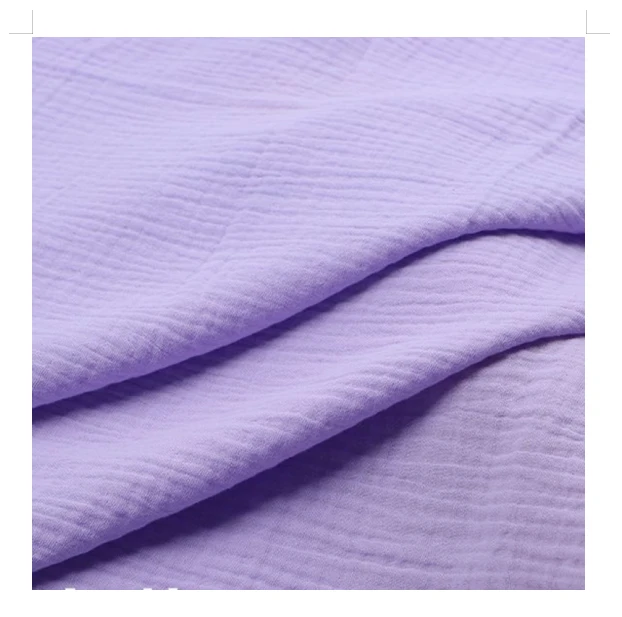
In short: our double gauze ready-stock program, M4011, is one greige - 100% cotton, 125 GSM, 135 cm - kept dyed in 182 solid colours at 300 metres per colour, shipping about 15 days after colour confirmation, FOB USD 1.40–2.20/m. Prints run on the M4011-1 base at 140 GSM: three ready colourways from USD 1.77–2.57/m, digital printing for any design with no plate fee. Class A infant-safe, OEKO-TEX Standard 100 on request.
The ready-stock programme in five numbers
Buyers searching for a "double layer gauze ready stock supplier" are usually holding a baby or kids collection and a launch date. The five numbers below are the whole programme on one line each - and every one of them is a promise we hold stock against, not a brochure claim. The full specification sits on the cotton double gauze manufacturer page.
| Item | Number |
|---|---|
| Base cloth | 100% cotton, 125 GSM, 135 cm, two-layer crinkle |
| Stock shades | 182 solid colours, one greige, shade 1–182 |
| MOQ | 300 metres per colour (solids and prints) |
| Lead time | About 15 days after colour confirmation |
| FOB price | USD 1.40–2.20/m solid; USD 1.77–2.57/m digital print |
Read the table as one decision, not five: if your collection can be built from 300 metres per shade, the whole card is open to you in about 15 days. If it cannot, the conversation moves to custom dyeing, and the numbers change with it.
What "ready stock" means here - and what it does not
Ready stock is the most misused phrase in fabric inquiries. On our floor it means a physical position: dyed rolls in named shades, reserved samples per shade, and batch records that let shade 63 match shade 63 four months apart. That is what the 182-colour stock programme actually costs - the samples and the discipline behind them are the product, not just the dyes.
What it does not mean: unlimited metres of every shade, and it does not mean the printed designs. The stock position moves every week as orders ship and new batches land. So the honest answer to "do you have it in stock" is always the current position for your shades and quantities - which is exactly what we answer with: stock position, lab-dip date and FOB price for the shades you asked about. For the wider sourcing sequence around that answer, see the muslin fabric sourcing guide.
Solid shades: 182 colours from one greige
Every solid shade on the card is dyed from the same M4011 greige: 100% cotton, 125 GSM, 135 cm, woven as two fine gauze layers joined at interlocking tie-points. One greige is the quiet advantage of the programme - the loom schedule stays simple, greige inventory turns fast, and quality control has one fabric to know cold, so every metre you dye starts from cloth the mill already understands.
The crinkle is built into that structure, not pressed in by a finishing trick: the two layers are joined at intervals, and the join is what makes the cloth pucker and trap air when it relaxes in the wash. The tie-point note explains the construction, and double gauze vs muslin explains why the layer count is the cloth: what separates gauze, double gauze and muslin is layers and tie-points, and the GSM number quoted per layer or in total decides which cloth you actually get.
Baby-grade: Class A is a specification, not a feel
Most double gauze inquiries are for baby and kids products, and the first question is nearly always about handfeel. The honest mill answer is that softness is cheap to promise and reversible; the class that governs whether the fabric is legal next to a baby's skin is not. The M4011 program is specified Class A infant-safe on our product data.
Class A is the top infant-contact class under China's national textile safety standard GB 18401. It covers the things a swatch cannot tell you: formaldehyde content, pH, colour fastness to water, perspiration and saliva, azo dye restrictions and extractable heavy metals. The exact limits depend on the market you sell into and the edition of the standard that applies, which is why the right move is to ask for the test report and match it against your own market's requirements. The full walk-through is in the baby-grade certification note.
| Question | Swatch | Certificate |
|---|---|---|
| Handfeel | Yes - in your hand | No |
| Formaldehyde, pH, heavy metals | No | Yes - Class A, GB 18401 |
| Fastness to water, perspiration, saliva | No | Yes - per test report |
| Azo dye restrictions | No | Yes - per test report |
That split is the whole compliance conversation: judge the hand on the swatch, judge the legality on the paper. Where buyers actually get burned is trusting one for the other.
Printed ready stock: the M4011-1 base at 140 GSM
Solids are the deep end of the stock programme; prints are a thinner shelf, and it is better to know that before you plan a collection around them. The printed line M4011-1 runs on a 140 GSM base at 135 cm in three ready colourways, quoted at FOB 1.77 to 2.57 US dollars per metre with a 300-metre-per-colourway minimum. Our print programme offers 20 floral designs in 3 colorways each, with pink rose (FC-01 to FC-03) in stock; beyond those, digital printing is available for any design with no plate fee.
| Item | M4011 solid | M4011-1 printed |
|---|---|---|
| Base weight | 125 GSM | 140 GSM |
| Width | 135 cm | 135 cm |
| Ready stock | 182 solid colours | Three ready colourways; pink rose FC-01 to FC-03 in stock |
| FOB | USD 1.40–2.20/m | USD 1.77–2.57/m |
| MOQ | 300 m per colour | 300 m per colourway |
| Custom route | Custom reactive dyeing | Digital print, any design, no plate fee |
Why the printed base runs heavier: a print pass needs a slightly denser cloth to carry the artwork. The full artwork-to-bulk sequence - where the print sits, registration, colour fastness, sampling - is the printed double gauze guide, and it is the right document to read before sending a floral file.
FOB prices and what moves them
Two published ranges cover the programme: USD 1.40 to 2.20 per metre for solid shades and USD 1.77 to 2.57 per metre for digital prints, both FOB China port. The range inside each quote reflects design and packing rather than colour depth. Both are T/T, with larger orders by agreement.
| Line | FOB range | What the range follows |
|---|---|---|
| M4011 solid shades | USD 1.40–2.20 / metre | Design and packing |
| M4011-1 digital prints | USD 1.77–2.57 / metre | Design and packing |
An FOB number is a build-up, not a mood: the FOB cost breakdown shows the lines inside one, and the practical consequence is that the price you get in an inquiry answer is built on your actual quantity and packing. For the payment half of the deal, the MOQ and payment guide covers terms and what a lab dip costs.
MOQ 300 metres per colour: how to read it
The minimum is 300 metres per colour for solids and prints alike. Per colour, not per order: splitting a quantity across shades does not meet it. A five-shade baby capsule therefore means a 1,500-metre order, and that arithmetic - not the 300 itself - is what decides whether the stock programme fits a first collection.
The 300-metre minimum exists because of what the stock programme carries: 182 shades, each with a reserved sample and batch records, each holding shelf space batch after batch. The upside for the buyer is real - a full colour card from one certified mill at a small minimum - and the trade is that each shade ordered respects the position that makes the next buyer's 300 metres possible.
Lead time: about 15 days after colour confirmation
Stock shades ship in about 15 days after colour confirmation. The qualifier matters: confirmation is its own step, and you approve a swatch or lab dip before the clock starts. Count the colour-approval step separately when you plan a season - a mill that quotes one fixed lead time for both "stock" and "custom" before seeing your shade is quoting a guess.
The same rule applies to the printed line: three ready colourways can ship against the stock clock, while a custom artwork goes through artwork approval and a print run - artwork to bulk is its own sequence. The full sample-to-bulk structure, with the approval steps laid out in order, is in the sample to bulk timeline.
Fuzz is not pilling: the grade to write down
Double gauze sheds loose fibre in its first washes. Buyers see that fuzz in the wash water or on a dark garment worn over the gauze and call it pilling. It is not: fuzz is housekeeping, the cloth shedding what was never anchored. A pill is anchored fibre worked into a knot by rubbing, and pills are what the tests measure.
The standard measure is ISO 12945-2 (Martindale), graded 1 to 5 against reference photos, where 5 means no visible change. A PO line that says "pilling grade 4" with no method and no wash state says nothing. Write the method, the grade and the wash state - the working example is in the pilling grades note.
What washing actually does to the cloth
"It gets softer with every wash" is on every double gauze listing, and it is half true. The first washes do three things at once: water releases the weaving tension held in the warp and weft, agitation frees short surface fibres, and mechanical action works the tie-points so the two layers move against each other. That relative movement - two layers with air trapped between them - is the softness buyers are actually feeling.
The half that is untrue is the open-ended promise: softness that comes from a finish can wash out, and a cloth that goes limp after eighteen months is a claim dispute waiting to happen. Judge softness on a washed sample, not a finished swatch - the mill-side version of this argument is in the softness-after-washing note.
Certification chain: Class A, OEKO-TEX on request, MTQS
Three documents cover the programme, and they answer different questions. Class A under GB 18401 answers "is it legal next to a baby's skin" - the M4011 program is specified Class A infant-safe on our product data. OEKO-TEX Standard 100 is available on request through certified upstream partners, with the certificate available on request. And MTQS, our proprietary quality inspection system, is the mill-side regime the rolls are inspected under before they leave.
Certificate numbers are article-specific, so a buyer ordering solids and prints should hold the papers for each. The certification picture across the wider range, and how to verify a claim before wiring money, is in the certification guide for China sourcing.
What to write in the inquiry
An inquiry that says only "double gauze, ready stock" gets a brochure. An inquiry with the six lines below gets the stock position, the lab-dip date and an FOB price built on your actual packing - the three things that turn a search result into an order.
| Line | Example |
|---|---|
| Product and construction | Double layer gauze (muslin crinkle), two-layer, tie-point join |
| Spec | 100% cotton, 125 GSM (solid M4011) or 140 GSM (printed M4011-1), 135 cm |
| Shades or artwork | Solid shades from the 182-colour card, or artwork file for digital print |
| Quantity | Metres per colour - 300 m per colour minimum |
| Compliance | Class A (GB 18401) test report; OEKO-TEX Standard 100 on request |
| End use | Baby and kids, loungewear, summer apparel |
Six lines, and most of the back-and-forth disappears. Most sourcing delays on a stock fabric are specification delays wearing a logistics costume; the inquiry is where they are prevented.
Frequently asked questions
What does "ready stock" actually mean for double gauze?
On our M4011 program it means this: one greige base - 100% cotton, 125 GSM, 135 cm wide - kept dyed in 182 solid colours, 300 metres per colour, shipping in about 15 days after colour confirmation. It does not mean unlimited metres of every shade: the stock position moves every week, so an inquiry gets the current position, lab-dip date and FOB price for the shades you actually want. Ready stock applies to the solid line; the printed line M4011-1 has three ready colourways and prints anything else to order.
How many colours are in stock, and what is the minimum per colour?
182 solid colours, numbered shade 1 through shade 182, from soft pastels through deep saturated hues, all dyed from the same M4011 greige. The minimum is 300 metres per colour for solids and for prints alike. The minimum is per colour, not per order - splitting a quantity across shades does not meet it, so a five-colour capsule means a 1,500-metre order.
Is the stock double gauze safe for baby products?
The M4011 program is specified Class A infant-safe on our product data. Class A is the top infant-contact class under China's national textile safety standard GB 18401, covering formaldehyde content, pH, colour fastness to water, perspiration and saliva, azo dye restrictions and extractable heavy metals. OEKO-TEX Standard 100 is available on request through certified upstream partners. Ask for the test report and compare it against your own market's requirements before you wire money.
What does ready stock double gauze cost?
Solid shades are quoted at USD 1.40 to 2.20 per metre FOB China port; digital prints on the M4011-1 base are quoted at USD 1.77 to 2.57 per metre. Both are T/T, with larger orders by agreement. The range inside each quote reflects design and packing, so the number you get in an answer to an inquiry is built on your actual quantity and packing, not the card.
Can I get a print from stock?
Partly. The printed line M4011-1 runs on a 140 GSM base at 135 cm in three ready colourways at a 300-metre-per-colourway minimum; our print programme offers 20 floral designs in 3 colorways each, with pink rose (FC-01 to FC-03) in stock. Beyond that, digital printing is available for any design with no plate fee - artwork to bulk is its own process, not a stock pick.
What is the lead time on stock shades?
About 15 days after colour confirmation for stock shades. Confirmation is its own step: you approve a swatch or lab dip first, then the clock starts. Count the colour-approval step separately when you plan a season, and ask for the stock position and the ship date together so the two numbers describe the same batch.
Does double gauze get softer with every wash?
Partly true. The first washes release weaving tension and free short surface fibres, and the mechanical action works the tie-points so the two layers move against each other - that relative movement, with air trapped between the layers, is the softness. But loose surface fuzz in the first washes is not pilling: fuzz washes away, while pills are anchored fibre knots measured under ISO 12945-2, graded 1 to 5. Write the grade, the method and the wash state into the PO, not just a word.
Where to go next
The programme lives on the cotton double gauze manufacturer page. For the corners of the programme, start with the 182-colour stock programme, the baby-grade certification note and the printed double gauze guide.
Send us your shades or artwork and your metres per colour. We will answer with the current stock position, the lab-dip date and the FOB price for your actual packing through the quote request.