Does Double Gauze Really Get Softer With Every Wash?
Every double gauze listing says the same sentence: it gets softer with every wash. It is on the product pages, in the trade show brochures, and in the first email from any supplier you ask. It is also half true, and the half that is untrue is the half that causes arguments eighteen months later when a customer says the cloth has gone limp.
This is what we see on the mill floor and in the returned garments, and it is the version we would rather you bought against.
What “softer” actually is
A woven cotton straight off the loom carries tension. The warp was held under tension to be woven, the weft was inserted against it, and the whole structure is locked in that state by the finish. Double gauze adds a second variable: two separate gauze layers joined at interlocking tie-points, so each layer can relax a little independently of the other.
The first wash does three things at once. Water lets the cotton fibres swell and the yarn crimp straighten out, which releases the weaving tension. Agitation frees the short surface fibres that the loom left standing up, which is the fuzz you see in the dryer filter. And the mechanical action works the tie-points, loosening the join just enough that the two layers start to move against each other rather than as one board.
That third effect is the one that makes double gauze feel the way it does. Not the fibre — the relative movement between two layers with air trapped between them.
The curve: softest is not infinite
If softening were a straight line, a garment washed fifty times would be softer than one washed five, and it is not. The change follows a curve that flattens quickly. In our experience the hand settles by the third to fifth home wash. Physically this is what you would expect: the residual weaving tension is a finite quantity, and once it is gone there is nothing left to release. What continues after that is abrasion, which is a different process — it takes fibre off rather than relaxing it, and its visible form is pilling, not softness.
This matters commercially for one reason. A supplier who promises “keeps getting softer” is promising something cotton cannot deliver. A supplier who says “settles by the fifth wash and holds” is telling you what will actually happen, and it is a better promise, because it is one you can test and one you can put in front of a customer.
What each wash takes out, and what it costs
Softening is not free. The same relaxation that makes the cloth feel supple also takes up length and width, and on a 125 GSM two-layer construction there is more room to take up than on a tightly woven poplin. Expect the first wash to move the cloth measurably, the second to move it a little, and the third to move it hardly at all.
The practical consequence is a sequencing rule: settle your dimensions after washing, not before. If a pattern is graded from flat, unwashed cloth, the first wash will hand the customer a garment one size down at the length and half a size down at the width. If it is graded from a washed sample, the garment stays where it was put. This is not a finishing detail. It is the difference between a programme that repeats and a programme that gets remade.
Measure it rather than assume it. Mark a 50 cm square on the flat cloth, wash and dry it the way the garment will be washed, condition it flat for a few hours, and measure again. The difference in each direction is the allowance your pattern needs, and it is a property of your cloth and your wash regime rather than a figure anyone can hand you across a table. We will tell you what our own lots do; only your test tells you what yours will do.
The second cost is at the tie-points. Every wash works them, and a join that was specified loosely will start to separate. That is why we treat “layers remain joined after five laundering cycles” as an acceptance condition rather than a nicety, and why the tie-point density is the first thing to look at on a swatch rather than the last.
Three kinds of fake soft
A swatch can feel wonderful and still be the wrong cloth. There are three ways to arrive at a soft hand that will not survive the customer's laundry, and all three are common enough on the market that a buyer should be able to name them.
| Kind | How it feels now | What happens after five washes |
|---|---|---|
| Softener finish | Supple, slightly slippery | Washes off; the hand drops back to where it started |
| Resin or easy-care finish | Smooth and flat, holds a crease | Stays soft but the crinkle goes; the cloth reads as flat gauze |
| Brushed or raised surface | Very soft, almost fleecy | Sheds into the filter, then pills where the raised fibre was anchored |
The genuine article has a fourth signature that none of these have: it feels slightly crisp when freshly pressed and softens again the moment it is handled. That is the weave relaxing, not a coating wearing off.
Dye depth changes where the curve starts
Two pieces of the same greige, one dyed pale and one dyed to a deep shade, do not arrive with the same hand. Reactive dye penetrates the fibre and, at heavy shade, the dye molecules occupy space inside the cotton that would otherwise be free. The visible result is a slightly firmer, drier cloth at the deep end of the card, and a buyer who approves a pale swatch and orders a deep shade is approving a different starting point.
The curve catches up. Deep shades soften on the same trajectory and land in the same place; they simply start further back, so the first wash does more work and the gap between a 30-wash garment and a 5-wash garment in the same colour is smaller than the gap a pale shade shows. That has a practical use: if you are building a range that runs from off-white to a deep navy on the same body, expect the deep colourway to feel boardier in the first sample round and do not read that as a quality problem.
The one place it genuinely matters is a mixed-colour programme that has to feel uniform on the shelf. A pale and a deep garment side by side in a shop, neither washed, will feel different. If that matters to the customer, both need a pre-wash or neither does. Splitting the treatment is the only option that reliably looks wrong.
How to see the final hand in one afternoon
You do not need to buy the cloth to know how it will behave in a year. Take the A4 swatch, cut it in three, and treat the pieces differently.
Wash one piece at 60 °C with a normal detergent and no softener, tumble dry it on low, and let it cool. Wash the second the same way and line dry it. Keep the third unwashed as the control. Compare the three on a flat table under daylight, not under a shop lamp — a warm lamp flatters every soft hand.
What you are looking for is the gap between the control and the washed pieces. If the washed piece is already as limp as a handkerchief, the cloth has little left to give and will look tired by the tenth wash. If the gap is modest and the crinkle has held its shape, the cloth has depth and will improve for a while before it settles. Also measure the washed piece against the control in both directions and write the number down — that is the allowance you need in your pattern, measured on your own cloth rather than taken from anyone's table.
Temperature, detergent and the softener trap
The wash you test with is not the wash the customer will use, so it is worth knowing which variable moves the hand most. Temperature does more than detergent. A 60 °C cycle relaxes the weave faster than a 30 °C one, which is why a swatch tested at 60 looks closer to its final state after one cycle than a swatch tested at 30 looks after three. Detergent matters far less, provided it rinses out; residue left in a soft, open weave is what makes cloth feel stiff and slightly scratchy rather than merely dry.
Fabric softener is the trap. It coats the fibre with a fatty film that makes the surface feel slippery and smooth, and on a two-layer gauze it also reduces the friction between the layers — the very movement that gives the cloth its character. A garment washed with softener for a year feels smooth and flat rather than supple and airy, and the effect is cumulative because the film builds up in the weave faster than it rinses out.
This is why the care label we recommend for M4011 says no softener, and why we would rather a customer complained about a slightly dry first wash than about a garment that went flat. Front-load machines with a long rinse do the most good. A dryer on low is fine and will speed up the settling; a dryer on high will set creases into the crinkle that water alone will not take out.
Where the curve matters most
Baby blankets and swaddles are washed constantly, sometimes daily, and they reach the settled hand within a fortnight of use. For that market the practical question is not how soft the cloth becomes but whether the tie-points survive that frequency — which is a construction question, not a softness one, and the reason we test the join through five cycles rather than through one.
Adult garments are the opposite case. A double gauze blouse might see thirty washes in five years, so it spends most of its life in the settled state and almost none of it in the freshly pressed one. What the customer experiences as “it got softer” is really the first three washes compressed into the first month, after which the garment is simply what it is. Grading the pattern from a washed sample makes that first month uneventful instead of a size change.
Why we will not promise “softer forever”
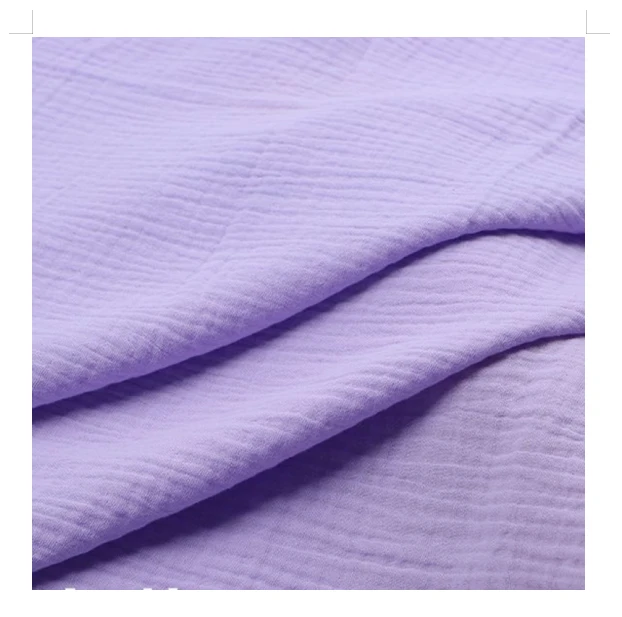
Our M4011 is 100% cotton, 125 GSM, 135 cm wide, two gauze layers joined at interlocking tie-points, 182 stock colours, natural crinkle. It softens after the first washes, it settles by the third to fifth, and it stays there. That is the whole promise, and it is one we can defend because it describes what the fibre does rather than what a brochure would like it to do.
What we will put in writing is the construction, the GSM, the width, the tie-point density, and the requirement that the layers stay joined through five laundering cycles. What we will not put in writing is an adjective. If your customer needs a hand that is soft from the first day and stays exactly there, a pre-washed finish is available on request — but it costs you the room the garment would otherwise have to relax into its final size, and that trade has to be made deliberately.
Frequently asked questions
How many washes before double gauze stops softening?
In our experience the hand settles by the third to fifth home wash. After that the cloth still feels pleasant but it stops changing in a way anyone would notice. Anything a supplier promises beyond that point is not describing cotton.
Does softening mean the cloth gets thinner?
It gets slightly lighter in hand because the surface fibre is released and the weave relaxes, but the weight per square metre does not drop in a way you would measure. What does change is the dimension: the first washes take up length and width, so settle the size after washing rather than before.
Can I make double gauze soft before it ships?
You can make a sample soft in an afternoon by washing it hot and tumble drying it on low, and that is exactly what we recommend for judging the final hand. It is not the same as shipping pre-softened cloth, because a garment that arrives already relaxed has less room left to move in the customer's laundry.
Is a softener finish the same thing?
No. A softener sits on the fibre and washes off within a few cycles, so the hand drops back to where it started. It also masks the true hand at approval, which is why a swatch that feels wonderful at the counter and stiff after a month is usually a finishing effect rather than the cloth.
What should the purchase order say?
Specify the construction rather than the adjective: 100% cotton, 125 GSM, 135 cm, two layers joined at interlocking tie-points, and a wash-state for dimensional tolerance. "Soft hand" is not an acceptance condition; "layers remain joined after five laundering cycles" is.