Quilted Fabric After Washing: What Shrinks, What Bunches, What Pills
The photograph that starts these conversations is always the same. A quilted jacket, worn twice, washed once, photographed on a bed: the face has gone wavy between the stitch lines, two channels have emptied into the hem, and the colour at the cuffs looks a shade lighter than the body. The message underneath is shorter than the photograph: “Is this normal?”
Sometimes it is normal, and the buyer is looking at the cost of a cotton sandwich rather than a defect. Often it is not, and the cause was decided months earlier, in a specification that named a weight and a pattern but never named a wash.
Quilted cloth is the one category where a mill can pass every inspection it runs and still ship a cloth that fails in a domestic machine, because nothing on a sample card measures what water, heat and agitation do to three layers stitched together. This article covers the four ways that failure arrives, the numbers that decide each one, a wash test that takes an afternoon, and the clauses to put on the purchase order so the question never reaches the photograph stage.
The four failures that arrive after the first wash
Almost every claim on a quilted order lands in one of four buckets. They look different to a consumer and they come from the same place: a construction decision that was made for the sample and never tested for the laundry.
| What fails | What the buyer sees | What causes it | What prevents it |
|---|---|---|---|
| Overall shrinkage | Hem short by 10–20 mm, sleeve loses length, placket gapes | Face cotton not compressed, residual shrinkage above 3% | Compression plus a written limit of ≤3% after three washes |
| Face puckering | Wavy surface between the stitch lines; the quilting looks raised | Face and backing moving at different rates; stitch grid holds what cannot shrink | Face and backing matched to within 1% residual, spacing of 40 mm or more |
| Fill migration | Bare channels, cold stripes, wadding clustered at one end | Loose wadding, channel wider than the loft can bridge, slick backing | Scrimmed or bonded wadding; 45–60 mm channels at 150 g/m² |
| Bearding and pilling | Fibre through the backing, bobbles at cuff and collar | Coarse staple, oversized needle, loose face, needle heat | Finer fibre, Nm 75/11 needle, denser face, needles changed each shift |
What makes these four expensive is that none of them is random. A shrinkage figure that sits at 5 percent on the test cutting will sit at 5 percent across the whole order, because it is a property of the cloth, not of the piece. The same is true in reverse: a panel that comes through three washes flat and even will come through three thousand metres the same way. The wash test is not a sampling exercise, it is a forecast.
There is one more failure that buyers report as a wash problem and which is not one: seam grin. The stitches open along a seam because the seam allowance was trimmed too fine for a 340 GSM sandwich, and the first wash simply makes an existing weakness visible. It belongs to the garment maker, not the mill, but it is worth separating from the four above before the conversation starts.
Shrinkage: the number, and why the panel behaves differently
Start with the number a buyer can use. An untreated cotton face cloth can move 4 to 6 percent in the warp direction after a hot wash. Mechanically compressed cloth holds 2 to 3 percent. Our quilted range is built on a compressed cotton face, a cotton wadding core and a lighter cotton backing, and the finished sandwich lands between 340 and 390 GSM. The panel as a whole, after three washes at 40 degrees, typically measures 1.5 to 3 percent shorter.
That last figure is smaller than the face on its own, and the reason is the stitch grid. The quilting anchors all three layers together every 45 to 70 mm, which restrains the panel from shrinking freely. Restrained is not the same as protected. The face still wants to move, and the part that cannot go into length has to go somewhere, so it goes into the surface between the stitch lines. The panel measures nearly right and looks wrong: a wavy face, a quilting pattern that appears to stand up, and a hand that reads as cheap.
This is why “shrinkage 3 percent” on a purchase order is not enough on its own. Two cloths can both meet that number and behave completely differently, one shrinking evenly and flat, the other arriving at the same measurement through puckering. The question to ask is not only how much, but whether the figure was measured on the finished quilted panel or on the face alone. A face-only number flatters the cloth twice: it is usually higher, and it says nothing about what the stitching does to it.
Compression is what buys the difference. Cotton that has been mechanically compressed has had most of its relaxation shrinkage taken out before it reaches the quilting frame, so the face and the backing arrive at the needle with less stored movement between them. Matching the two is the other half: if the face has 3 percent residual and the backing has 1 percent, the panel has a 2 percent internal argument, and the stitch lines become the place where that argument is settled. We hold the face and backing of a given pattern to within 1 percent of each other for exactly this reason.
For colour, the figure that matters on a washed quilted cloth is fastness to washing at 40 °C to grade 4 or better, assessed per lot rather than per qualification sample. A quilted panel is washed as a whole garment, so staining on the backing counts as a failure even when the face is perfect.
Bunched fill: why cotton wadding moves and bonded polyester does not
Fill migration, which the trade also calls bunching or cold striping, is the failure buyers find most difficult to accept, because the cloth looked perfectly even when it was delivered. It is also the most predictable of the four, and it comes down to three things: how the wadding is held together, how wide the channels are, and how much grip the backing gives it.
Cotton wadding is a web of staple fibre with no resin bond. Nothing holds it together except fibre entanglement and the quilting itself. Wet cotton wadding collapses as it absorbs water, and as it dries it re-deposits wherever gravity and the channel geometry allow. If the channel is narrow enough that the web bridges it, the wadding stays put. If the channel is wider than the loft can span, the middle of the channel has nothing supporting it, and after two or three cycles the wadding has slid to one end and stabilised there. What the customer sees is a bare strip beside a ridge, which is why the complaint usually describes “lumps” rather than thin patches.
Polyester wadding behaves differently because it is usually resin-bonded or laminated to a scrim. The bond holds the web together independently of the stitching, so a 100 mm channel is survivable. This is not a claim that polyester is better. It is the reason a specification copied from a polyester-filled jacket and applied to a cotton one fails: the channel width that was safe on the bonded fill is twice as wide as the cotton web can bridge.
Our seven patterns run between 45 and 70 mm between stitch lines, and the wadding core sits somewhere between 150 and 190 g/m², with the face and the backing making up the rest of the 340–390 GSM total. The tighter geometries, the hearts and the florals, are the ones we recommend where a garment will be washed often; the open hexagon and diamond grids are better suited to bags, mats and cushions that are spot cleaned. The fill weights quoted in general jacket-quilting writing, 40 to 150 g/m² over a bonded polyester fill inside a 50–90 g/m² shell, describe a much lighter construction than this one and should not be carried across to a cotton sandwich without recalculating the channel width. On the sample bench there is a one-second test that predicts migration before any washing: pinch a channel lengthwise between finger and thumb and try to slide the wadding inside it. If it moves under light pressure, it will move in the machine.
Bearding and pilling: what the shell and the needle do
Bearding is fibre working its way through the backing, and it is the failure that most often gets blamed on the wadding when the cause is a needle. Every stitch through a 340 GSM sandwich opens a hole, and the needle passes through the same line thousands of times. A large needle leaves a channel wide enough for a fibre end to follow; a hot needle, running fast on a dense sandwich, softens and cuts the fibres it passes, and each cut end becomes a candidate for migration. On our line the quilting needles are Nm 75/11 for the standard sandwich and Nm 90/14 only where a multi-layer seam demands it, changed on a shift basis rather than when they feel blunt.
Pilling is the other half of the same coin and it is a surface question. Short staple, low twist and a loose face all give surface fibres the freedom to entangle, and abrasion does the rest. Cotton pills less than wool, but it pills where the garment is rubbed hardest: cuffs, collar edges, the corners of a bag. The usual commercial limit is grade 3-4 or better on Martindale, ISO 12945-2, at 2,000 rubs for apparel and grade 4 for a bag or a cushion that will see more friction. Ask for the grade per lot, and ask which method was used, because the pilling box and Martindale do not produce the same number on the same cloth.
Bearding is rare on a 340–390 GSM sandwich with a properly dense face. It becomes a real risk on lighter quilted cloth in the 200 to 280 GSM range, where the face is thinner and the same needle opens a proportionally larger hole. If a buyer is moving down in weight to hit a price, that is the moment to specify a finer needle and a tighter face rather than assume the construction will carry over.
The wash test you can run in an afternoon
None of the four failures needs a laboratory to detect. What it needs is three wash cycles, a steel rule and the discipline to measure before and after rather than judging by eye. The protocol below is the one we run on request for a production lot, and it is deliberately simple enough for a buying office to repeat independently.
| Step | What to do | What to record | Pass |
|---|---|---|---|
| 1. Cutting | 50 × 50 cm from mid-roll, one per pattern or shade | Roll number, position in the roll | — |
| 2. Marks | Three pairs of points 350 mm apart: warp, weft, diagonal, in contrasting thread | Exact distance in mm, measured with a steel rule | — |
| 3. Condition | 4 hours at 20 °C and 65% relative humidity | Room reading | — |
| 4. Wash | Three cycles at 40 °C, 20 g mild detergent, 600 rpm spin | Cycle count, detergent, machine | — |
| 5. Dry | Line dry one piece, tumble low a second, keep a third unwashed as control | Which piece was dried how | — |
| 6. Measure | Re-measure all three pairs after each cycle, condition 4 hours first | Change per direction per cycle | ≤3% warp and weft |
| 7. Inspect | Raking light across the face; check channels, backing, cuffs | Photographs against a rule | No bare channels, no bearding, pilling ≥3-4 |
Two details decide whether the result is worth anything. The first is conditioning: cloth measured straight out of the dryer reads short and then relaxes, so both the before and after measurements belong on cloth that has rested four hours at 20 °C and 65 percent relative humidity. The second is the control piece. Keeping one cutting unwashed lets you see whether a difference is the wash or the roll, and it is the piece you photograph beside the washed ones.
Run the test on the production lot, not on the qualification sample that was approved three months earlier. Wadding lots differ, and a change of wadding supplier is the single most common reason a repeat order behaves differently from the first one. If the bulk arrives with a wadding ticket that does not match the approved sample's, the wash test is the only way to know before the cutting room does.
Reading the result into the garment
Three percent sounds small until it is applied to a pattern. On a 60 cm body length it is 18 mm; on a 62 cm sleeve it is 19 mm; on a two-piece collar it is enough to change how the collar sits. A pattern cut with no allowance for shrinkage will show that 18 mm as a placket that gapes and a hem that sits high, and no amount of pressing will bring it back.
The allowance itself is the easy part: add the measured figure to the marker in both directions. What cannot be corrected by allowance is the second-order effect. Puckering and migration are not dimensional changes that a pattern can absorb, because they are not uniform: one channel goes bare while the next holds, and the panel distorts in a way that no cutting allowance anticipates. A buyer who plans for 3 percent shrinkage and receives a puckered panel has planned for the wrong failure.
There is also a repeat-order trap worth naming. A 1 percent drift between the first order and the second is normal across wadding lots and dye lots, and it is invisible on a swatch. On a programme that reorders every season it is the difference between a garment that fits like the one in the lookbook and one that does not. Holding the same wadding source across a repeat programme is worth more than a cent a metre.
Six clauses for the purchase order
Most of what this article describes can be settled in one page of a purchase order. These are the six lines we would want to see if we were buying the cloth rather than making it.
- Construction and weight. Three-layer quilted, 340–390 GSM finished, face, wadding and backing each named with its own weight, tolerance ±5 percent on the finished figure.
- Shrinkage. Residual shrinkage of 3 percent or less in warp and weft after three washes, measured on the finished quilted panel, with the test method named (ISO 6330 procedures, ISO 5077 measurement).
- Stitch geometry. Spacing between 45 and 70 mm by pattern, and a written maximum channel width at the specified wadding weight. A pattern number alone does not fix the spacing, because the same pattern can be scaled.
- Wadding anchorage. Wadding type, weight per square metre and whether it is scrimmed or bonded. This one line prevents most migration claims.
- Surface performance. Pilling grade 3-4 or better on the named method, no bearding through the backing after three washes, colour fastness to washing grade 4.
- Pre-shipment test. A three-wash test on the production lot, reported with measurements and photographs, before the goods leave. This is the clause that turns the other five from intentions into evidence.
If the order is going into a rental or institutional laundry, add the cycle count and the temperature to the specification, and expect the conversation to move towards a poly-cotton face. Cotton quilted cloth at this weight is comfortable through domestic washing at 30 to 40 degrees; a 50-cycle industrial tunnel is a different requirement with a different answer.
Where we sit in this
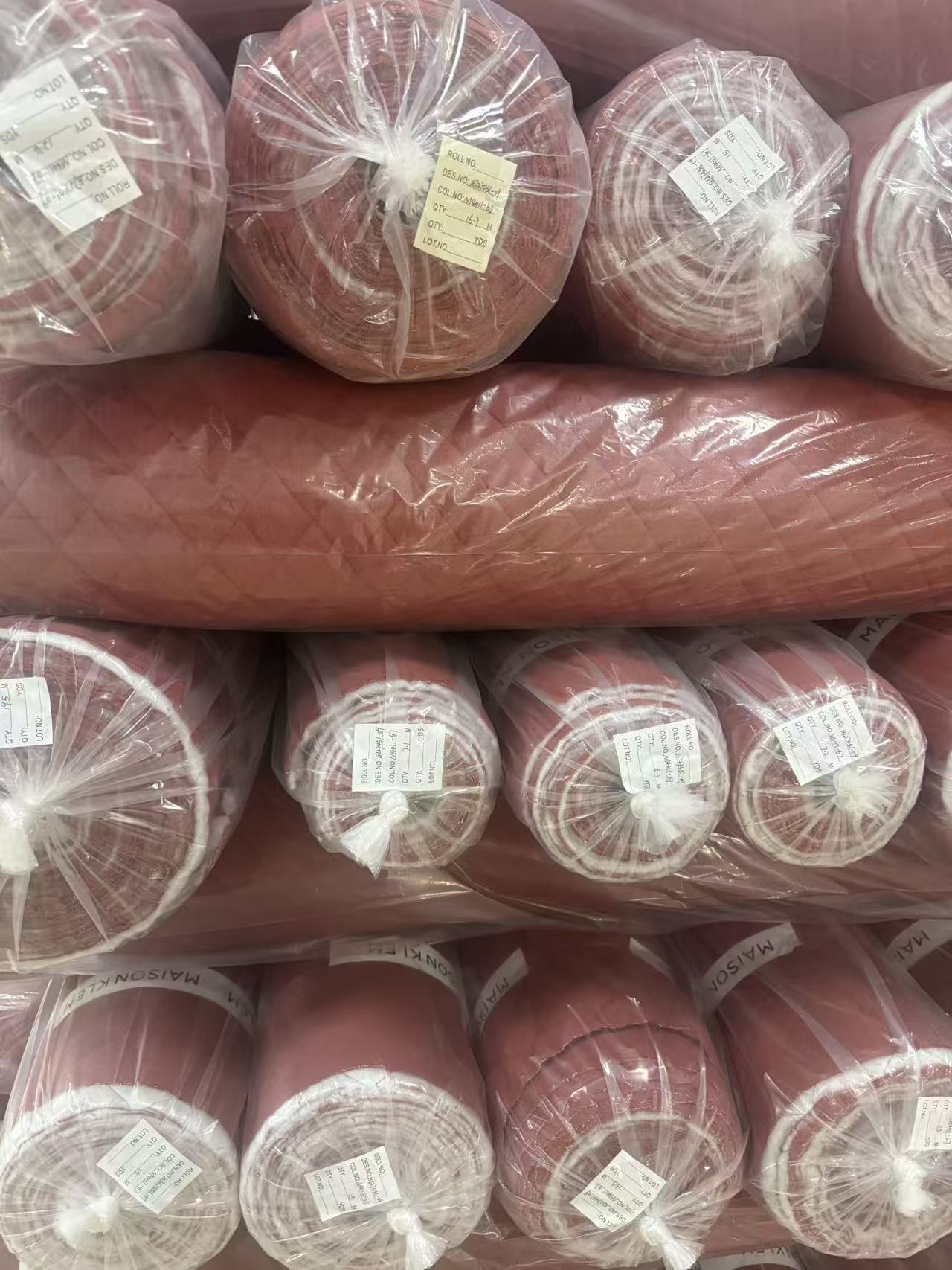
Our quilting workshop runs seven patterns on a 340–390 GSM three-layer cotton construction, 140–150 cm usable width, at 300 metres per pattern minimum. Stock patterns ship in about 15 days from confirmation; a custom quilting pattern takes 20 to 30 days including sample approval. FOB China port runs US $3.65 to $4.85 per metre depending on pattern and quantity.
Because the failures in this article are construction questions, the wash test is part of how we quote rather than an extra service. Tell us the garment, the wash regime and the pattern you are considering, and we will run three cycles on the actual lot, photograph the face under raking light, and send the measurements with the quotation. If the pattern you want cannot hold the wadding at the weight you need, we would rather say so before the order than after the first complaint.
Every roll also travels with a batch test report and the seven-day uncut inspection window: seven days from delivery to open the roll and check it before cutting, with a replacement or a refund if a defect is found in that window. That covers what arrives. The wash test covers what happens next.
The figures in one place
Every number quoted above, collected for a specification sheet. None of them stands alone: the shrinkage limit assumes the channel width, and the channel width assumes the wadding weight.
| Item | Figure we work to |
|---|---|
| Construction | Three-layer cotton quilted, 340–390 GSM finished, 140–150 cm usable width |
| Wadding core | 150–190 g/m² loose cotton, held by the stitch grid rather than resin |
| Stitch spacing | 45–70 mm by pattern; no channel above 60 mm at 150 g/m², 45–55 mm safer |
| Shrinkage | ≤3% warp and weft after three 40 °C washes, measured on the finished panel |
| Face and backing | Matched to within 1% residual shrinkage of each other |
| Surface | Pilling grade 3-4 (apparel) or 4 (bags) on Martindale ISO 12945-2 at 2,000 rubs; colour fastness to washing grade 4 |
| Needle | Nm 75/11 standard, Nm 90/14 only for multi-layer seams, changed each shift |
| Commercial | Seven patterns, 300 metres per pattern minimum, about 15 days for stock and 20–30 days for a custom pattern, FOB China port US $3.65–$4.85 per metre |
What to send us
For a useful answer in one reply, the enquiry needs five things: the garment and its end use, the finished weight you are targeting, the pattern number or a photograph of the quilting, the wash regime (domestic cycles, temperature, tumble or line dry), and the quantity per pattern with the destination port.
The quilted cotton fabric page carries the seven patterns, the price bands by pattern and the stock position. The quilted cotton buyer's guide covers the three-layer construction and pattern selection in more depth, and the jacket construction article deals with fill weight and stitch density from the warmth side rather than the wash side.
On the wider questions, the fabric shrinkage guide sets out why woven cloth moves at all, the fabric testing methods guide maps the standard behind each figure quoted here, and the pilling test grade article explains how to read a Martindale result when two laboratories disagree.
Frequently asked questions
Does quilted cotton fabric shrink in the wash?
Yes, and less than the face cloth alone would suggest. An uncompressed cotton face can move 4 to 6 percent in the warp; the same face after mechanical compression holds 2 to 3 percent. In a quilted panel the stitch grid anchors all three layers, so the whole panel usually measures 1.5 to 3 percent shorter after three washes. The movement is smaller than the face on its own, but the surface looks worse, because the part that cannot shrink goes into puckering between the stitch lines.
Why does the filling bunch up after washing?
Because wet cotton wadding collapses, and when it dries it re-deposits wherever the stitch channels let it. If a channel is wider than the loft can bridge, the web slides towards one end and stabilises there. Bonded or scrimmed wadding resists this; loose cotton wadding relies entirely on channel width and fibre entanglement, which is why our patterns run 45 to 70 mm between stitch lines rather than the 100 mm that works on a bonded polyester fill.
Can a quilted jacket be machine washed?
A 340 to 390 GSM cotton quilted cloth can, at 30 to 40 degrees on a normal cycle with mild detergent, provided the panel has passed a three-wash test before bulk. What it cannot take is a hot wash plus a hot tumble dry: the combination adds roughly 1 to 1.5 percent on top of the line-dried figure and drives the puckering that shows up as a wavy face. Wash cool, dry flat or line dry, and press on the reverse if the garment needs it.
What stitch spacing stops the wadding migrating?
At 150 g/m2 of cotton wadding, no channel should be wider than 60 mm, and 45 to 55 mm is safer. Wider spacing is fine on a bonded fill because the resin holds the web together; on loose cotton it leaves the middle of each channel unsupported. Our seven patterns sit between 45 and 70 mm, and the tighter geometries, hearts and florals, are the ones we recommend for garments that will be washed often.
How many washes should a pre-production test run?
Three cycles, not one. One wash shows the immediate shrinkage, which is the smaller half of the problem; the second and third cycles are where wadding consolidation and surface puckering settle into their final state. Measure after each cycle and photograph after the third, because a panel that moves 2 percent in cycle one and another 1 percent in cycles two and three will pass a single-wash check and still fail in the market.
Is cotton wadding or polyester wadding better after washing?
Polyester wadding is more dimensionally stable and is normally bonded or scrimmed, so it migrates less. Cotton wadding gives a drier hand, breathes, and is the reason a quilted cotton garment feels like cloth rather than like a sleeping bag. The trade is maintenance: cotton needs tighter stitch channels and a cooler wash cycle, and it consolidates a little with every wash. Choose by the garment's wash regime, not by the sample's hand feel.
What GSM quilted fabric should I order for a jacket?
340 to 390 GSM finished is the band we run for jackets, bags and home textiles. Below 300 GSM the sandwich is light enough that bearding through the backing becomes a real risk and the quilting reads as decorative rather than structural. Above 400 GSM the cloth stops draping and starts behaving like a padded panel, which suits bags and pet beds more than it suits a garment.