Cotton Poplin Yarn Count and Density: Reading a Spec Sheet
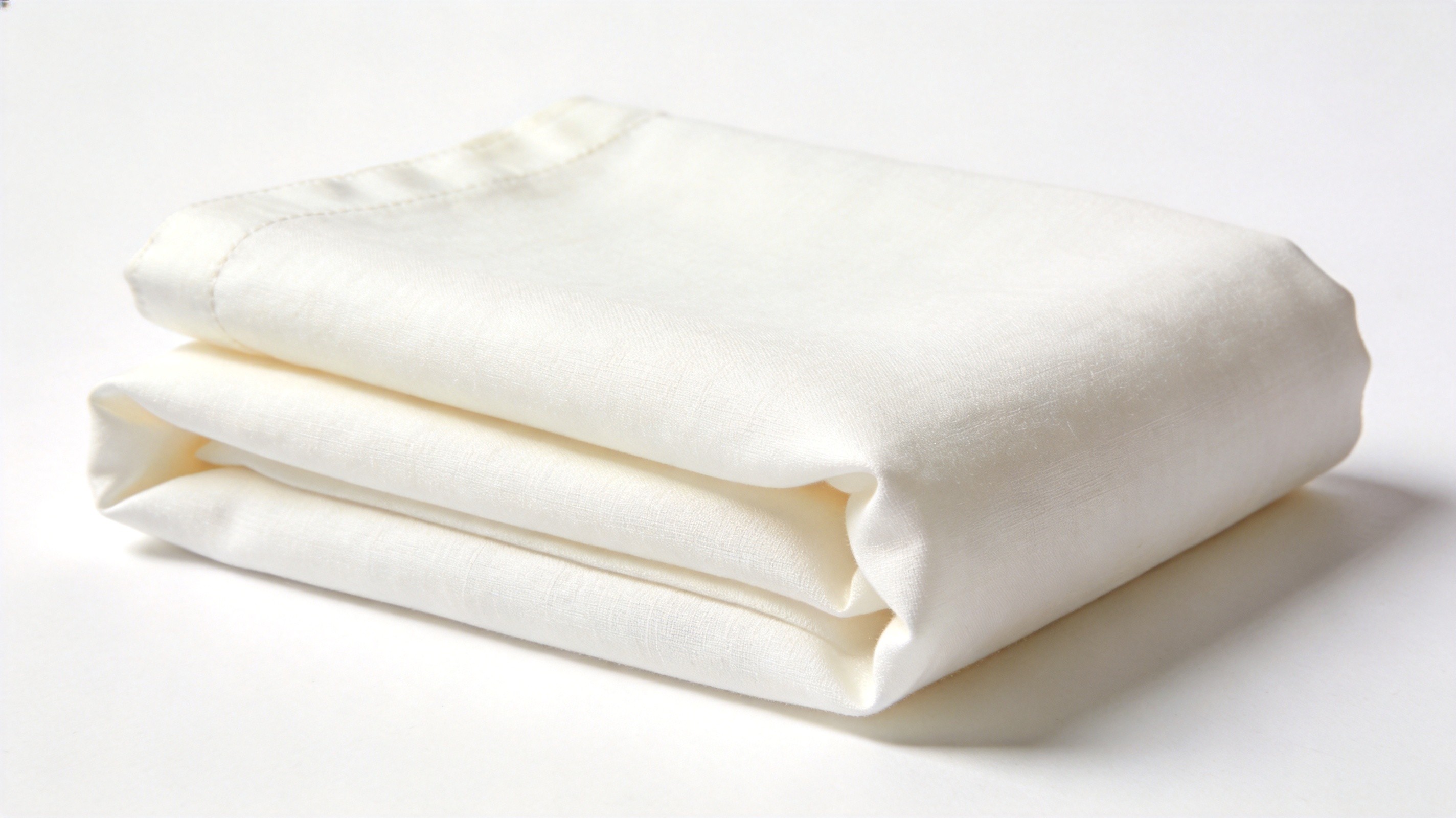
Short answer: 120 GSM does not tell you how a poplin will feel, because weight is the result of three numbers — yarn count, twist and sett. Two cloths can both read 120 GSM and behave nothing alike: one is coarse yarn openly set, the other fine yarn densely set. Read the count and the sett together and the hand becomes predictable.
Why Weight Alone Cannot Tell You How a Poplin Will Feel
Two cotton poplins, both quoted at 120 GSM, both 100% cotton, both plain weave, both 146 cm wide. One presses into a shirt that holds a collar stand for a full day. The other hangs like a soft blouse and wrinkles at the elbow by lunchtime.
Nothing on the quotation tells you which is which. GSM is a measurement of the finished cloth, not an instruction for how it was built. The same 120 GSM can be produced by a coarse yarn woven openly or a fine yarn woven densely, and those two cloths behave like different materials.
This is not a technicality. It is the single most common reason a buyer approves a sample, orders 3,000 metres, and then discovers the bulk does not make up the way the sample did. The sample was the right weight. It was not the right construction.
Three numbers decide how a poplin feels and performs. They are usually quoted together, but only one of them is on most quotations.
Part 1: Three Numbers, Three Different Jobs
1.1 GSM — the result
Grams per square metre is the weight of the finished cloth. It is a consequence, not a cause. It tells you how much material is in a square metre, and it tells you nothing about how that material is arranged.
It is also the number most often compared across suppliers, which is unfortunate, because it is the easiest number to hit and the easiest number to hit in several different ways.
GSM is measured on finished, relaxed cloth. It moves with finishing: a sanforised or washed poplin can land several grams lighter than the same greige construction finished flat. Two mills can both ship honest 120 GSM cloth that behaves differently because the finishing route differs.
1.2 Yarn count — the thickness of the thread
Yarn count describes the yarn itself, before it becomes cloth. In the cotton system it is written as Ne and read as “40s” or “40 Ne”.
The number runs the opposite way to intuition: higher count means finer yarn. Ne 40 is a thicker thread than Ne 100. A finer yarn needs better cotton, spins slower, and costs more per kilogram, which is why the count is one of the strongest drivers of poplin price after the fibre itself.
1.3 Sett — how many threads, and how close
Sett is the number of yarns per unit of length in the woven cloth, counted separately in each direction: warp (along the length) and weft (across the width). It is usually written as two numbers, warp first.
In the shirting trade the unit is almost always inches, written as EPI × PPI — ends per inch by picks per inch. In European technical sheets you will also see threads per centimetre. The two are not interchangeable and a sheet that does not state its unit is a sheet you cannot compare.
Sett is what turns yarn into a cloth of a given weight. Coarse yarn at low sett and fine yarn at high sett can land on the same GSM from opposite directions.
1.4 The relationship in one line
GSM is roughly what you get when yarn thickness and sett are multiplied together. Change either one and you can hold the weight while changing everything about the hand.
That is the whole idea. The rest of this guide is about reading each number off a sheet, and about the combinations that produce a cloth you did not intend to buy.
Part 2: Reading Yarn Count (Ne)
2.1 What “40s” literally means
In the English cotton count system, Ne is the number of 840-yard lengths of yarn that weigh one pound. A single 840-yard length weighing one pound is Ne 1. Forty such lengths weighing one pound is Ne 40.
Practically, that definition only matters because it explains the direction: more lengths per pound means each length is thinner. Everything else about the number follows from that.
2.2 The conversion you need for European suppliers
Most of the world does not quote cotton count. Turkish, Italian and German mills usually quote Tex (grams per 1,000 metres) or dtex/denier. If you are comparing a Chinese quotation in Ne against a European one in Tex, convert before you compare.
The standard conversion for cotton count is:
Tex = 590.5 / Ne and Denier = Tex × 9
| Cotton count (Ne) | Tex (approx.) | Denier (approx.) | Where it sits |
|---|---|---|---|
| 20s | 29.5 | 266 | Canvas, workwear, heavy shirting |
| 30s | 19.7 | 177 | Entry shirting, linings |
| 40s | 14.8 | 133 | The commercial shirting standard |
| 50s | 11.8 | 106 | Better department-store shirting |
| 60s | 9.8 | 88 | Entry premium business shirting |
| 80s | 7.4 | 67 | Premium, usually two-ply |
| 100s | 5.9 | 53 | Luxury, two-ply, fine cotton required |
Two cautions on that table. The conversions are arithmetic and reliable; the placement column is trade usage, not a rule. A 60s poplin can be woven openly and land closer to a 40s in hand than to another 60s. And a count quoted without a ply is incomplete — see below.
2.3 What changes as the count rises
Raising the count does four things at once, and buyers usually only expect the first one:
- Surface gets smoother. Finer yarns make a flatter, more even face. This is the effect most people are buying.
- Cloth gets lighter at the same sett. Finer yarn covers less area, so you need more ends per inch to hold the same GSM.
- Transparency goes up. A high-count, low-sett poplin shows the hand behind it. This is why premium shirting is almost always woven dense, not just fine.
- Durability goes down at the same sett. Finer yarn has less fibre per cross-section. A 100s poplin at open sett abrades faster than a 40s at the same weight.
The fourth point is why “higher count is better” is a poor buying rule. Above a certain point the returns flatten, and past that they reverse unless the sett and the ply go up with the count.
2.4 Single ply and two ply — the notation that gets misread
A single yarn is written as one number: 60s or Ne 60/1. Two finer yarns twisted together into one thread is written as 2/60s or 60s/2, meaning two 60s yarns plied.
This matters because 2/60s and 60s are not the same cloth and are not priced alike. A two-ply yarn is rounder, stronger and more even, and the cloth resists pilling better. A sheet that says only “60s” when the mill is actually supplying two-ply is understating the goods; a sheet that says “60s” when you assumed two-ply is overstating them. Ask which, in writing.
40s × 40s — warp is 40s, weft is 40s, both single ply.40s × 20s — finer warp, coarser weft. Common in poplin, where the weft is deliberately heavier.2/80s × 2/80s — both directions are two-ply 80s. A premium construction.40s/1 × 40s/2 — warp single, weft two-ply. Rare, but it exists, and it is not a typo.
2.5 Why our poplin is 40s
Our cotton poplin — the solid-dyed M60201 line and the printed 8135 base — is woven from 40s yarn. We publish that number because it is the one that matters most for how the cloth makes up.
The reason 40s dominates this tier of the market is not that it is the finest count available. It is that 40s is the count at which a mill can hold a broad stock programme — 154 shades, 100–140 GSM, 146 cm, from 300 metres per colour — at a price that works for independent brands. Finer counts require better cotton, slower loom speeds and a narrower set of acceptable shades per lot, and all three push the minimum order up. That is the commercial logic of this tier, not a technical limit on what poplin can be.
If your specification calls for 60s, 80s or 100s poplin, say so at inquiry. We will tell you we do not weave it rather than quote a number we cannot hold. That is a shorter conversation than discovering it at the inspection table.
Part 3: Reading Sett on a Spec Sheet
3.1 “133 × 72” — which number is which
Warp first, weft second. Always. 133 ends per inch running the length of the cloth, 72 picks per inch running across it.
The convention is universal in the shirting trade and it is stated on almost no spec sheet, which is how buyers end up comparing a warp figure against a weft figure and concluding two cloths are similar when they are not.
If a sheet gives a single number, it is usually a total and is close to useless. 205 threads per inch could be 133 × 72. It could also be 160 × 45. Those two cloths have the same total and nothing else in common.
3.2 Why the two numbers are rarely equal
In poplin, the warp count is normally higher than the weft count. The reason is mechanical: warp yarns are held under tension from the loom beam and can be packed close together, while the weft is beaten into place against them and has to bend around each warp end. Fewer, slightly heavier weft picks beat up more cleanly than the same number of fine ones.
This is also where poplin gets its characteristic faint crosswise rib and its dry, crisp face. The weft is deliberately a little heavier than the warp. A poplin whose warp and weft counts are identical and whose sett is balanced is, structurally, closer to a plain batiste than to a poplin.
So when a supplier quotes a balanced sett on a poplin, it is worth asking what the weft count actually is. The answer usually explains the price.
3.3 The specifications you will actually see quoted
The combinations below are the ones that recur across supplier quotations for cotton shirting poplin. They are market practice, not an industry standard. Two mills can both quote 40s × 40s / 133 × 72 and ship cloth that feels different, because the cotton grade, the spinning and the finishing all move the hand.
| Position in the market | Yarn count | Sett (EPI × PPI) | Typical GSM | What it is used for |
|---|---|---|---|---|
| Basic shirting | 40s × 40s | 133 × 72 | 115–125 | School and corporate uniform, mid-range retail, value shirting |
| One step up | 50s × 50s | 140 × 80 | 110–120 | Better department-store shirting, less transparency |
| Premium business | 60s × 60s | 140 × 90, or 144 × 80 | 100–115 | High-end business shirting |
| Luxury | 2/80s or 2/100s | Higher than above | 90–110 | Luxury dress shirting, two-ply construction |
Read the table as a map of the trade, not a specification to copy. The useful part is the direction of travel: as the count rises, the sett rises with it and the weight falls. A high count paired with a low sett is not a premium cloth, it is a light cloth, and it will show the hand behind it.
3.4 Cover factor, without the algebra
Cover factor is the share of the cloth's area that is covered by yarn rather than by the gaps between yarns. Every cloth has two, one for warp and one for weft, and they are usually added into a total.
It matters because it predicts two things GSM cannot: how much light and air pass through, and how much the cloth can be pushed before the yarns jam against each other on the loom. A buyer who specifies only GSM is choosing a weight; a buyer who specifies cover factor is choosing a surface.
You will meet two systems. The Pierce system works in threads per inch against cotton count. The SI system works in threads per centimetre against tex. They give answers within about five per cent of each other, but the numbers are not interchangeable and a sheet that does not name its system cannot be compared with one that does.
If you need a hard number rather than a construction figure, ask for air permeability to ISO 9237. It is a physical measurement, it is directly comparable between mills, and it settles arguments that cover factor cannot.
Part 4: Three Combinations, Three Hands
Every poplin on the market sits somewhere on a line between two extremes. Understanding the ends of that line is more useful than memorising specifications, because most buying mistakes come from asking for the wrong end.
4.1 Coarse yarn, open sett
20s or 30s yarn, low sett, heavier weight. The cloth is built from thick threads with visible space between them. It is strong, abrasion-resistant, breathable and relatively cheap per metre, and it does not drape — it holds a shape.
This is workwear, uniform, utility trousers, casual jackets. It is a poor choice for a dress shirt because the surface is too coarse to press flat and the yarn is too thick to sit under a collar stand neatly.
4.2 Fine yarn, dense sett
60s and above, high sett, lighter weight. Fine threads packed close. The surface is smooth and slightly lustrous, the cloth drapes rather than holds, and it is more expensive on three counts at once: better cotton, slower spinning, slower weaving.
This is premium shirting and occasionwear. It is a poor choice where the garment will be washed hard and worn against abrasion, because fine yarn has less fibre per cross-section and wears through sooner at the same weight.
4.3 The middle band
40s at a sett around 133 × 72, landing near 120 GSM. This is where most of the world's cotton shirting poplin sits, and it is a compromise in the useful sense of the word: fine enough to press flat and take a collar, coarse enough to survive industrial washing, dense enough not to be transparent in white, open enough to be wearable in summer.
Most buyers who think they want 60s actually want a better 40s. The difference in hand between a well-finished 40s and a cheaply finished 40s is larger than the difference between a well-finished 40s and an average 60s.
| Combination | Count | Sett | Hand | Suits |
|---|---|---|---|---|
| Coarse, open | 20s–30s | Low | Firm, dry, slightly rough, holds shape | Workwear, uniform, utility, casual bottoms |
| Middle band | 40s | ~133 × 72 | Dry and faintly crisp, presses flat, light drape | Shirting, dresses, blouses, uniform, loungewear |
| Fine, dense | 60s–100s | High | Smooth, cool, slight lustre, drapes | Premium shirting, occasionwear, linings |
Part 5: The Combinations That Catch Buyers Out
5.1 Same GSM, different sett
This is the expensive one. A 120 GSM poplin at 133 × 72 and a 120 GSM poplin at 110 × 76 are the same weight and different cloths. The second uses a coarser yarn woven more openly; it will be softer, more breathable, less opaque and will lose its press sooner.
If a quotation says 120 GSM and nothing else, you have not been quoted a cloth. You have been quoted a weight.
5.2 Same count, different sett
Two 40s poplins can differ by 20 ends per inch and land at different weights with different opacity. The count tells you the thread; the sett tells you the cloth. Neither is sufficient alone, which is why serious spec sheets carry both plus the finished weight.
5.3 The “thread count” trap
Thread count, usually abbreviated TC, is a marketing number and it is routinely inflated in ways that are technically defensible.
The common method is to multiply by ply. A two-ply 60s cloth at 150 ends per inch is advertised as “300 thread count” because each of the 150 positions contains two yarns. Nothing false has been said, and the number is roughly double what a single-ply cloth of the same sett would carry. A 40s single-ply poplin at 133 × 72 carries a genuine 205, and would be sold as 205 TC against a competitor's “300”.
Thread count also ignores yarn thickness entirely. A high TC built from coarse yarn is a heavy, rough cloth with a big number on the label. For shirting, sett plus count plus GSM tells you what you need. Thread count on its own tells you what the marketing department decided to print.
5.4 What a high count cannot fix
Three things, and buyers ask for all three:
- It cannot fix a loose sett. A 100s yarn at 110 ends per inch is a transparent, weak cloth. Fineness without density is a liability.
- It cannot fix poor cotton. A high count requires long-staple cotton to spin cleanly. If the fibre is short, the mill can only reach the number by combing aggressively, and the cloth pills sooner.
- It cannot fix finishing. A well-woven 40s finished badly feels worse than an average 40s finished well. Buyers comparing only construction numbers systematically underestimate finishing, which is where most of the hand actually comes from.
If you have one question left at the end of a mill visit, ask to feel two cloths of the same construction finished differently. That comparison teaches more about what you are buying than any specification sheet.
Part 6: How to Verify Count and Sett
None of this is worth much if you cannot check it. All three numbers are measurable in a sample room without a laboratory, and one of them can be checked at the inspection table in under a minute.
6.1 Counting the threads
The standard field method uses a pick glass — a small folding magnifier with a graduated scale, usually one inch square divided into tenths. Lay it on a flat, relaxed sample, count the warp ends across one inch, then rotate and count the picks.
Three rules that decide whether the number is real:
- Measure on relaxed cloth. Cloth pulled tight reads higher than it should. Let the cutting sit flat for a few minutes first.
- Count in three places. Selvedge to centre to selvedge. A cloth that reads 133 near the selvedge and 126 in the middle is not a 133 cloth.
- Count the yarn, not the colour. In a striped or printed cloth, follow one continuous yarn line rather than counting visual ridges.
6.2 Unravelling, when you need a number you can defend
Counting through a glass is fast and approximate. When the figure has to hold up in a claim, unravel instead: cut a square of known size, fray one direction out completely, and count the removed yarns. It is slower and it is the method the laboratory uses in principle, which is why the two usually agree.
6.3 Verifying the count
Yarn count cannot be read off the cloth by eye. It has to be measured: remove a known length of yarn, condition it, weigh it, and convert.
For a rough field check, pull ten yarns of equal length from the same direction, weigh them together, and compare the result against the count you were quoted. A 40s yarn is roughly 14.8 tex, meaning 1,000 metres weighs about 14.8 grams. If the arithmetic comes out at 20 tex, you have been supplied something nearer 30s.
Do not attempt this on a printed or coated cloth without removing the print first. The coating adds mass and the number will read heavier than the yarn actually is.
6.4 What the laboratory report should say
Three measurements cover the whole construction question, and all three have a standard method:
| Property | Method | What it gives you |
|---|---|---|
| Thread density (warp and weft) | ISO 7211-2 | Ends and picks per unit length, reported separately |
| Mass per unit area | ISO 3801 | GSM on the conditioned sample |
| Yarn linear density | ISO 2060 | Tex of the removed yarns, from which Ne is derived |
A report that gives GSM and nothing else has not tested the construction. It has weighed the cloth.
6.5 Tolerances worth writing into the order
Construction figures are not exact and no mill holds them exactly. What matters is that the tolerance is agreed before production rather than argued about after delivery.
- Density: ±2% on each direction is a normal commercial tolerance. Anything quoted as an exact figure with no tolerance is a figure that will not be met.
- GSM: ±5% on the finished, conditioned cloth. Finishing moves weight, so a tighter figure than this is a promise about the finishing route, not the weaving.
- Yarn count: usually stated as a nominal. Counts are not adjusted mid-lot; if the count is wrong, the lot is wrong.
Part 7: What to Put on the Spec Sheet
Most construction disputes trace back to a purchase order that specified weight and colour and left everything else to interpretation. A complete construction block takes four lines.
Weave: plain weave, weft slightly heavier than warp
Yarn count: warp ___ Ne, weft ___ Ne, single ply / two ply (delete one)
Sett: ___ ends per inch × ___ picks per inch, measured to ISO 7211-2
Finished weight: ___ g/m² ±5%, measured to ISO 3801 on conditioned cloth
Finished width: ___ cm, usable
Colour: shade ___ on the ___ card, or Pantone ___ with lab dip approval
Two clauses are worth adding beyond the block.
One, construction must match the approved sample, not only the weight. Written as: “Bulk construction shall match the approved sample in yarn count and sett within the tolerances stated. Weight conformity alone shall not constitute conformity of construction.” Without this, a supplier who ships 120 GSM at a different sett has met the specification.
Two, the buyer may verify construction before cutting. Written as: “Buyer reserves the right to verify yarn count, sett and mass per unit area on receipt, prior to cutting. Non-conformance identified at this stage shall be treated as a quality defect.” The phrase prior to cutting is what creates the right. Once the cloth is cut, the practical remedy is gone.
Frequently Asked Questions
Why do two cotton poplins at the same GSM feel completely different?
Because GSM is the outcome of yarn thickness multiplied by sett, and there is more than one way to reach the same weight. A coarse yarn woven openly and a fine yarn woven densely can both land at 120 GSM, and the first will be firmer, more breathable and less opaque than the second. The weight is the same; the arrangement of material is not.
What is the difference between 40s and 60s poplin?
40s is a thicker yarn and 60s a finer one, so 60s has a smoother surface, is lighter at the same sett, is more transparent, and costs more because the cotton has to be better and the loom runs slower. Whether 60s is worth the premium depends on your finishing: a well-finished 40s feels closer to an average 60s than the numbers suggest.
What does 133 × 72 mean on a poplin specification?
133 warp ends per inch and 72 weft picks per inch. Warp is always quoted first. It is the construction that most of the world's mid-range cotton shirting poplin is built on, and it typically lands between 115 and 125 GSM depending on yarn and finishing.
Is thread count a reliable number to buy on?
No. Thread count is routinely doubled by counting plied yarns twice, so a two-ply cloth at 150 ends per inch is sold as 300. It also ignores yarn thickness, which means a coarse, heavy cloth can carry a higher number than a fine, light one. For woven shirting, sett plus yarn count plus GSM tells you what you need.
How can I check the density myself without a lab?
A pick glass and one inch of relaxed cloth. Count the warp ends across an inch, rotate, count the picks. Do it in three places from selvedge to centre, because a cloth that reads correctly at the edge and loosely in the middle is a cloth with a problem. For a figure you can defend in a claim, unravel a measured square and count the removed yarns.
Can yarn count be verified in a laboratory?
Yes, to ISO 2060. The laboratory removes a known length of yarn, conditions it, weighs it and reports linear density in tex, from which cotton count is derived. It is a destructive test and it takes a day, so it is normally done on a retained sample rather than on every delivery.
What density tolerance should I write into the purchase order?
±2% on each direction is normal commercial practice, and ±5% on finished GSM. A supplier who offers an exact figure with no tolerance is either quoting greige rather than finished cloth, or will not meet the number.
What sett and yarn count does Mujia's cotton poplin use?
Our cotton poplin — solid-dyed M60201 and the printed 8135 base — is woven from 40s yarn at 100–140 GSM and 146 cm. We publish the count because it is the number that governs how the cloth makes up. We do not publish a single sett figure on this page. The construction actually run on your shade is stated on the data sheet sent with your inquiry, and we would rather you check that sheet than rely on a website figure.
Is a higher yarn count always better?
No. Finer yarn is smoother and lighter, but it also has less fibre per cross-section, so it abrades faster at the same sett and needs denser weaving to avoid transparency. Above roughly 80s the gains flatten, and past that the cloth becomes delicate enough to need different care. A high count on a loose sett is a worse cloth than a moderate count on a proper sett.
A Chinese mill quotes Ne and a European mill quotes Tex. How do I compare them?
Convert to one system first. Tex = 590.5 / Ne, so Ne 40 is about 14.8 tex, Ne 60 about 9.8 tex and Ne 80 about 7.4 tex. Remember that the conversion only compares yarn thickness — it says nothing about sett, finishing or cotton grade, so two cloths at the same tex can still be different products.
Next Steps
If you are specifying a cotton poplin programme, three things are worth doing before you request a quotation.
- Write the construction block, not just the weight. Count, sett, finished GSM, width, colour reference. The four-line block above is enough to make quotations comparable.
- Ask for two samples of the same construction finished differently. It is the fastest way to learn how much of the hand comes from finishing, and it will change which supplier you choose.
- Order the physical shade card and cuttings before the first bulk order. A screen cannot show you opacity, and opacity is the property most often discovered too late in white and pale shades.
Our own cotton poplin runs 40s at 100–140 GSM, 146 cm, in 154 stock shades on the M60201 card, from 300 metres per colour. The data sheet with the construction actually run on your shade goes out with every quotation. See the cotton poplin range or send us the specification you are working to and we will tell you honestly whether it is a cloth we can weave.
Data Sources and Scope
This is a sourcing guide, not a textile engineering text. The construction figures quoted here come from three places, and it is worth knowing which is which.
- Market specifications (the 40s × 40s / 133 × 72 / 120 GSM benchmark and the tiers above it) are the combinations that recur across supplier quotations for cotton shirting poplin. They are trade practice, not a published standard, and they are not enforced by any body.
- Conversion formulae (
Tex = 590.5 / Ne,Denier = Tex × 9) are standard arithmetic in the cotton count system and can be checked against any textile calculation reference. - Test methods are cited by number only: ISO 7211-2 for thread density, ISO 3801 for mass per unit area, ISO 2060 for yarn linear density, ISO 9237 for air permeability. The standard documents themselves are the authority on procedure.
What this guide does not cover: fibre quality and cotton grade, which move the hand as much as construction does; finishing routes and their effect on weight and shrinkage; and the spinning details (combing, carding, twist) that determine whether a given count can be reached at all. Those are separate subjects and each one is worth its own inquiry.
One deliberate omission: we do not publish a sett figure for our own poplin. The alternative to publishing one number for a range is to send the data sheet for the lot you are actually buying, which is what we do.
Mujia Textile — running our own air-jet looms in Zhuji since 2012.