Poplin Weight Bands: Our Printed Runs 90–120 GSM, Our Solid Runs 100–140
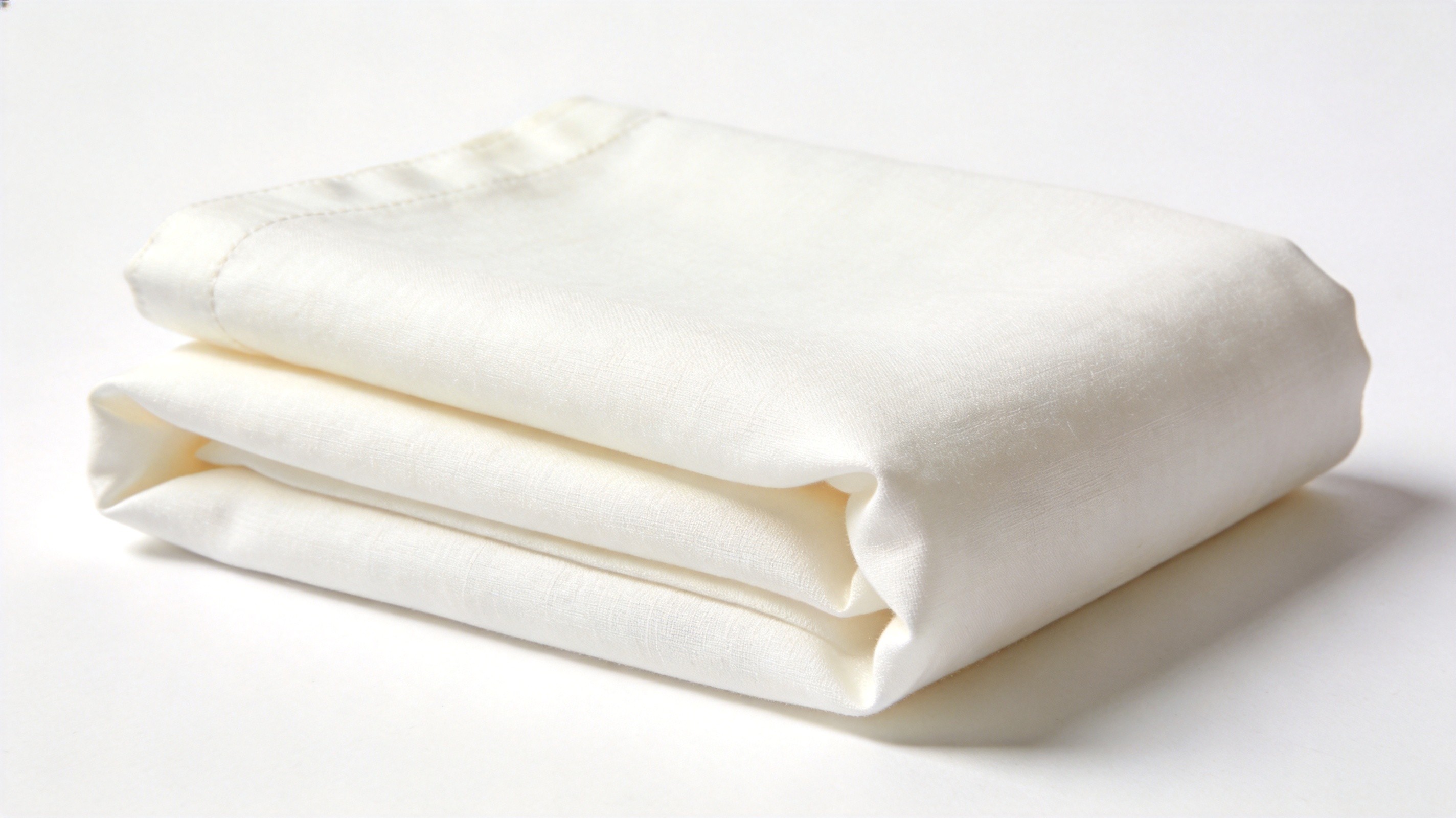
Short answer: our two poplin lines are the same 100% cotton plain-weave base cloth at 40s, and they are published with different weights because the finishing route differs. Solid dyed M60201: 100–140 GSM at 146 cm. Printed 8135: 90–120 GSM at 145 cm. The bands are ranges on purpose — a poplin lot is not one number, and a PO that asks for one number will be argued about at inspection.
Table of Contents
- One base cloth, two bands
- Why the printed line runs lighter
- What each end of the band does on a garment
- How to write the weight on a purchase order
- The one centimetre between the two lines
- What we do not claim
- Frequently asked questions
One base cloth, two bands
Both lines begin in the same place: 100% cotton, plain weave, woven on our own looms in Fengqiao, Zhuji, at 40s yarn count. The greige goes to a partner dyehouse next to Keqiao. What happens after that is where the two lines separate — one is dyed to a stock shade and finished soft and dry, the other is printed and finished crisp.
That separation shows up in the published weight. The solid dyed line, M60201, is sold as 100–140 GSM at 146 cm and is held in 154 stock shades. The printed line, 8135, is 90–120 GSM at 145 cm, held in six rotary-screen colourways plus an 18-design European digital library.
Buyers sometimes read that as two different cloths, or worse, as one line being "the cheap one". It is neither. It is one base cloth specified twice, because print and dye finish differently. Which is why the question that matters is not "what is your poplin weight" but "which band, for which garment".
Why the printed line runs lighter
Three things move the number, and none of them is the loom.
First, the paste and the wash-off. Printing adds colour paste to the surface, then the cloth is dried, fixed and washed. The washing step is what pulls weight back out, and it takes more out than the paste puts in. A printed lot therefore tends to land below the dyed lot from the same greige.
Second, the finishing target. The printed line is finished crisp because that is what a print needs in order to look like a print — a soft, drapey finish makes a small floral look muddy. The solid line is finished soft and dry, closer to a lyocell handfeel, and that finishing route holds more of the cloth's substance.
Third, the width. The printed line runs at 145 cm and the solid at 146 cm. One centimetre is not a typo and it is not a marketing difference — it is what the two finishing ranges actually hold. If you are planning a marker, plan it against the line you are buying, not against the other one.
What each end of the band does on a garment
We do not sell poplin as a number on a spreadsheet. We sell it into garments, and the garment tells you where in the band you want to sit.
Shirting and uniforms. The upper end of the solid band, roughly 120–140 GSM, is where a poplin holds a collar stand and a cuff without fusing, and survives a school or corporate wash cycle. This is the end we would point a uniform buyer at, and it is the end most of our shirting conversations settle on.
Dresses, blouses and loungewear. Lower in the band, and on the printed line by default. A dress wants drape and a print wants a crisp face; both are served by 90–120 GSM. This is where the printed 8135 lives, and it is why the printed band starts where it does.
Kidswear and baby garments. Same lower band, chosen for hand rather than for weight. A parent judges a child's shirt by how it feels on the arm, not by the gsm on the label, and the softer end of the band wins that test.
Quilting, percale bedding and scarves. These are weight-tolerant. Pick by the finished article: a quilt back wants the solid line's body, a scarf wants the printed line's crispness.
How to write the weight on a purchase order
The single most common paperwork problem we see is a PO that specifies one number — "120 GSM" — with no tolerance, followed by an inspection that measures a different lot and rejects it. A woven cotton lot varies across the piece and between pieces; the band exists because the cloth exists that way.
Write it as a target plus a tolerance, and name the method: for example "120 GSM ±5%, measured per ISO 3801 on the finished, conditioned sample". Then attach the data sheet for the lot you approved. If your QA team measures greige, or measures before conditioning, you will get a different number from the same cloth, and the argument will be about method, not about quality.
Two practical notes. First, ask for the data sheet with the lot number, not a generic page — a lot-specific sheet is the only version that survives an inspection. Second, if you are splitting one design across colourways, remember the minimum is 300 m per colour on both lines, so six colourways is six minimums.
The one centimetre between the two lines
146 cm solid, 145 cm printed. On a shirt panel this is noise. On a marker for a long dress or a wide skirt panel it is not: one centimetre across a 150 cm marker is a centimetre of usable width on every ply, and on a 200-ply lay that is a real quantity of cloth.
The rule we give buyers is simple: build the marker against the line you are actually ordering, and add the seam allowance and the shrinkage reserve on top of the finished width. Do not assume the printed line will run at the solid line's width because the base cloth is the same. It will not, and the difference will show up as a cutting shortage rather than as a width complaint.
What we do not claim
Three honest limits, because they save a sample round.
We do not publish finer counts. Our poplin is 40s. If your spec says 60s, 80s or 100s, we will tell you we do not weave it rather than quote a number we cannot hold. Say it at inquiry and the conversation gets shorter.
We do not position poplin as a lining. Our own list is shirting, dresses, blouses, loungewear, kidswear, school and corporate uniforms, baby garments, quilting and craft cotton, percale bedding and scarves. If you need a lining cloth, ask for a lining cloth.
We do not quote one weight for both lines. If a supplier gives you a single poplin number and applies it to solids and prints alike, ask which line that number was measured on. It is usually the dyed lot.
Frequently asked questions
Why is your printed poplin lighter than your solid poplin?
Both start from the same 100% cotton plain-weave base cloth. The printed 8135 runs 90–120 GSM at 145 cm after print and finishing; the solid dyed M60201 runs 100–140 GSM at 146 cm. Print paste, the wash-off after fixation and a crisp finishing target all move the final weight, so the two lines are published as two bands rather than one number.
Which weight should I specify for shirting?
On our range, shirting sits at the upper end of the solid band, around 120–140 GSM, where the cloth holds a collar and a cuff without fusing. Below that it reads as a blouse cloth. Ask for the data sheet of the exact lot before you write the PO, and write the tolerance into it.
Do you weave 60s, 80s or 100s poplin?
Our published poplin is 40s, on both the solid M60201 and the printed 8135. Finer counts are not part of the current line, so we do not quote them. If your spec calls for 80s or 100s, tell us at inquiry and we will say honestly whether we can weave it.
Is poplin a lining cloth?
Not in our range. We position poplin for shirting, dresses, blouses, loungewear, kidswear, school and corporate uniforms, baby garments, quilting, percale bedding and scarves. If you need a lining, specify a lining and we will quote a cloth built for that job.
What is the minimum order and lead time?
300 m per colour on both lines. Solid dyed ships about 15 days after colour confirmation; stock printed colourways about 10 days. Trial quantities are negotiable on the printed line.
Choosing between the bands
Start from the garment, not from the number. If it is a shirt or a uniform, you want the top of the solid band and you want the data sheet with it. If it is a dress, a blouse or a print-led collection, you want the printed band and the crisp finish that comes with it.
Then write it down properly: target weight, tolerance, method, lot number. That sentence is worth more at inspection than any promise made in an email.
Mujia Textile — running our own air-jet looms in Zhuji since 2012.