Dirac Fabric Yardage — What One Set Takes, and What 300 m Buys You
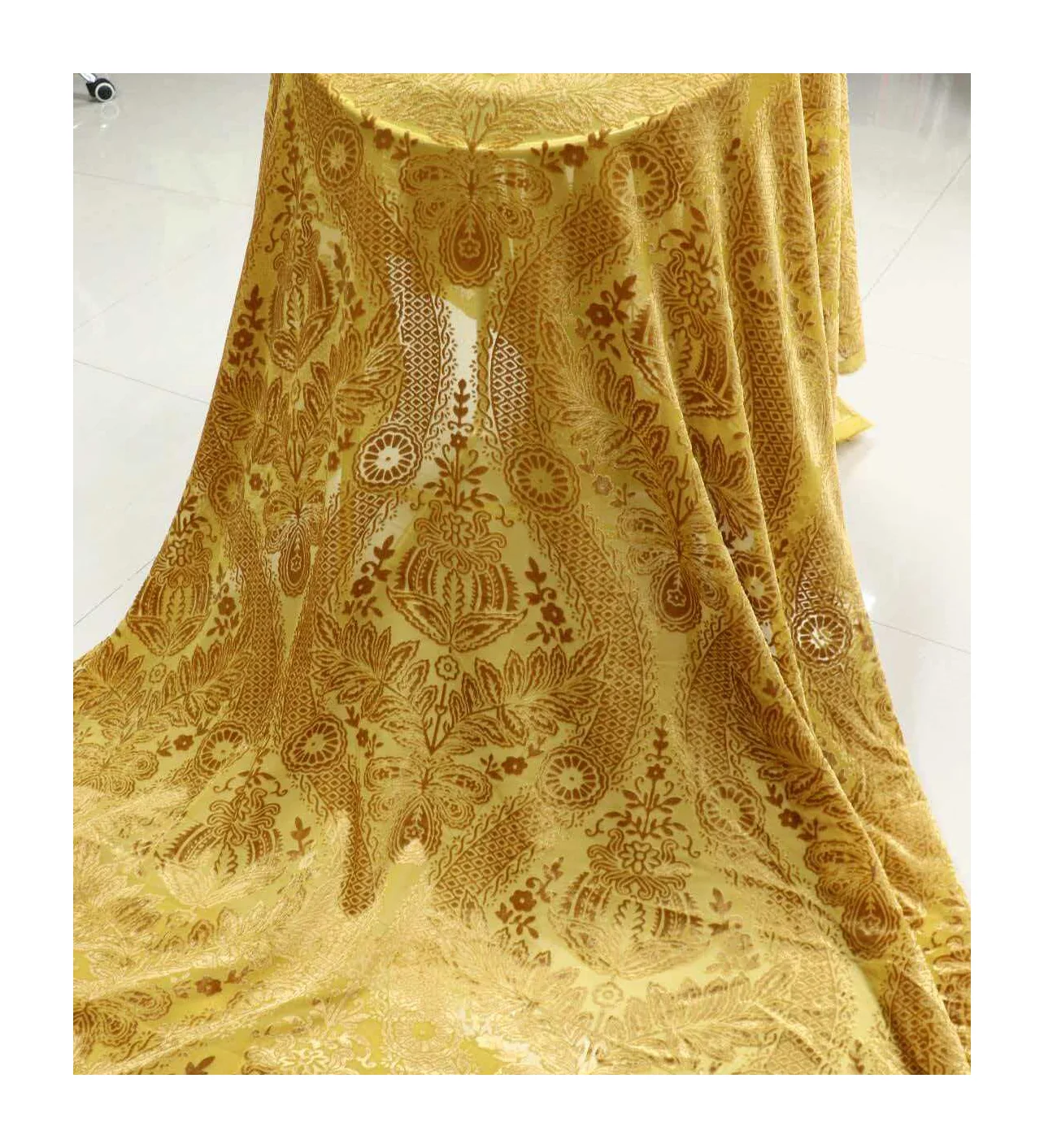
One Somali dirac takes 4 to 6 metres of maqbal velvet at 140 cm usable width, cut to floor length. That single line is the answer buyers ask for first — and it is only half of the question that actually decides an order. The other half is what the mill minimum converts into: a 300 m colourway of dirac velvet is 50 to 75 finished sets and US$930 of fabric at the published from-price. This page works through both numbers, the height and cutting arithmetic behind them, and the six lines an inquiry needs so the answer comes back as a quote instead of another question.
Everything here refers to the maqbal — the main dirac cloth — woven at our mill as 80% viscose / 20% nylon burnout (devoré) velvet, 170–220 GSM, on about 140 cm of usable width. Specifications, colourways and the full product detail sit on the Somali dirac velvet product page; this guide does not repeat them. It only answers the two purchasing questions: how many metres, and what the minimum buys.
Table of Contents
- The Rule in One Line
- Why the Range Is Two Metres Wide
- Yardage by Height Band
- What 300 m Actually Buys You
- Cutting Table at 140 cm
- Where the Wastage Hides
- Garbasaar and Gorogard Are Extra
- A Worked Example: Three Colourways
- What to Put in Your Inquiry
- Frequently Asked Questions
The Rule in One Line
At 140 cm usable width and floor length, one dirac set takes 4–6 m of maqbal velvet. From that one range, everything else on this page is arithmetic:
sets per 300 m colourway = 300 ÷ metres per set = 75 down to 50
fabric per set = metres per set × US$3.10 = US$12.40–18.60
fabric per colourway = 300 × US$3.10 = US$930
Two of the three inputs are fixed by the product: the usable width is about 140 cm and the from-price is US$3.10/m. The third — metres per set — is the one that moves, and the next section explains why it moves by a full two metres.
Why the Range Is Two Metres Wide
A dirac is not one pattern piece. It is a long, wrapped dress, and four decisions push the consumption from the bottom of the range to the top:
- Height. The dress is worn floor length, so every extra centimetre of wearer height is a centimetre of cloth on both the front and back lengths. Height alone accounts for roughly half a metre across the common range — see the height table below.
- Floor length versus ankle length. A dirac hemmed at the ankle saves length on every panel. Most bridal and occasion orders are floor length; some everyday fransawi-style orders are not.
- Hem sweep. A narrow, straight sweep uses noticeably less width per panel than a full sweep that flares from the hip. A wide sweep can push a panel past the efficient cutting widths and force the next bracket of cloth consumption — the 70 cm cliff in the cutting table below.
- Whether the set is cut from one cloth. A dirac set is three pieces: the maqbal (the dress itself), the garbasaar (the shawl worn over it) and the gorogard (the underskirt). The 4–6 m figure covers the maqbal. If the garbasaar and gorogard are ordered in the same velvet, they are additional metres and additional order lines — covered in their own section below.
The practical reading: a buyer who says “about 5 metres” is right for an adult of average height, floor length, moderate sweep, maqbal only. Each deviation from that profile moves the number in a known direction, and none of the deviations is a surprise once the four levers are on the table.
Yardage by Height Band
The table scales the 4–6 m reference (set at a 160 cm wearer) across the common height range. These figures are a linear extrapolation by dress-length ratio from the product-page reference, not mill-measured values — use them for order planning, and confirm the final consumption against the actual pattern before cutting.
| Wearer height | Metres per set | Sets per 300 m | Fabric per set |
|---|---|---|---|
| 150 cm | 3.75–5.62 m | 53–80 | US$11.62–17.44 |
| 155 cm | 3.88–5.81 m | 52–77 | US$12.01–18.02 |
| 160 cm (reference) | 4.00–6.00 m | 50–75 | US$12.40–18.60 |
| 165 cm | 4.12–6.19 m | 48–73 | US$12.79–19.18 |
| 170 cm | 4.25–6.38 m | 47–71 | US$13.18–19.76 |
Sets per 300 m uses the low and high consumption ends of each band; fabric per set uses the from-price of US$3.10/m. Round down, not up: part-sets do not ship.
The spread inside one band (the gap between the two set counts) is wider than the spread between bands. In other words, sweep and length decisions move the order more than height does. A 160 cm wearer in a full-sweep floor-length dirac can consume more cloth than a 170 cm wearer in a narrow ankle-length one.
What 300 m Actually Buys You
The minimum order for dirac maqbal velvet is 300 m per colourway, because every colourway is its own dye lot. Converted into trading terms at the reference consumption:
| Item | Value | Derivation |
|---|---|---|
| Sets per 300 m | 50–75 | 300 ÷ 6 m = 50; 300 ÷ 4 m = 75 |
| Fabric per set | US$12.40–18.60 | 4–6 m × US$3.10/m |
| Fabric per colourway | US$930 | 300 m × US$3.10/m |
Three properties of this minimum matter for planning. First, Same price from 300 m to 2000 m. Buying at the minimum carries no surcharge — the 300 m buyer and the 2000 m buyer pay the same per metre. Second, the minimum is per colourway, so a three-colour order is 900 m; there is no sharing of the minimum across colours. Third, 300 m is a wholesale-scale but container-light quantity: the whole colourway fits in a small corner of one container, which keeps logistics simple for a first order — the worked example below puts a number on it.
Cutting Table at 140 cm
Panel widths in a dirac pattern decide how much of each metre actually lands in the garment. The table uses the same counting rule as our 140 cm vs 160 cm cutting-yield guide: panels per metre = floor(140 ÷ cut width), metres per panel = 1 ÷ panels per metre. Cut width is the width of the piece as cut, before sewing — a finished 68 cm panel is a 70–71 cm cut once 1–1.5 cm of seam allowance per side is added.
| Cut width (cm) | Panels per metre | Metres per panel | Yield at 140 cm |
|---|---|---|---|
| 45 | 3 | 0.333 m | 96.4% |
| 50 | 2 | 0.500 m | 71.4% |
| 55 | 2 | 0.500 m | 78.6% |
| 60 | 2 | 0.500 m | 85.7% |
| 65 | 2 | 0.500 m | 92.9% |
| 70 | 2 | 0.500 m | 100.0% — optimum |
| 75 | 1 | 1.000 m | 53.6% — cliff |
| 80 | 1 | 1.000 m | 57.1% |
| 100 | 1 | 1.000 m | 71.4% |
| 140 | 1 | 1.000 m | 100.0% |
70 cm is the cliff line, and it is the most valuable sentence in this guide. Widen a panel from 70 cm to 75 cm and the roll stops fitting two panels across: panels per metre drop from 2 to 1, metres per panel double from 0.500 to 1.000, and the same dress takes close to twice the cloth. A dirac pattern that keeps every panel at or under a 70 cm cut width — a finished panel of about 67–68 cm once seam allowance is added — is the single biggest lever on fabric consumption, worth more than any price negotiation.
Where the Wastage Hides
Three dirac-specific effects consume cloth that never appears on a yardage estimate:
- Pile direction. Burnout velvet has a pile, and the pile must run the same way on every panel or the dress shows two shades. Panels cannot be nested head-to-tail to use the offcut, so the offcut is waste. This is why velvet yardage estimates run higher than the same pattern on flat cloth.
- Pattern placement. On a burnout design the motif sits where it sits; a cutter who must centre a motif on the front panel sacrifices length around it. Small, evenly spaced motifs waste less than large placement motifs.
- The 70 cm cliff, again. A pattern graded up for a wider hip or a fuller sweep can cross 70 cm without anyone noticing on paper. The moment it does, consumption jumps by a panel per metre. Check the widest panel against the table before fixing the pattern, not after the cloth arrives.
None of these three changes the 4–6 m reference; they explain why a cutting room that ignores them lands at 7 or 8 m for the same dress.
Garbasaar and Gorogard Are Extra
The dirac set is three pieces, and the 4–6 m figure covers only the maqbal. The garbasaar (the shawl worn over the dress) and the gorogard (the underskirt) are separate garments with their own cloth, their own minimums and their own lead times. Two consequences for ordering:
- Quote them as separate lines. An inquiry that asks for “300 m of dirac with matching shawl and underskirt” cannot be priced as one number; the shawl and underskirt may run in a different quality or a different width. State whether you want them in the same maqbal velvet or in a coordinating quality.
- Plan the timelines separately. The maqbal minimum is 300 m per colourway with about 15 working days of production; the companion pieces follow their own schedules. A set that ships in two parts is normal and should be in the purchase plan, not discovered at the port.
A Worked Example: Three Colourways
A buyer building a first dirac assortment takes the three strongest bridal colourways — gold, black and burgundy — at the minimum, 300 m each, in burnout maqbal at the from-price:
- Quantity: 3 × 300 m = 900 m of cloth.
- Sets: 50–75 per colourway at reference consumption, so 150–225 sets across the assortment.
- Fabric value: 3 × US$930 = US$2,790 at US$3.10/m.
- Production: about 15 working days for the three colourways, FOB Ningbo or Shanghai; CFR or CIF on request.
On shipping volume: at standard packing of 50 m rolls with an estimated roll diameter around 30 cm, one 20GP container holds roughly 11,850 m, a 40GP roughly 24,550 m and a 40HQ roughly 28,750 m of this velvet. These are rough planning estimates — confirm against the actual roll packing before booking space. On those estimates the 900 m order occupies well under a tenth of a 20GP, so a first order of this size normally ships as LCL or inside a consolidated container. The full packing method and per-container arithmetic are in our velvet container loading guide.
What to Put in Your Inquiry
Six lines turn an inquiry into a quote in one round:
- Colourway(s) — from the published card (gold/champagne, black, ivory, cobalt, olive, burgundy) or a lab-dip target; remember the minimum is per colourway.
- Quantity in sets or metres — either converts to the other through the tables above.
- Height band of your market — so consumption is planned on your customers, not on the reference figure.
- Confirmation of the 140 cm usable width — and your widest cut panel, so the 70 cm cliff is checked before the pattern is fixed.
- Whether garbasaar and gorogard are included — and in which quality.
- Destination port — the quote is FOB Ningbo or Shanghai, with CFR or CIF on request.
Certification travels with the cloth: the maqbal lines carry OEKO-TEX® STANDARD 100, Class II (Cert. No. BJ050 121424). For how the from-price behaves across order sizes, see the 300 m vs 3,000 m cost structure guide; for the product itself, specifications and colourways are on the Somali dirac velvet page.
Frequently Asked Questions
Q1: How many metres of fabric does one Somali dirac take?
4 to 6 metres per set at 140 cm usable width and floor length. The range moves with height, hem sweep, and whether the garbasaar shawl and gorogard underskirt are cut from the same cloth. Most orders for adults of average height land near 5 metres for the maqbal alone.
Q2: How many dirac sets does a 300 m MOQ make?
50 to 75 sets. At 6 metres per set, 300 divided by 6 gives 50 sets; at 4 metres per set, 300 divided by 4 gives 75 sets. The 300 m minimum applies per colourway, not per order.
Q3: What does the fabric for one dirac set cost?
From US$12.40 to US$18.60 per set at the published FOB from-price of US$3.10 per metre: 4 metres times US$3.10 at the low end, 6 metres times US$3.10 at the high end. A full 300 m colourway is US$930 of fabric.
Q4: Does the 300 m minimum include the garbasaar and gorogard?
No. The 300 m per colourway minimum covers the maqbal velvet itself. The garbasaar shawl and gorogard underskirt are quoted separately, with their own minimums and lead times, so list them as separate lines in your inquiry.
Q5: Can several colourways share one 300 m minimum?
No. The minimum is 300 m per colourway because each colourway is a separate dye lot. Three colourways means 900 m in total. The from-price is the same from 300 m to 2000 m, so there is no penalty for ordering exactly at the minimum.
Q6: How long does a 300 m dirac order take to ship?
About 15 working days of production for a 300 m colourway of burnout maqbal velvet, FOB Ningbo or Shanghai. CFR or CIF can be quoted on request. Jacquard lines are quoted per design and may take longer.
Related Guides
- Velvet Cutting Yield: 140 cm vs 160 cm Roll Width
- Velvet Cost Structure: 300 m vs 3,000 m
- Velvet Fabric Container Loading Guide
- Burnout (Devoré) Velvet: Manufacturing & Sourcing Guide
- Velvet Hijab Fabric: Which Weight Actually Works
- Fabric MOQ & Payment Terms from China
- Fabric Price Calculation & FOB Cost Breakdown
- FOB Shipping Terms for Fabric Importers
- How to Read a Fabric Specification Sheet
- Velvet Fabric Buying Guide: Burnout vs Solid-Dyed
Standards, Regulations and Data Sources Cited
The measurement references behind the figures in this guide:
- ISO 3801:1977 — Mass per unit length and mass per unit area of woven fabrics — the reference method behind every GSM figure cited here (170–220 GSM for burnout maqbal, up to 280 GSM for jacquard).
- OEKO-TEX® STANDARD 100 — the product-safety certification carried by the maqbal lines, Class II, Cert. No. BJ050 121424.
- General Administration of Customs of China — 海关总署 — the official source for export declarations and HS classification of pile fabrics under heading 5801.3.
- National Enterprise Credit Information Publicity System — 国家企业信用信息公示系统 — China's official registry for verifying a supplier's legal entity, registered capital and operating status.